Granting Unique Ownership to Content via Blockchain... Tradable on Online Auction Platforms
Not Recognized as Intellectual Property Rights Under Current Law
Risk of Disappearance if Hacked... Expanded Opportunities for Artists Are an Advantage
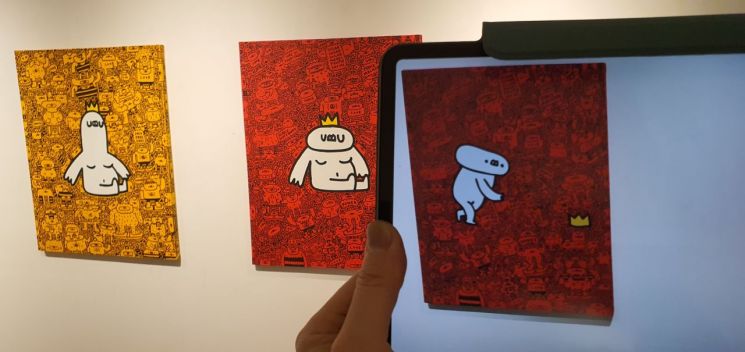 Artist Yo Yo-jin's 'Yo Yo Form'. He is converting this work into a non-fungible token (NFT) and conducting simultaneous online and offline sales. (Photo by Artist)
[Asia Economy Reporter Donghyun Choi] "Non-fungible tokens (NFTs) are an inevitable phenomenon. I believe that so-called ‘capitalist kids,’ who can accept forms of capital without resistance, will lead the expansion of NFTs."
Youth artist Yoyojin (37) recently evaluated NFTs, which are spreading like a trend in the domestic and international art world, in this way. Since the 1st, he has been holding Korea's first NFT-linked exhibition at the Factory Gallery in Seongsu-dong, Seongdong-gu, Seoul.
NFTs are digital assets that grant unique ownership to content through blockchain encryption technology. When an artist creates a digital painting on a computer and issues an NFT linked to it, a non-replicable identification code indicating "this painting is the original" is embedded in the NFT. Simply put, it serves as a digital certificate of authenticity. NFTs can also be bought and sold on online auction platforms.
Yoyojin is attempting an interesting experiment in this exhibition. Among the 34 offline exhibition works, 15 will be produced as NFTs and uploaded to the NFT trading platform ‘OpenSea,’ followed by an auction. The plan is to sell the same works both offline and online simultaneously to test which sells better. The artist will reveal the results personally around 7 p.m. on the closing day of the exhibition, the 15th.
The art market is currently experiencing a new paradigm brought about by NFTs. According to NFT specialist analysis site NonFungible.com, last month’s NFT trading volume reached $216.54 million (approximately 245 billion KRW). Since statistics began on July 23, 2017, 38% of the total $563.56 million traded has occurred in just the past month. In Korea, on the 18th of last month, the first NFT-applied artwork, Mari Kim’s 10-second video ‘Missing & Found (2021),’ sold for 600 million KRW.
As the NFT art market rapidly grows, debates related to it are also in full swing. Some argue that the spread of NFTs will broaden opportunities for emerging and unknown artists. Yoyojin said, "A new market to introduce works has emerged," adding, "NFTs may not be a panacea, but they will certainly be an opportunity for unknown artists." A new artist predicted, "To sell works at famous galleries or well-known auction houses, it’s not just about painting skills. If market leadership shifts to digital, competition can occur under more equal conditions."
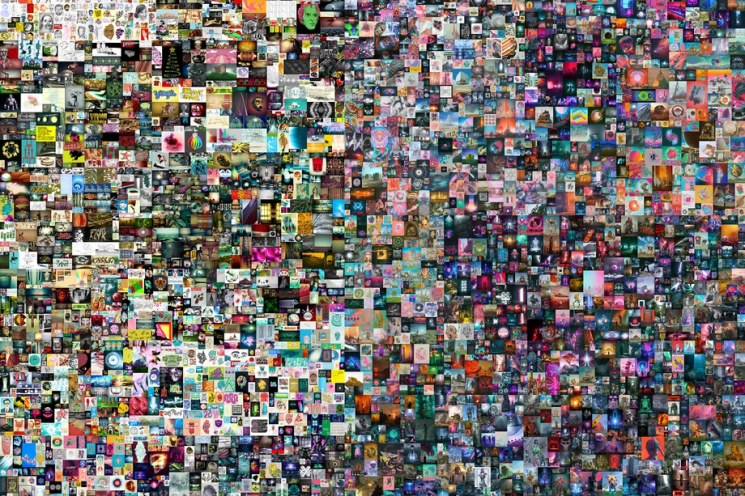 The non-fungible token (NFT) artwork "Everydays: The First 5000 Days" created by digital artist Beeple attracted attention after being sold for 78.6 billion KRW at Christie's auction in New York.
Recently in the U.S., there was a case where an unknown artist suddenly rose to fame through NFTs. On the 11th of last month, an artist known by the pseudonym ‘Beeple’ sold the NFT digital artwork ‘Everydays: The First 5000 Days’ at Christie’s auction in New York for $69.3 million. This price exceeded that of works by Paul Gauguin (1848?1903) and Salvador Dal? (1904?1989). With this sale, Beeple became the third most expensive living artist after Jeff Koons (66) and David Hockney (84).
There is also a view that the recent NFT phenomenon is exaggerated, with a strong speculative nature. Even Beeple has pointed out that "NFTs are a bubble." In fact, the buyer of his work is a major player in the industry who is also an NFT fund organizer.
Contrary to popular belief, there are claims that NFTs cannot guarantee the ‘originality’ of a work. In reality, NFTs do not contain the original digital image file. They only record the address of a specific server where the original file exists. If the server is hacked or shut down, there is a risk that the file could be altered or lost.
Even when traded as NFTs, intellectual property rights are not yet protected under current law. Professor Byungwook Lee of Seoul National University of Science and Technology Graduate School said that NFT transactions are "like hiding the real artwork in a warehouse and only handing over an Excel file recording the purchase," pointing out that "NFTs do not automatically guarantee rights relationships, and only when the NFT issuer ‘keeps their promise’ can it serve as a receipt, making it an unstable and primitive method."
© The Asia Business Daily(www.asiae.co.kr). All rights reserved.
![Clutching a Stolen Dior Bag, Saying "I Hate Being Poor but Real"... The Grotesque Con of a "Human Knockoff" [Slate]](https://cwcontent.asiae.co.kr/asiaresize/183/2026021902243444107_1771435474.jpg)

















