Stock Prices Moving Following Mine Closure Fund Returns Since Last Month
Possibility of Casino Industry Regulation Easing Raised... "Revenue Recovery Expected if Game Table Regulations Are Relaxed"
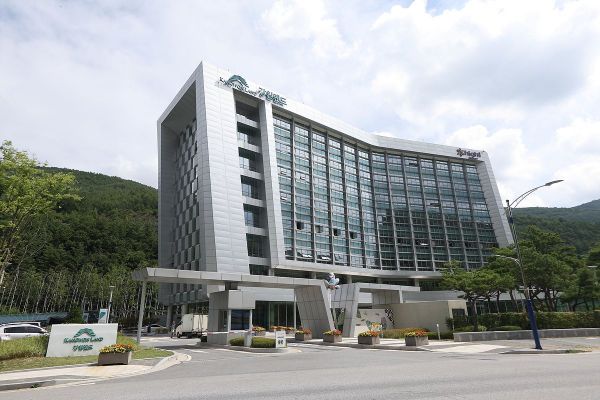
[Asia Economy Reporter Gong Byung-sun] Conflicts surrounding the mine closure fund are shaking Kangwon Land. Despite inevitable deficits due to COVID-19, concerns are rising over the negative impact on performance caused by payments to the mine closure fund.
According to the Korea Exchange on the 1st, Kangwon Land recorded 25,300 KRW on the 31st of last month, down 0.59% (150 KRW) from the previous trading day. Except for a flat performance on the 25th, the stock price has been declining continuously since the 23rd of last month. During this period, the stock price fell by 6.3%. Meanwhile, the KOSPI rose by 0.86% (25.96 points) over the same period.
The sluggish return of the mine closure fund is interpreted as a negative factor. The mine closure fund is a kind of quasi-tax that Kangwon Land pays for regional development under the Special Act on Support for Development of Mining Areas (Mine Special Act). Kangwon Land, which has faced operational difficulties due to COVID-19, attempted to reclaim 107 billion KRW of the mine closure fund from local governments in Gangwon Province. This sparked strong opposition from local residents. On the 22nd of last month, the Taebaek City Regional Issues Countermeasure Committee criticized Kangwon Land, citing disruptions to community projects.
The issue of returning the mine closure fund has previously affected Kangwon Land’s stock price. On the 4th of last month, following a decision by the Chuncheon District Court allowing Kangwon Land to reclaim 225 billion KRW of the mine closure fund from Gangwon Province, the stock price rose 4.40% that day. On the 16th of last month, when Kangwon Land sent a certified letter to Gangwon Province to reclaim 107 billion KRW of that amount, the stock price increased by 3.67%.
The amendment to the Mine Special Act passed on February 26th is also a negative factor for Kangwon Land. The basis for calculating the mine closure fund was changed from about 25% of pre-tax profit to 13% of casino sales revenue. This change was made because using pre-tax profit as a basis causes greater volatility in the mine closure fund. The fund must be paid even if a deficit occurs.
Last year, Kangwon Land’s casino revenue was 404.3 billion KRW, a decrease of about 70% compared to 2019. At the beginning of this year, casino operations were suspended due to Level 2 social distancing measures, making a deficit expected. Sung Jun-won, a researcher at Shinhan Financial Investment, said, "Kangwon Land is expected to record an operating loss of 136.6 billion KRW on a consolidated basis this year," adding, "Nevertheless, it may have to pay a mine closure fund of about 11.6 billion KRW in the first quarter."
On the other hand, this situation also increases the possibility of easing regulations on the casino industry. Researcher Sung said, "If Kangwon Land’s operating profit decreases due to the mine closure fund, corporate taxes and dividends that the central government can collect will also decrease," adding, "This is a situation the central government does not want." He further explained, "Kangwon Land has always been one of the places where supply is insufficient compared to demand, so if restrictions on gaming tables are eased like in 2013, it can recover the damages experienced so far."
© The Asia Business Daily(www.asiae.co.kr). All rights reserved.

















