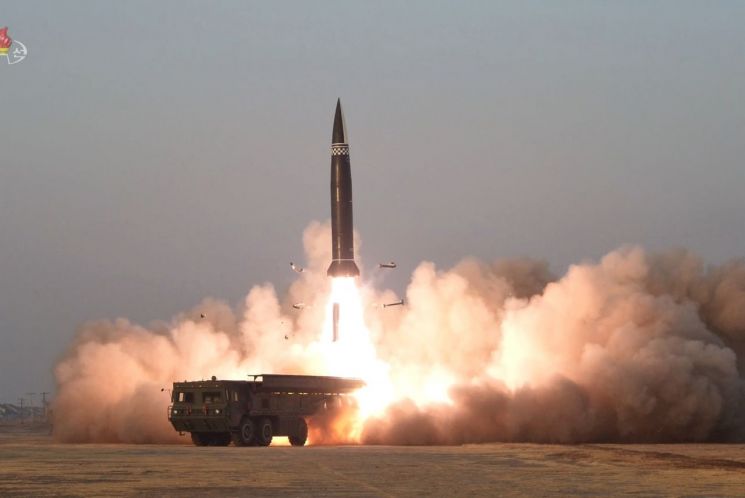
[Asia Economy Reporter Lee Ji-eun] North Korea's missile development strategy has shifted since Kim Jong-un, General Secretary of the Workers' Party, took power, moving towards a dual approach of 'extending the range of liquid-fueled missiles' and 'developing solid-fueled missiles.' This change is analyzed as a result of the missile development competition between South and North Korea. It is pointed out that if the development competition between the two Koreas intensifies in the future, it could lead to a 'security dilemma.'
Jang Cheol-woon, Associate Research Fellow at the Unification Policy Research Office of the Korea Institute for National Unification, pointed this out on the 31st during the online series "Changes in North Korea's Missile Development Strategy and the Missile Development Competition between South and North Korea."
Researcher Jang analyzed that while North Korea's missile development strategy during the Kim Il-sung and Kim Jong-il eras focused on extending the range based on liquid-fueled Scud ballistic missile technology, the Kim Jong-un era has shifted to a 'parallel strategy' that continues the existing approach while simultaneously promoting the development of solid-fueled surface-to-surface ballistic missiles and cruise missiles.
Researcher Jang said, "This can be evaluated as North Korea's response strategy to the United States' hostile policy toward North Korea, but in terms of range, it has a strong focus on South Korea," adding, "In this regard, it is necessary to pay attention to the context of the 'missile development competition between South and North Korea."
South and North Korea have continued their missile development competition. To respond to the rapidly advancing North Korean missile forces in the 1980s and 1990s, South Korea began full-scale missile development, and by the 2000s, it completed the independent development of the Hyunmoo-3 series surface-to-surface cruise missiles, gaining qualitative superiority.
Researcher Jang explained, "As a result, it has become difficult to assert the superiority of either South or North Korea in missile forces capable of striking each other," adding, "Since 2019, North Korea's launches of solid-fueled ballistic missiles and cruise missiles are part of efforts to regain the lost superiority over South Korea in missile forces."
Researcher Jang forecasted, "The missile development competition between South and North Korea is likely to continue," adding, "North Korea's missile development can be a factor prompting South Korea's countermeasures, and the 'security dilemma,' where military buildup for self-defense causes a reaction of military buildup by the other side, will deepen between South and North Korea."
© The Asia Business Daily(www.asiae.co.kr). All rights reserved.
![A Woman Who Jumps Holding a Stolen Dior Bag... The Mind-Shaking, Bizarre Con of a "Human Knockoff" [Slate]](https://cwcontent.asiae.co.kr/asiaresize/183/2026021902243444107_1771435474.jpg)
















