"First time seeing a sandwich with bread inside" Lowest rating left
Store owners suffer psychological distress from 'rating terrorism'
Delivery app ratings greatly impact actual business revenue

[Asia Economy Reporter Lim Juhyung] "It's my first time seeing sandwich made with sliced bread."
Some consumers are leaving harsh reviews on delivery application (app) ratings for absurd reasons, causing small business owners to suffer. It has even been confirmed that there are cases of 'rating terrorism' where the lowest scores are given with the sentiment of being disappointed that the sandwich was made with sliced bread. The problem is that these harsh reviews affect the overall rating on the delivery app, significantly impacting the businesses' profits.
As such cases continue to occur, public anger is also growing. It is pointed out that malicious pain is being inflicted by exploiting the fact that delivery app reviews are important to store owners.
On the 30th, a recent 'verbal dispute' between a consumer and a store owner on a delivery app review page was revealed on an online community.
The controversy began with a consumer's review of a sandwich. The consumer wrote, "It's my fault for not looking at the photo, but it's my first time eating a sandwich made with sliced bread. It would be nice if you gave plenty of salad dressing," and left a 1-star rating (lowest score).
Seeing this, the store owner replied directly to the review, asking, "If not sliced bread, then what would you make the sandwich with?"
The store owner also explained the origin of the sandwich. He said, "John Montague, the 4th Earl of Sandwich, made a tremendous achievement by firmly associating his title with a popular snack filled between two slices of bread." He pointed out that sandwiches originally started as food made by putting fillings between slices of bread.
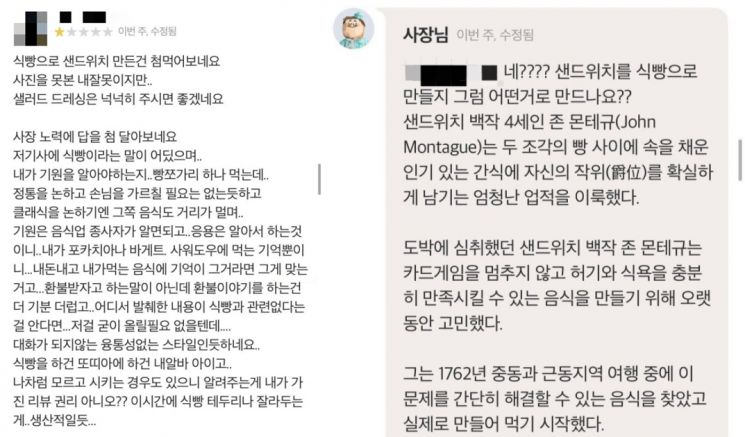 On the 30th, a review of a delivery application (app) posted on an online community and the owner's response to it. / Photo by Online Community Capture
In response, the consumer revised their review again, saying, "Do I need to know the origin just because I’m eating a piece of bread?" and "The origin is something food industry workers should know, but my memory is only of eating sandwiches with focaccia, baguette, or sourdough. If that’s my experience with the food I pay for and eat, then that’s correct."
They added, "Whether it’s made with sliced bread or tortilla, it’s none of my business," and "Since there are cases like me who order without knowing, isn’t informing others part of my right to review?"
As their dispute spread through online communities and social networking services (SNS), netizens criticized it as 'excessive complaints.' It was pointed out that leaving harsh reviews for absurd reasons on ratings that can actually influence a business’s profits is malicious.
A netizen who revealed they run a cafe said, "How selfish is that way of thinking? Those consumers’ standards are only themselves," and "How would the store owner know what kind of bread you usually eat in your sandwich? There’s no such thing as a more troublesome customer than that."
Another netizen pointed out, "A single comment in a review can kill a person, so how can someone commit rating terrorism with such words?"
This is not the first time that some consumers’ rating terrorism has caused controversy. Previously, on a delivery app, there were cases of rating terrorism where people put food into kitchen sink drains or garbage bags and left 'proof photos.'
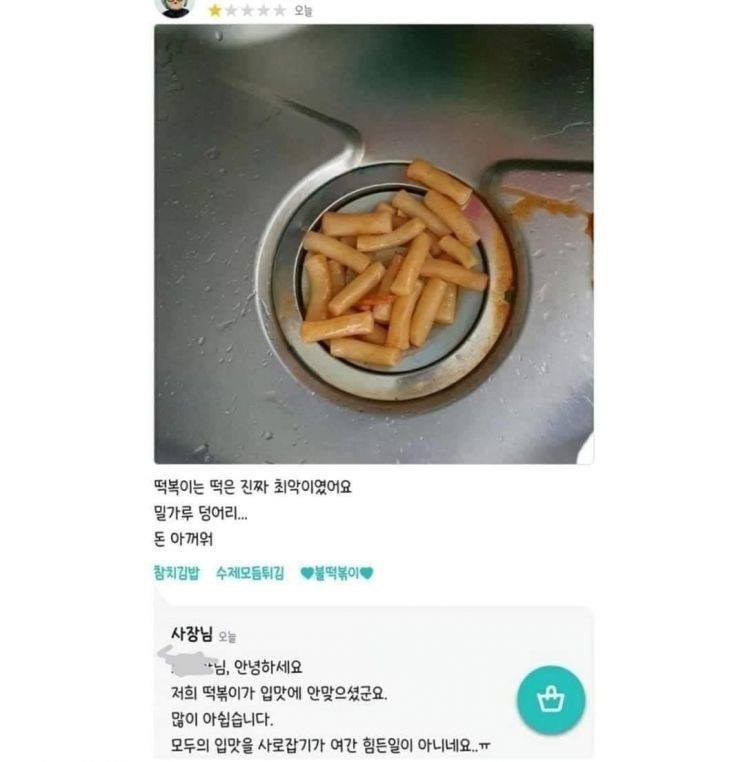 Recently, a post criticizing ordered food after dumping it in the sink was uploaded on a delivery app, sparking controversy. / Photo by Internet Community Capture
At that time, a tteokbokki restaurant owner who suffered from such rating terrorism said, "I retired from work in my late 50s and run this store with my wife as a matter of life and death. Many things have happened so far, but seeing photos of food being thrown away like garbage breaks my heart and makes me feel like dying."
Review information registered on delivery apps can greatly affect the actual sales of businesses. Consumers mainly search for restaurants they want to use through delivery apps, and the most intuitive criterion to evaluate the quality of a business is the rating. Some delivery apps sort restaurant lists in order of highest average rating, so it is also important from a promotional perspective.
According to data from the mobile app analytics company 'Mobile Index,' as of January, the total monthly active users of major domestic delivery apps such as Baedal Minjok, Yogiyo, and Coupang Eats reached 29.21 million. Practically, the majority of the adult population in Korea uses these apps, so the influence of rating review scores on restaurant profits is inevitably huge.
Given this situation, delivery app service providers are actively managing rating reviews. Baedal Minjok has deleted a total of 62,000 malicious reviews as of April 2019 since launching its service in 2010.
Yogiyo has strengthened sanctions by introducing technology that uses artificial intelligence (AI) to monitor and filter out fake and abusive reviews in real time.
© The Asia Business Daily(www.asiae.co.kr). All rights reserved.

![Clutching a Stolen Dior Bag, Saying "I Hate Being Poor but Real"... The Grotesque Con of a "Human Knockoff" [Slate]](https://cwcontent.asiae.co.kr/asiaresize/183/2026021902243444107_1771435474.jpg)

















