Reduced Ice-Covered Areas and Extended Navigation Periods Due to Global Warming
Transport Distance Also Over 30% Shorter Than Indian Ocean Route
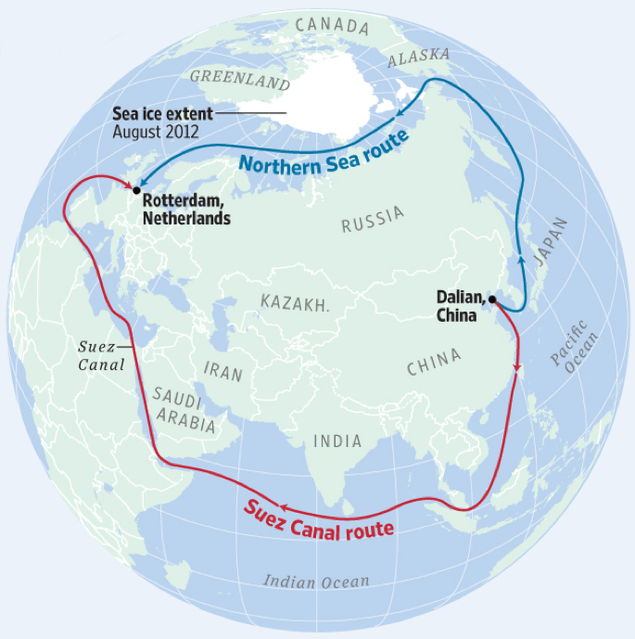
[Asia Economy Reporter Hyunwoo Lee] The Russian government has actively promoted the use of its Arctic shipping route in connection with the Suez Canal grounding incident. The Arctic route is known to be up to 37% shorter in sailing distance than the Indian Ocean route that passes through the Suez Canal. However, due to the freezing of the Arctic Ocean, it was unusable for more than five months. With global warming extending the navigable period, expectations are growing that it will become an alternative route.
On the 29th (local time), according to the Russian state-run TASS news agency, the Russian Ministry of Energy issued a statement regarding the Suez Canal grounding incident in Egypt, actively encouraging international shipping companies to use the Arctic route. The Russian Ministry of Energy emphasized, "The Northern Sea Route (NSR), which connects Asia and Europe, can significantly reduce the transit time of maritime cargo," adding, "Last year, the navigable period reached 9 to 10 months, considerably shortening the cargo transport time between Asia and Europe."
The Arctic route is a sea lane along the Russian Arctic coast, with a sailing distance of 12,964 km. In terms of distance alone, it is about 37% shorter than the Indian Ocean route passing through the Suez Canal, which is 20,372 km. However, due to thick ice-covered areas in parts of the East Siberian Sea, ship navigation was limited to about five months from spring to summer, so few vessels used it in the past. But with global warming, the ice in the frozen areas has melted, and the regions that freeze during winter have significantly decreased, doubling the annual navigable period.
Additionally, as the Russian government advances energy development in the Arctic region, cargo volume is increasing significantly. According to the Russian Ministry of Energy, cargo volume through the Arctic route last year was 33 million tons, of which more than half, 18 million tons, was liquefied natural gas (LNG). Russian President Vladimir Putin previously pledged to increase the annual cargo volume through the Arctic route to 80 million tons by 2024.
© The Asia Business Daily(www.asiae.co.kr). All rights reserved.

















