Concerns Over the Production of Innocent Victims and Land Market Slump
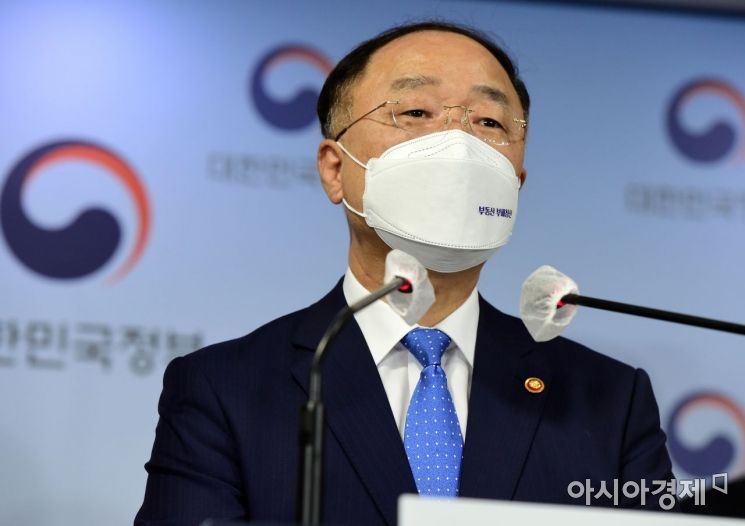 Hong Nam-ki, Deputy Prime Minister and Minister of Economy and Finance, is giving a follow-up briefing on the results of the Anti-Corruption Policy Council on the 29th at the Government Seoul Office in Jongno-gu, Seoul. Photo by Kim Hyun-min kimhyun81@
Although the government has introduced ultra-strong regulatory measures to prevent land speculation, concerns are being raised about unintended harm caused by overly comprehensive regulations and a potential stagnation in the land market. There are even criticisms that the government has effectively labeled the entire population as 'potential speculators' in an effort to catch speculators.
According to the government and ruling party on the 30th, the government’s measures announced the previous day require submission of a funding plan for acquiring land above a certain size, and expand the asset registration system, which previously applied only to high-ranking officials of grade 4 or above, to include officials as low as grade 9. Additionally, since farmland was the background of the recent land speculation incident, the acquisition review for farmland has been significantly strengthened.
Experts are voicing concerns about 'overregulation' in response to these regulatory measures.
Professor Ko Joon-seok of Dongguk University’s Department of Law said, "It is clear that secretly acquiring real estate information in advance to invest should be regarded as speculation," but added, "However, looking at the government’s current measures, they are mandating asset disclosure even for the majority of public officials who do not have access to related real estate information."
Professor Seo Jin-hyung of Gyeongin Women’s University (President of the Korea Real Estate Society) said, "Looking at the overall trend of these measures, the government is effectively branding the entire population as speculators." He pointed out, "Regulation should target those who actually possess high-level information, and asset disclosure for all public officials is merely administrative waste." He also raised concerns about a serious transaction stagnation in the real estate market, saying, "If the entire real estate market is squeezed, the market shock will be significant."
Professor Ko said, "For those owning more than one house or newly acquiring land, reporting should be allowed, but the scope of information disclosure should be somewhat limited compared to the current measures that require all public officials to disclose all assets." Professor Seo advised, "A pre-approval system for land acquisition should be introduced to protect genuine demanders and prevent speculative forces, thereby mitigating market shocks."
The strengthened farmland acquisition review measures are also evaluated as having loopholes. Professor Sa Dong-cheon of Hongik University’s Department of Law, an expert on the Farmland Act, said, "I understand the intention to carefully review farming plans, but this is a notion that does not understand the agricultural field." He added, "In reality, when visiting agricultural sites, farming rarely goes according to plan," warning, "There is a risk that all farmers could be penalized."
Meanwhile, former Presidential Chief of Staff Noh Young-min evaluated the government’s real estate speculation eradication measures as "a powerful measure that no government has been able to implement, a groundbreaking system comparable to the real-name financial system or real-name real estate system."
Former Chief Noh appeared on MBC Radio that day and said, "A new era has come where speculation results not in profit but in great disadvantages." Regarding President Moon’s dismissal of former Policy Chief Kim Sang-jo the previous day, he said, "It is an extension of a strong will to eradicate deep-rooted evils."
© The Asia Business Daily(www.asiae.co.kr). All rights reserved.

















