[Asia Economy Reporter Seulgina Jo] Last year, the accessibility score of domestic websites barely reached the average of 60 points.
On the 29th, the Ministry of Science and ICT, together with the Korea Intelligent Information Society Agency, announced the results of the '2020 Web Accessibility Survey (National Approved Statistics No. 127011)'.
Web accessibility refers to ensuring that all users, including people with disabilities and the elderly, can use all content provided on websites regardless of their physical characteristics.
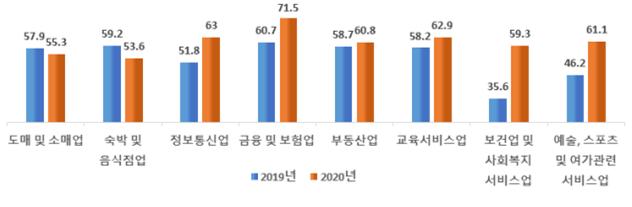
As a result of randomly selecting and evaluating 1,000 websites from 8 industries with relatively high website usage frequency, the overall average web accessibility score was 60.7 points.
Although it improved by 7.0 points (13.0%) compared to the previous year, overall web accessibility was still evaluated as low. It remains difficult for digitally vulnerable groups such as people with disabilities and the elderly to access information provided on websites.
By industry, the web accessibility levels of the 'Finance and Insurance' and 'Information and Communication' sectors were relatively good, while the 'Wholesale and Retail' and 'Accommodation and Food Service' sectors showed relatively low web accessibility.
By business size, companies with higher annual sales and more employees had relatively higher web accessibility levels. Additionally, when examining by survey items, more than 90% of the surveyed sites complied with 9 items such as 'response time adjustment' and 'prohibition of autoplay.' However, compliance rates for 7 items, including 'providing video subtitles' and 'providing alternative text' necessary for screen narration functions, were below 50%.
The Ministry of Science and ICT plans to provide technical support and consulting for accessibility improvements targeting institutions with poor web accessibility, such as welfare centers mainly used by people with disabilities (40 cases annually), and to continuously promote awareness and improvements by offering technical education for web developers and producing and distributing educational content.
Furthermore, it will actively support the prompt passage of the 'Digital Inclusion Act,' which includes measures to strengthen the effectiveness of systems ensuring information accessibility for digitally vulnerable groups, through the National Assembly.
The Ministry of Science and ICT stated, "In the situation where a digital transformation of the economy and society is taking place due to COVID-19, we will continuously pursue digital inclusion policies such as accessibility improvements and digital gap reduction to create an inclusive digital usage environment so that digitally vulnerable groups such as people with disabilities and the elderly are not excluded or marginalized."
© The Asia Business Daily(www.asiae.co.kr). All rights reserved.

















