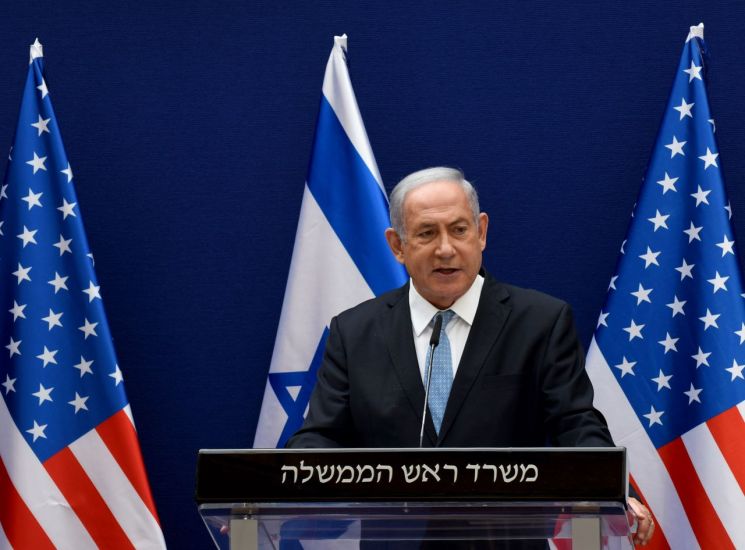
[Asia Economy Reporter Yujin Cho] Prime Minister Benjamin Netanyahu made a final move by proposing a coalition government to Gideon Saar of the anti-Netanyahu alliance.
Netanyahu pledged to end his rule and reportedly stated that if Gideon Saar, who left the Likud party and now leads the New Hope party, accepts his coalition proposal, he would transfer all power to Saar one year after taking office, according to the Jerusalem Post on the 26th (local time).
In the general election held on the 23rd, the right-wing Likud party led by Netanyahu secured 30 seats in the Knesset (Israeli parliament). Although it maintained its status as the largest party, it lost 6 seats compared to the previous 36 seats. Even when combining the seats of Likud's allied parties, they only have 52 seats, falling 9 seats short of the majority (61 seats).
On the other hand, the anti-Netanyahu alliance secured 57 seats, including 17 seats won by the centrist Yesh Atid party led by Netanyahu's biggest rival, Yair Lapid. Other minor parties such as Yamina and the Arab party United Arab List secured 7 and 4 seats respectively.
This election was a showdown between the coalition parties centered on Netanyahu's Likud party and the anti-Netanyahu alliance front, including the centrist Yesh Atid party aiming to end Netanyahu's 15-year rule.
To form a coalition, Netanyahu must either bring in minor parties or induce defections from the anti-Netanyahu alliance. It appears Netanyahu made a decisive move to induce defections from New Hope within the anti-Netanyahu alliance.
However, New Hope only secured 6 seats in this election, making it difficult to surpass the majority with a coalition solely with New Hope.
Initially, the media expected Netanyahu to bring in both Yamina and the United Arab List, but some pro-Netanyahu parties strongly oppose cooperation with the United Arab List, making coalition formation difficult, according to prevailing views.
Since the coalition dissolved at the end of 2018 and Netanyahu faced indictment on corruption charges during the election period, Israel has held four general elections in two years: in April and September 2019, March last year, and this time.
The Washington Post (WP) analyzed that the four elections held in just two years caused division between Netanyahu supporters and those seeking to end his term, and that forming a coalition for Netanyahu will become even more difficult going forward.
Yohanan Plesner, director of the Israel Democracy Institute, called it "the worst political crisis in decades" and said, "It has become clear that it is now difficult to find a decisive winner in our political system."
Netanyahu is currently on trial for charges including bribery, breach of trust, and fraud during his tenure as prime minister. If he does not secure a new term through this election victory, his political career, having held the longest tenure as prime minister for 15 years, could be in jeopardy.
© The Asia Business Daily(www.asiae.co.kr). All rights reserved.

















