Ranked 5th Worldwide in International Passengers
ASQ Evaluation 1st Place for 12 Consecutive Years
Demand Contraction Due to COVID-19 Challenges
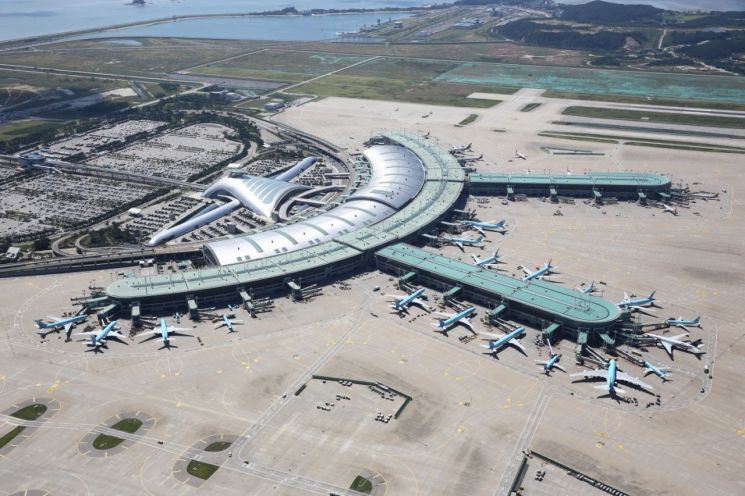
[Asia Economy Reporter Dongwoo Lee] Incheon International Airport will celebrate its 20th anniversary on the 29th. Over the past 20 years, it has firmly established its position as a ‘global hub airport,’ but challenges such as competition from neighboring mega airports and the sharp decline in demand due to COVID-19 have emerged.
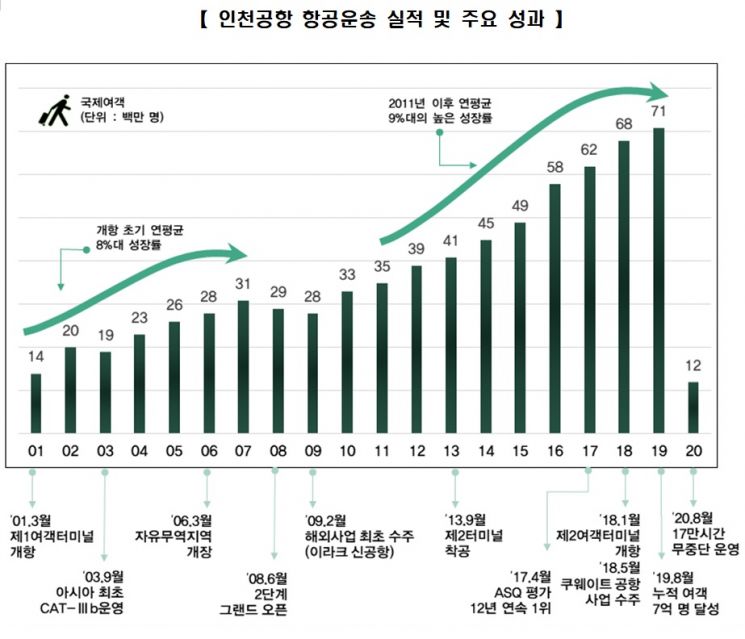
According to Incheon International Airport Corporation on the 26th, Incheon Airport, which opened on March 29, 2001, has transported a total of 730 million passengers up to last year. In 2019, before the COVID-19 pandemic, the annual number of passengers exceeded 70 million, ranking it 5th in the world for international passengers and 3rd for international cargo volume.
From Mudflats to a World Top-Tier Airport
The process of Incheon Airport’s growth into a global airport was not smooth. Following the liberalization of overseas travel in 1989, which caused a surge in international air travel demand, the government selected Yeongjong Island as the final site out of 22 candidates in 1990.
From 1992 to 2001, a monumental 100-month project began to build Incheon Airport’s Terminal 1, which is 18 times the size of Yeouido. The project cost 5.6 trillion won, with an average annual workforce of 13.8 million man-days, and 2.53 million pieces of equipment were mobilized annually. The total number of design drawings created during the process reached 480,000, which if stacked would reach 560 meters, equivalent to a 180-story building.
In 1997, the unexpected IMF financial crisis struck. Despite the crisis causing many large-scale national projects to be halted or delayed, Incheon Airport continued construction by raising funds through high-interest bonds with rates soaring to 18.25%.
Growth in Quantity and Quality... Intensified Competition and COVID-19 as Challenges
After these ups and downs, Incheon Airport has continued to grow over the past 20 years.
Since its opening, flight operations have increased 3.1 times and passenger numbers 3.4 times compared to 2002. In its first year, Incheon Airport served 34 countries and 117 cities; by 2019, this expanded to 52 countries and 173 cities, with the number of airlines using the airport increasing by 87% to 88 airlines.
Incheon Airport has focused not only on quantitative growth but also on qualitative improvements such as service. It has established itself as a global standard airport by being the only airport worldwide to rank first in the Airport Service Quality (ASQ) evaluation for 12 consecutive years.
However, significant challenges remain. The immediate issue is the demand contraction caused by COVID-19. Competition from mega airports in rival countries, such as Beijing Daxing International Airport in China, is also intensifying.
Incheon Airport views the COVID-19 crisis last year as a new beginning for the aviation market and plans to lead the global paradigm shift by adapting to changes.
Kim Kyung-wook, President of Incheon International Airport Corporation, said, "We will continuously invest and research to create the most efficiently operated airport and will not be complacent with the current situation."
© The Asia Business Daily(www.asiae.co.kr). All rights reserved.



















