430,000 High School Seniors Take Seoul Metropolitan Office of Education's First Mock Exam
Korean and Math Common + Elective Subjects System... Harder Than Last Year's CSAT
Changing Elective Subjects Based on Mock Scores Is Discouraged "Focus on Mastery"
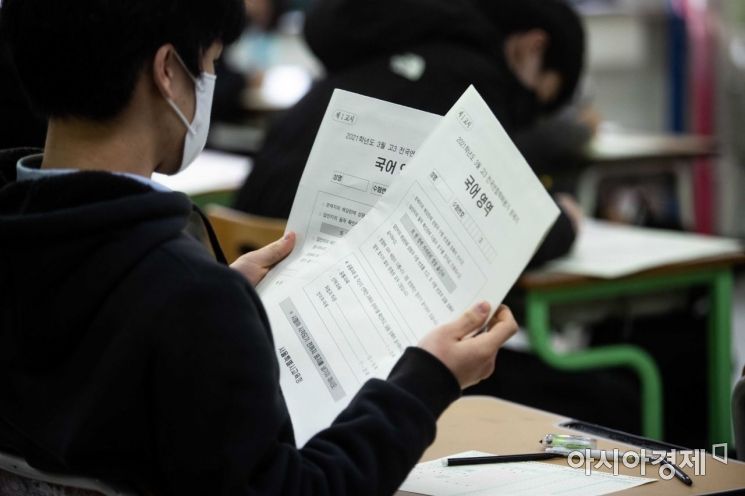 On the 25th, when the national joint academic achievement test for high school seniors was conducted, examinees at Gyeongbok High School in Jongno-gu, Seoul, are checking their test papers. Photo by Jinhyung Kang aymsdream@
[Asia Economy Reporter Han Jinju] High school seniors preparing for the 2022 college entrance exam took the first mock test aligned with the new selective CSAT system. In the March academic assessment, the difficulty level of Korean and Mathematics subjects was higher than last year's CSAT, while the English section was somewhat easier.
On the 25th, the nationwide joint academic assessment organized by the Seoul Metropolitan Office of Education was conducted. A total of 430,000 third-year high school students nationwide participated.
The March academic assessment was the first mock test with Korean and Mathematics subjects presented as 'common + elective subjects' according to the revised 2022 CSAT system. For the Korean and Mathematics sections of the third-year students, after adjusting elective subject scores using the 'common subject' scores, standard scores and grades are calculated. In the fourth period inquiry subject test, Korean history answer sheets were provided separately, and the number of elective inquiry subjects changed to a maximum of two subjects regardless of the academic track.
11 Elective Questions... Higher Difficulty than Last Year’s CSAT
Admissions experts evaluated that both the common and elective Korean subjects were somewhat difficult. The number of questions related to reading and literature increased, changing the number of questions per passage in some cases. The literature section had a low EBS linkage rate, featured unfamiliar works, and included discriminative questions. Out of 45 questions, 34 were common subjects, and the elective subjects (Speech and Writing, Language and Media) each had 11 questions.
In Speech and Writing, questions included a student's presentation on the Joseon Dynasty blueprint ‘Jaseungchadohae,’ a student's dialogue and draft about reading activities, a draft of a club activity report, and a post for a website. In Language and Media, five questions covered derivational methods for adjectives, sentence structure, particles and endings in Middle Korean, phonological assimilation, and Romanization. Six questions used materials combining internet blogs and television news, as well as mobile messenger conversations and storyboards.
Kim Byungjin, Director of the Etoos Educational Evaluation Research Institute, explained, "The increase in the number of questions per reading and literature passage requires deeper understanding or application to other cases, which can only be solved with strong reading comprehension skills. Focus should be placed on reading comprehension in the common subjects."
Han Giyeon, Senior Researcher of Korean Language at Uway, said, "The high difficulty of the 2021 EBS textbooks seems to have been reflected in the March academic assessment." He added, "For Speech, Writing, and Language and Media, it is important to accurately grasp the main concepts and principles presented in the textbooks. For Reading and Literature, since difficult content is often presented in the materials or answer choices, it is crucial to carefully read the passages and questions to minimize mistakes."
Mathematics Common Subject Scores 74 Points... Will Liberal Arts Students Be Disadvantaged?
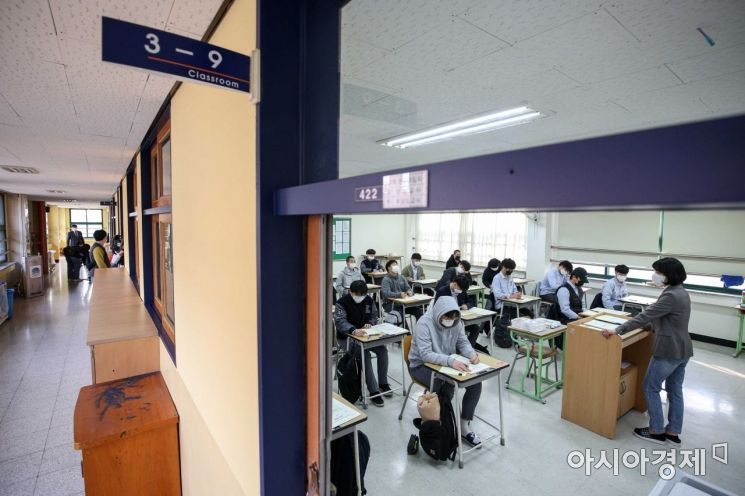 On the 25th, when the nationwide mock exam for high school seniors was conducted, examinees were waiting for the test to begin at Gyeongbok High School in Jongno-gu, Seoul. Photo by Jinhyung Kang aymsdream@
Experts commonly agreed that the Mathematics subject was slightly more difficult than last year’s CSAT. Out of 30 questions, 22 were common subjects and 8 were elective subjects. Based on the scoring ratio, the common subject is estimated to be worth 74 points, and the elective subjects about 26 points. Killer questions, which were mainly placed at numbers 21, 29, and 30 in the past, were relocated to common subject questions 15 and 22, and elective subject question 30 due to changes in the CSAT system.
Kim Byungjin, Director of Etoos, evaluated, "Although the difficulty of killer questions has decreased, the number of semi-killer questions has increased, and the geometry problems in the common subject were difficult. Calculus and differentiation, which are expected to be taken mainly by science track students, were somewhat easier."
Kim Seongcheol, Senior Researcher of Mathematics at Uway, said, "The overall difficulty of the questions increased, and the number of high-difficulty questions rose, so students may lack sufficient time to solve the questions. It is important to secure time by practicing solving the easier questions quickly, excluding the high-difficulty ones."
Lim Seongho, CEO of Jongro Academy Haneul Education, explained, "The common subject was relatively more difficult than the elective subjects. The proportion of liberal arts students entering the top 1 to 3 grades in Mathematics may significantly decrease. Liberal arts students, who are relatively weaker in Mathematics, will be greatly disadvantaged in the common subject."
EBS Linkage Rate Decreased but English Was Somewhat Easier
The English subject was easier than last year’s CSAT. Even in high-difficulty question types, it was relatively easy to find the correct answer by understanding the flow of the text. The question types, order of questions, and scoring were similar to last year’s CSAT. The EBS linkage rate dropped to 50%, and with indirect linkage, the topics became more diverse.
Jo Hyunseop, Senior Researcher of English at Uway, said, "Since questions are not directly linked to EBS textbooks, students need to read many passages using various topics, themes, and main ideas. For high-ranking students, the outcome is ultimately decided by blank-filling and writing questions, so they should repeatedly study solving high-difficulty questions while managing their time. For middle and lower-ranking students, it is important to improve comprehension, vocabulary, and syntax skills."
Kim Byungjin of Etoos said, "Overall difficulty was slightly lower than the 2020 CSAT, but the vocabulary difficulty within passages was high, making the test difficult for students lacking vocabulary skills. The killer question trend was maintained in blank inference questions, but the passages used had logical developments similar to last year’s CSAT questions."
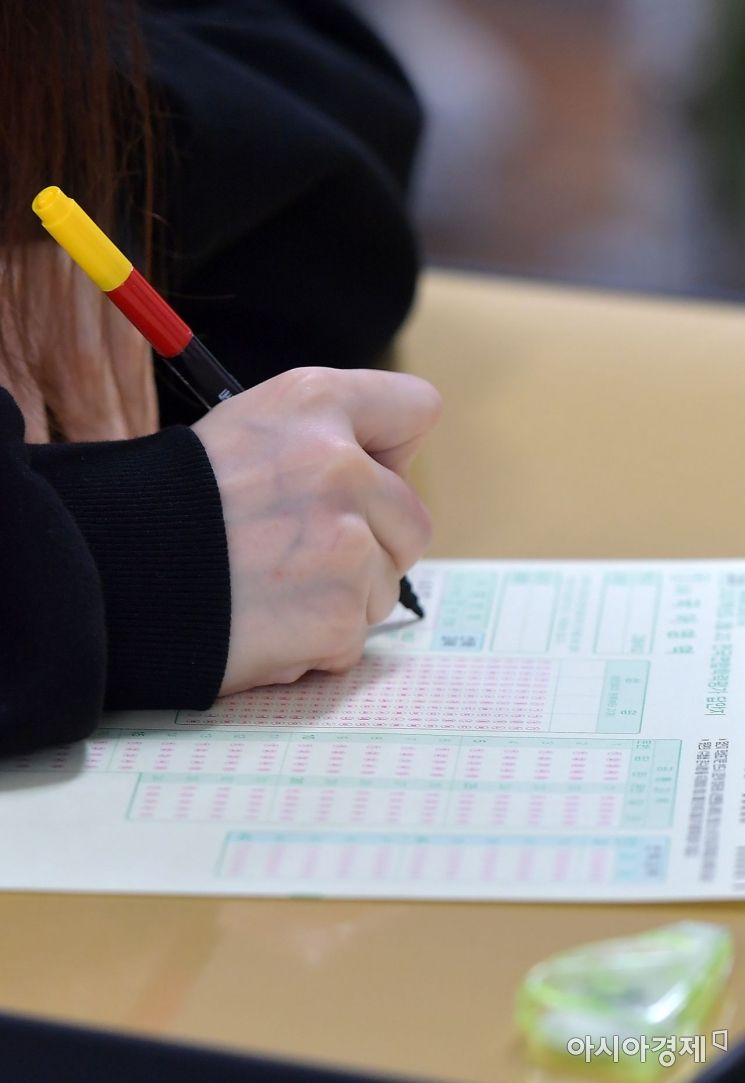 On the 25th, when the 2021 academic year nationwide joint academic achievement test for third-year high school students was conducted, examinees were taking the exam at Seoul Girls' High School in Mapo-gu, Seoul. Photo by Hyunmin Kim kimhyun81@
Study Methods After the March Academic Assessment
After the March academic assessment, it is advisable to analyze the overall question types and separately organize high-scoring questions and incorrect answers. As the scope of the test expands with each mock exam, reviewing concepts becomes difficult. For Mathematics, although the EBS linkage rate has decreased, it is good to organize textbook questions by type.
Many students may consider the advantages and disadvantages of elective subjects under the new system, but switching subjects and starting anew can be more burdensome. Especially, changing subjects based on the March academic assessment elective subject scores is risky.
Kim Byungjin of Etoos advised, "For Korean and Mathematics elective subjects, the characteristics of the elective subject group are important, but the likelihood that the characteristics of the elective subject group in the March academic assessment will be maintained in the actual CSAT is low. Therefore, it is a better strategy to improve the completeness of the subjects currently chosen. Since the importance of the common subject in Mathematics has increased, it is important to accurately study the problems you can solve, focusing on the common subject."
© The Asia Business Daily(www.asiae.co.kr). All rights reserved.
!["The Woman Who Threw Herself into the Water Clutching a Stolen Dior Bag"...A Grotesque Success Story That Shakes the Korean Psyche [Slate]](https://cwcontent.asiae.co.kr/asiaresize/183/2026021902243444107_1771435474.jpg)


















