Experience Leading Chaebol Reform and Kindergarten 3 Laws as an Asset
Armed with Insight and Action as a Capital Market and Economic Expert
The President Considers Me a 'Professional Among Professionals'
Will Realize 'Pursuit of Happiness' Beyond Welfare
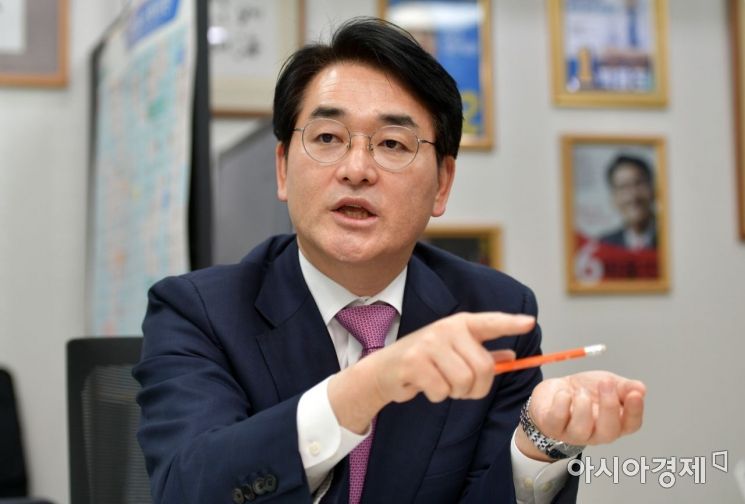
[Asia Economy Reporters Park Cheol-eung, Koo Chae-eun] "All reforms begin from the margins and the periphery."
This is what Park Yong-jin, a member of the Democratic Party of Korea, said in an interview with Asia Economy on the 22nd. Having declared his intention to run in next year's presidential election, he said he is fully committed to correcting market unfairness, cheating, privilege, and special favors. If he had been part of the 'mainstream' inevitably swayed by vested interests and votes, he would not have been able to investigate the illegal suspicions surrounding the chaebol family, which is regarded as a 'sanctuary' in our society, nor would he have been able to push through the Kindergarten Three Acts despite the fierce opposition from the entrenched Korea Kindergarten Association (HanYuChong).
Park, who entered the Democratic Party through the 2016 general election, has tackled sensitive and contentious issues. During the 20th National Assembly, when he was known as the 'rookie sniper,' he secured a legal interpretation that nominee accounts are subject to taxation under the Capital Markets Act, and exposed the Samsung Biologics accounting fraud case, becoming a star of the National Assembly audit. He raised the issue of accounting transparency in private kindergartens, leading to the passage of the Kindergarten Three Acts (amendments to the Early Childhood Education Act, Private School Act, and School Meals Act).
He was also busy during the 21st National Assembly. He persistently raised issues regarding Hyundai Motor's electric vehicle fire incidents, securing recalls and free repairs, and pushed for major reform legislation such as the Fair Economy Three Acts (amendments to the Commercial Act, Fair Trade Act, and the enactment of the Financial Conglomerate Act). Earlier this year, he pointed out illegal short selling practices, including naked short selling and falsifying contract facts, earning applause from 'Donghak ants' (individual investors).
We met Park at the National Assembly Members' Office Building. He opened the conversation with allegations of improper loans and conflicts of interest involving Samsung Securities, which had led to a comprehensive inspection by the Financial Supervisory Service. "This was pointed out during last year's audit, but the results of the comprehensive inspection have yet to be released. This is a representative example of cheating and unfairness in the economy. Correcting such issues is essential for young people to start businesses and fairly challenge new opportunities," he continued.
"Some say Park Yong-jin has no faction or lineage. (Conversely) because he is not surrounded by major vested interests and connections, he was able to lead difficult reform legislation. The current era demands from the president 'the courage to face change' and 'a new kind of social contract.' I believe that only a young politician strong on economic issues like Park Yong-jin can bring about change."
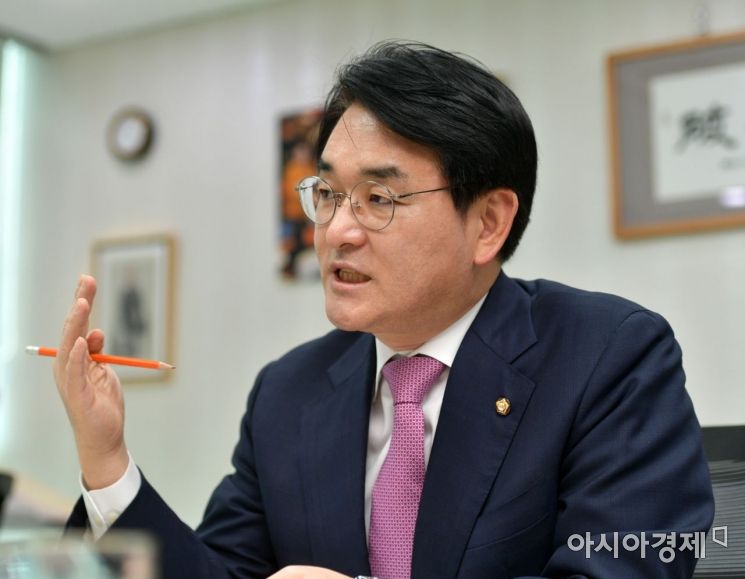
Below is a Q&A with Representative Park.
-Among the Democratic Party's reform legislations in the 21st National Assembly, many were pushed but ultimately stalled or failed.
▲Every endeavor has its achievements and limitations. If it reached that point, that is the limit. Many people have tried the Fair Economy Three Acts for quite some time. But that was as far as it went (some within the ruling party pointed out that the relaxation of the 3% limit on separate election voting rights for audit committee members in the Commercial Act and the decision to maintain rather than abolish exclusive prosecution rights in the Fair Trade Act represent the limits and setbacks of the Fair Economy Three Acts). In fact, many presidential pledges were not fulfilled. But is it better not to try? Obviously, it is better to try. In 2005, the National Security Act was also pushed for abolition but ended up being scrapped after debates over amendment versus abolition. However, even a step forward or half a step is meaningful. The party may have hesitated or wavered. But despite regrets, I think we have reached about 70% in chaebol reform and economic democratization legislation. You could say only 70%, or you could say we have come as far as 70%.
-There is criticism that the income-led growth policy was pursued but ended up diluted and inconclusive.
▲It is regrettable that it was started and then stopped midway. The minimum wage reflects how a country, government, and society treat and value their citizens. Yet, our people are treated as if worth 8,720 won per hour (the legal minimum wage in 2021). That is unacceptable. Our citizens and youth should be able to live lives where appropriate wages are guaranteed, and housing stability is secured, whether renting or leasing, even if they work 8 hours serving and spend 8 hours on hobbies. There is certainly regret that consensus politics was not exercised in the process of raising the minimum wage. It would have been better to agree to increase it by a certain amount each year within the five-year term, provide support to small business owners who would be shocked, and adjust and compromise accordingly.
-What kind of country do you think is a 'good country to do business'?
▲It should be a country good for startups, in other words, a country good for challenges. It should be a country where the second Kakao or Baemin can emerge, where Kim Beom-su (Chairman of Kakao) and Kim Bong-jin (Founder of Baedal Minjok) can start businesses without entry barriers. To do that, there must be no cheating or special favors in the market. If the powerful decide arbitrarily and prey on others, everyone fails. That does not happen in nature either. Economic democratization is not about harassing anyone. It is about preventing the chaebol families from cheating and pursuing private interests, thereby protecting investors, companies, and market participants. Because Microsoft was regulated, Apple, Google, Amazon, and Facebook grew. Even under the Trump administration, the US regulated the four IT giants. There was an understanding that without regulation, US consumers and latecomers would suffer. To make a country good for business, issues like seal regulations, entry barriers, and monopoly problems must be resolved. Bureaucrats refusing to stamp approvals prevent startups from playing their roles, existing mainstream businesses build entry barriers to block latecomers, and chaebol conglomerates monopolizing the market must not be allowed.
-There is a saying that the current government's Achilles' heel is the real estate issue. What aspects would you inherit and what would you improve?
▲The Moon Jae-in administration penalized multi-homeowners. I agree with the direction of issuing warnings to multi-homeowners through taxes. It made owning houses other than one's primary residence troublesome and burdensome. However, I think holding property tax or capital gains tax low for a while to encourage putting properties on the market is necessary. Especially, the desire to live in a 'good house' should not be antagonized. The desire to live in Seoul city, close to jobs, is not a moral issue. But the core of past governments' housing policies was like trying to control apartment prices in the Gangnam 3 districts. Our constitution guarantees the right to housing. Ensuring housing rights can be done through rental housing supply, promoting the private sector, social housing cooperatives, and more. My idea is to relocate Gimpo Airport's functions to Incheon Airport and build a smart city on that site. Building 200,000 households there could solve Seoul's housing problem. It could become a Seoul axis like Sangam and Magok, alongside the Gangnam 3 districts.
-The LH scandal is becoming a political black hole. How can it be resolved? You mentioned a Public Housing Agency.
▲The LH scandal touched on issues of unfairness and inequality that had been pressing on our society. First, LH's method of forcibly acquiring land for development is no longer appropriate. It has too large and extensive authority. Development should be negotiated with the private sector, and authority should be decentralized. Concentrated authority is never good. Creating a Public Housing Agency could be one solution. While maintaining the current donation and acceptance method, it might be possible to mandate that a certain percentage of apartments be sold to the Public Housing Agency when apartments are sold. It would be better for the central government to coordinate with metropolitan cities and provinces on rental housing policies. I believe the state and the Housing Agency can function to regulate housing supply and demand.
-You have declared your candidacy for the presidential election. The question remains: 'Why Park Yong-jin?'
▲The era needs young leaders. We must see who will stand against unfairness and inequality and lead change in this era. It is not just about saying impressive words but being evaluated on what one has actually done. Of course, I have worries and fears. What matters is whether one has faced and fought unfairness and inequality through conflicts, struggles, and loneliness. Politics also needs founders. The presidents we respect were founders. Some ask what faction or lineage Park Yong-jin has. For someone trying to start something, saying they have no backing or are not from a chaebol family is like saying they cannot succeed. Park Yong-jin is precisely the person who, with a New Frontier spirit, can bring change to the many challenges Korean politics faces.
-Former Prosecutor General Yoon Seok-youl is gaining momentum. How do you view him as a presidential candidate?
▲I think it is unfortunate for Korean politics. The president is a professional among professionals. Politics is about creating paths where none exist. The logic of 'follow the law, arrest everyone, be strict' is easier. Politics is about making paths without laws or regulations. Minimum wage negotiations, US-China relations, private kindergarten corruption?where are the laws? Following the law means the vested interests win. Politics requires difficult compromises, agreements, and conflict mediation. It is unfortunate for both him and the people if he gains popularity and becomes a presidential candidate simply because people suddenly dislike the current president and he benefits from that. If he has presidential ambitions, he should tell the people quickly and undergo scrutiny. He should not avoid it.
-What do you think about Gyeonggi Province Governor Lee Jae-myung's 'basic income' agenda?
▲It must be considered in the post-COVID context. Viewed that way, it is mistaken. Few who advocate basic income say it will happen within 10 years. Then the question remains: what about inequality and imbalance in Korean society over the next 10 years? Should we wait 10 years to receive 40,000 won? The 20s generation president of Korea should be the president for the 20s generation. Rather than a few coins of consolation, it is important to help young people secure jobs and build assets. The state should design and support various institutional measures so that our citizens can form assets of about 500 million won per household as quickly as possible. To achieve this, tax reform, investment methods in asset markets, various social funds, and efficient sovereign wealth fund management must be integrated into a comprehensive platform. We are developing policies for this.
-The 4.7 Seoul mayoral by-election is leaning heavily toward the opposition party.
▲I think we must acknowledge the poll results showing that. But elections are unpredictable until the lid is opened. In the 2010 election between Oh Se-hoon and Han Myeong-sook, Han was nearly 20 percentage points behind in a desperate situation but Oh Se-hoon won by a narrow margin of 0.6 percentage points. If the party mobilizes its organizational strength to the fullest and reflects the characteristics of a by-election, the election result will not be as easy as the polls suggest.
-Can we say the short selling controversy is settled for now?
▲I think it is still insufficient. The biggest problem with short selling is that naked short selling cannot be verified. We asked for a system to verify it, but the financial authorities only added after-the-fact procedural systems and stopped there. Individual investors suffered from naked short selling and shed tears, but no one compensates them, and the system was not created; only the resumption was delayed again. It is a stopgap measure. My bill (an amendment to the Capital Markets Act mandating securities firms that receive short selling orders to have computerized systems) proposed cooperation from securities firms and the Korea Securities Depository to create a system to verify whether borrowing was done at the time of sale.
-What is your stance on prosecutorial reform?
▲Even trees stop growing briefly in winter to form growth rings. Trees that grow without rings are weak. Social reform also requires a period of growth and stabilization. Functional decentralization of prosecutorial power has been agreed upon, and the Corruption Investigation Office has just been launched. Time is needed for the system to stabilize and strengthen. Now that the system is established, it needs to be stabilized and operated efficiently.
-Who is the politician you respect?
▲The late President Kim Dae-jung. He was a deeply progressive politician but achieved social compromise well. He accomplished things like integrating health insurance premiums, separating drug prescription and dispensing, and building high-speed internet infrastructure, and legalized the Korean Teachers and Education Workers Union and reinstated dismissed teachers, which were long-standing goals of the progressive camp. I respect him because, even if a leader is criticized, politics is about changing people's lives, and he made decisive and responsible plans and executed them.
© The Asia Business Daily(www.asiae.co.kr). All rights reserved.



















