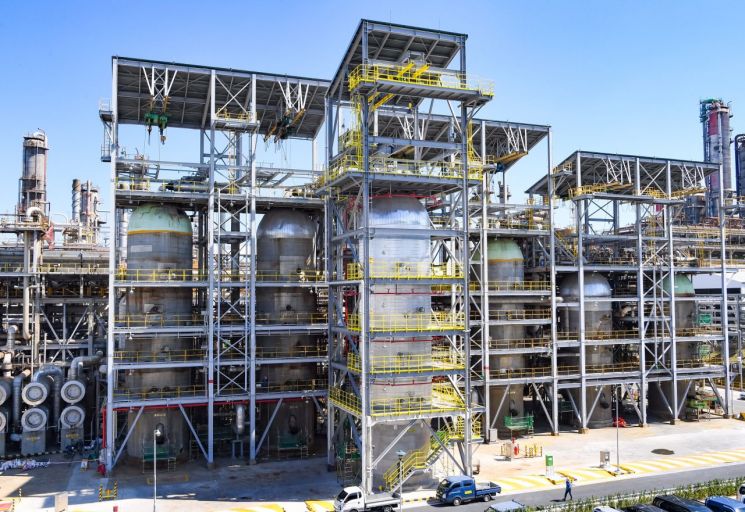
[Asia Economy Reporter Yoonju Hwang] S-OIL has recently completed and started operating new eco-friendly facilities aimed at reducing air pollutant emissions, accelerating its ESG management efforts.
S-OIL finished the expansion construction of the Residual Hydrodesulfurization Unit (RHDS) and began its operation on the 20th. Earlier in early March, the Vapor Combustion Unit (VCU) also started operating. Approximately 73 billion KRW was invested in the RHDS expansion and the new VCU installation to reduce air pollutant emissions during petroleum product production processes.
The RHDS is an environmentally friendly facility that removes impurities from high-sulfur residual oil feedstock through hydrogen addition catalytic reactions in a high-temperature, high-pressure reactor, thereby reducing air pollutant emissions from the produced products. The newly expanded desulfurization facility (1st RHDS) increased the residual oil processing capacity by 18%, from 34,000 barrels per day to 40,000 barrels per day.
The desulfurized residual oil undergoes subsequent processing to produce light oil products such as naphtha and ultra-low sulfur diesel, and some of it is converted into high value-added low-sulfur marine fuel oil to meet the growing global demand, thereby enhancing profitability. Additionally, improvements in the efficiency and production capacity of existing refining facilities are expected to generate an annual profit improvement effect of 40 billion KRW.
The RHDS expansion construction was safely completed over 24 months from April 2019 to March this year without any COVID-19 infections or accidents. An S-OIL official stated, "The RHDS expansion investment was made as part of ESG management to actively respond to the increasing demand for low-sulfur marine fuels following the International Maritime Organization (IMO)'s strengthened sulfur content regulations on marine fuel oil last year."
The VCU, which started operating earlier this month than the RHDS, is an eco-friendly facility that captures vapor emitted from storage tanks and completely combusts it to prevent harmful substances from being released into the atmosphere. Construction began in September 2020 and by the end of February this year, emission facilities installed on 19 storage tanks were modified, and a total of 7 km of new piping was installed and connected.
S-OIL’s ESG management, including investments in eco-friendly facilities, is expected to be further strengthened. An S-OIL official said, "We are planning to build a larger capacity VCU to prevent vapor leakage from storage tanks used for crude oil and product storage at the Ulsan plant."
© The Asia Business Daily(www.asiae.co.kr). All rights reserved.
![Clutching a Stolen Dior Bag, Saying "I Hate Being Poor but Real"... The Grotesque Con of a "Human Knockoff" [Slate]](https://cwcontent.asiae.co.kr/asiaresize/183/2026021902243444107_1771435474.jpg)











