Kimchi Main Ingredient Restaurants Hit Hard
Most Delivery-Only Stores Use Chinese Products
Domestic Prices Twice as High
Sharp Rise in Raw Materials Like Cabbage and Chili
Too Daunting to Make Kimchi at Home
Origin Verification Leads to Negative Reviews
Even HACCP Certification "Can't Be Trusted"
[Asia Economy Reporter Seungjin Lee] Last weekend, office worker Min Juhwan (33) gave up ordering kimchi stew, which he usually ordered frequently for delivery. After the hygiene issues of Chinese-made kimchi surfaced, he started to carefully check the country of origin labels, which he had not paid much attention to before, and found out that his regular restaurant used Chinese-made kimchi. Min said, "I lost my appetite when I found out that the restaurant I often used used Chinese kimchi," adding, "For the time being, I will check whether the kimchi is domestically produced before eating it, or if the origin is unclear, I would rather not eat it."
The kimchi crisis originating from China is increasing the difficulties for self-employed business owners. Due to the prolonged COVID-19 situation, dining-out demand has decreased, and delivery orders were compensating for the slump, but recently, after videos of unsanitary Chinese kimchi factories were released, consumers are even avoiding delivery food. The places hit hardest are restaurants that use kimchi as the main ingredient, such as kimchi stew and kimchi jjim. Some have reported sales dropping to one-tenth and are expressing their hardships.
"The price difference is huge... no alternatives"
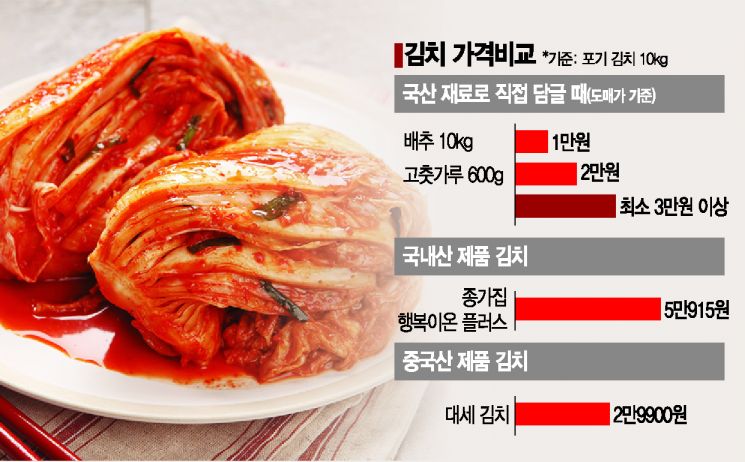
According to the food service industry on the 23rd, restaurants specializing in delivery of kimchi dishes such as kimchi stew and kimchi jjim have been cornered since the Chinese kimchi crisis. Delivery-only restaurants have mostly used Chinese-made kimchi because their food prices are relatively low and consumers rarely check the country of origin labels carefully. Domestic kimchi costs nearly twice as much as Chinese kimchi, making it impossible for them to afford using it. Currently, Chinese-made kimchi sold at food material marts costs less than 30,000 KRW for 10 kg, while domestic kimchi exceeds 50,000 KRW.
Some restaurants are considering making kimchi themselves, but even that is difficult. Due to last year's longest rainy season on record, the prices of napa cabbage and red pepper powder soared, adding to the cost burden of raw materials. According to the Korea Agro-Fisheries & Food Trade Corporation (aT), as of the 22nd, the wholesale price of 10 kg of napa cabbage was 11,040 KRW, 18.1% higher than a year ago. For dried red pepper (yanggeon), the wholesale price for 30 kg was 1,001,000 KRW, soaring 96.3% compared to the previous year. Based on this, the industry explains that making 10 kg of pogi kimchi costs at least 20% more than Chinese kimchi, excluding labor and additional material costs.
One-star rating if Chinese kimchi is used
As consumers have started to check the country of origin carefully, not only sales have decreased but so-called 'star rating terrorism' giving the lowest rating has continued. When using delivery platforms, consumers can rate restaurants on a 5-point scale, and restaurants are introduced on the app screen according to their star ratings.
A person running a Korean restaurant, Mr. A, said, "There was a request in the order saying 'Please do not send Chinese kimchi as side dishes,' but I habitually included kimchi and received a one-star rating," adding, "After that, I completely removed kimchi from the side dishes."
HACCP certification is meaningless
Restaurants that have no choice but to use Chinese kimchi due to cost burdens have recently requested food safety management certification (HACCP) certificates from kimchi manufacturers to show that the kimchi is safe to eat. However, consumer reactions remain lukewarm. Most certificates are written in English or Chinese, and there is also suspicion that they might be forged.
Mr. B, the owner of a kimchi stew specialty restaurant, said, "We requested and received the HACCP certificate, but most customers still do not trust it, so we are considering whether we should use domestic kimchi after all," adding, "In that case, we would have to raise the food price by at least 1,000 to 2,000 KRW to make a profit, and I am worried whether we can continue running the restaurant."
© The Asia Business Daily(www.asiae.co.kr). All rights reserved.

















