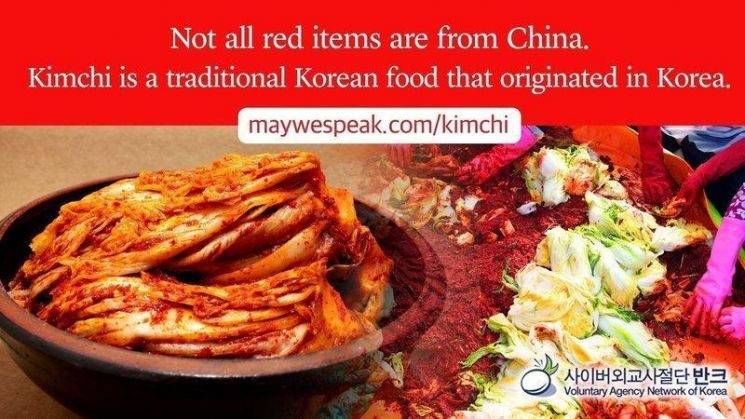
 A digital poster created by the cyber diplomacy delegation VANK to promote Kimchi worldwide. On November 29 last year, China's state-run media Global Times distorted the facts by reporting, "Since China's pickled vegetable pao cai (泡菜) was designated as an international standard by the International Organization for Standardization (ISO), Korean kimchi also falls under pao cai, making China the global standard for the kimchi industry." (Image source=Yonhap News)
[Sejong=Asia Economy Reporter Moon Chaeseok] Amid growing rejection of Chinese-made kimchi following the release of a video showing cabbage being pickled naked in China, the government announced that the name "kimchi" can also be included on kimchi products exported to China. This is a solution proposed by the government in response to Chinese authorities enforcing the use of the term "pao cai (泡菜)." The government has stepped in to support domestic food companies, but many predict it remains uncertain whether this will resolve the issue amid increasing consumer "China phobia."
The Ministry of Agriculture, Food and Rural Affairs stated on the 18th, "According to China's National Food Safety Standard (GB), it is understood that labeling with both 'kimchi' and 'KIMCHI' alongside pao cai is possible." This was in response to claims by some Korean companies that the Chinese government does not recognize the term "kimchi" when registering trademarks for kimchi-related products sold in China. The Chinese GB basically requires food labeling in Chinese characters but allows foreign languages to be included as well.
According to the Ministry, although Chinese authorities enforce the use of the term pao cai for kimchi, there is no problem with using "kimchi" or "KIMCHI" together. Currently, it is widespread in China to refer to Korean kimchi as pao cai, and many people argue that since pao cai is a Chinese dish, China is the original home of kimchi.
The government is promoting the registration of "geographical indication of country name" for kimchi to prevent illegal acts where foreign-made kimchi is disguised as Korean-made. The geographical indication system recognizes the name of the origin as a trademark when the uniqueness of a specific product comes from its place of origin, such as "Boseong Green Tea" or "Goryeo Ginseng." Until now, the geographical indication system has only applied to domestic regions, but the government plans to apply it at the national level. Currently, South Korea has partnerships on geographical indications with the European Union (EU) and others.
However, the revision of the "Enforcement Decree of the Agricultural and Fishery Products Quality Control Act," which will provide the legal basis for the geographical indication of country name, is still underway. Registration of the geographical indication of country name can be made if the main ingredients of kimchi, such as cabbage and radish, are domestically produced and processed in Korea. A Ministry of Agriculture, Food and Rural Affairs official said, "We plan to gather opinions from producer and consumer groups regarding some industry demands, such as whether to allow imported raw materials for kimchi."
© The Asia Business Daily(www.asiae.co.kr). All rights reserved.
![Clutching a Stolen Dior Bag, Saying "I Hate Being Poor but Real"... The Grotesque Con of a "Human Knockoff" [Slate]](https://cwcontent.asiae.co.kr/asiaresize/183/2026021902243444107_1771435474.jpg)
















