No Asian Lead Actor or Actress Winner in 92 Years
Academy Membership Dominated by White Males
Asian Members Say "We Have Been Overlooked... Signs of Change Now"
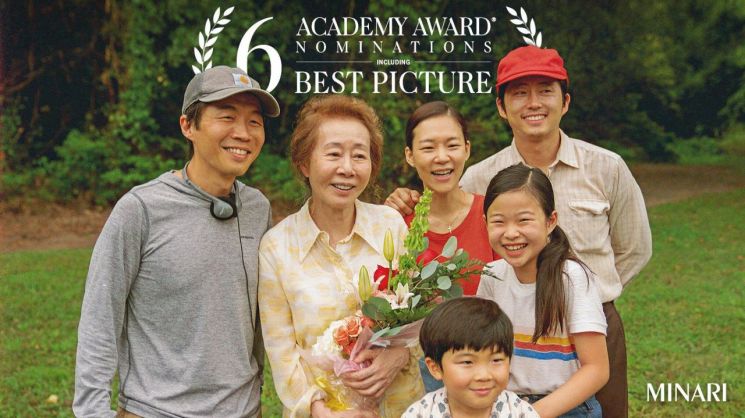
[Asia Economy Reporter Kim Suhwan] Foreign media reactions to the upcoming 93rd Academy Awards (Oscars) in 2021 describe it as the "biggest upset in history." Notably, an Asian actor has been nominated for an acting award for the first time ever. This Academy Awards ceremony, praised for having the most inclusive list of nominees in terms of race and gender, has drawn attention to the history of Asian filmmakers' participation in the Oscars.
First Asian Actor Nominated for Leading Role at the Oscars
The nominee announcement ceremony, broadcast live worldwide on the 14th, was full of surprises. Actress Youn Yuh-jung from the film Minari was nominated for Best Supporting Actress, becoming the first Korean to receive such a nomination. Additionally, Steven Yeun, the lead actor in the same film, was nominated, marking the first time an Asian actor has been nominated for Best Supporting Actor.
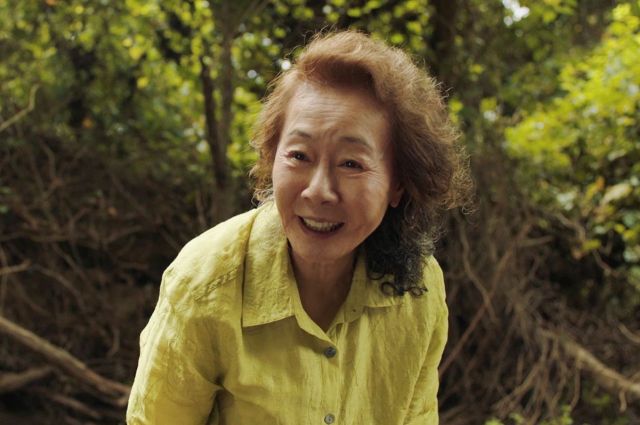 Korean actress Youn Yuh-jung, the first Korean actress nominated for the Academy Award for Best Supporting Actress
 [Photo by Yonhap News]
Moreover, for the first time in history, two female directors were nominated for Best Director, and a Muslim actor was nominated for an acting award for the first time. Over 70 women were nominated across all categories, setting a record for the highest number of female nominees in a single year. The Hollywood Reporter, a culture-focused media outlet, commented on this list of nominees, stating, "The Oscars have made new history," and particularly highlighted that "the first nomination of an Asian actor for an acting award signifies real progress in diversity at the Oscars."
Asian Filmmakers Overlooked in 93 Years of Oscar History
In the nearly 100-year history of the Oscars, Asian filmmakers have received less attention compared to other races. To date, only eight films directed by Asian directors have been nominated for the Oscar's top honor, Best Picture. Calculated by year, Asian directors' films have been nominated for Best Picture in only seven out of the 93 years of Oscar history.
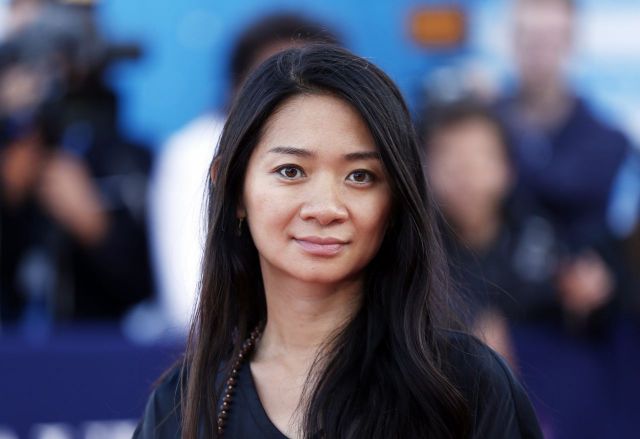 Director Chlo? Zhao nominated for Best Director at the 93rd Academy Awards
 [Image source=EPA Yonhap News]
The directors of these nominated films include ▲ one Indian (Ismail Merchant, known for Room with a View), ▲ one Taiwanese (Director Ang Lee, known for Crouching Tiger, Hidden Dragon), ▲ one Korean (Director Bong Joon-ho of Parasite), ▲ one Korean-American (Director Lee Isaac Chung of Minari), and ▲ one Chinese (Director Chlo? Zhao of Nomadland), totaling five individuals.
The Best Director category shows a similar trend. In the 93-year history of the Oscars, six Asian directors have been nominated for Best Director.
Specifically, these include ▲ two Japanese directors: Hiroshi Teshigahara (1965, Woman in the Dunes) and Akira Kurosawa (1985, Ran), ▲ Taiwanese director Ang Lee (2000 for Crouching Tiger, Hidden Dragon, 2005 for Brokeback Mountain, 2012 for Life of Pi), ▲ Korean director Bong Joon-ho (2019, Parasite), ▲ Korean-American director Lee Isaac Chung (2020, Minari), and ▲ Chinese director Chlo? Zhao (2020, Nomadland).
Amid this history of the Oscars 'overlooking' Asians, voices of dissatisfaction have emerged among Asian filmmakers. Chris Tashima, an actor and member of the Asian Action Committee, a group of Asian members of the Academy of Motion Picture Arts and Sciences (AMPAS), criticized, "We were almost nonexistent," adding, "It was difficult to even get opportunities to appear in films, let alone be nominated for an Oscar."
The situation is similar in the Best International Feature Film category, which awards non-English language films. Over the past 20 years, only seven films from Asian countries have been nominated, while European films have had 59 nominations during the same period.
Notably, the lack of recognition for Asians is most pronounced in the acting categories. In the 92-year history of the Oscars, no East Asian has ever been nominated for Best Actor or Best Actress.
Even the film Parasite, which won the Screen Actors Guild Award for Outstanding Performance by a Cast in a Motion Picture, did not receive any acting nominations at the Oscars. Sylvia Jung, a professor of American Studies at the University of Virginia, remarked, "The Oscars have begun to recognize the artistic merit of Asian films, but actors are still overlooked," questioning, "If the acting was not good, how could the film's artistic merit be so highly regarded?"
The underlying reason for the low number of Asian nominees and winners is interpreted as stemming from the composition of Academy members who hold voting rights for Oscar nominees. According to ABC News, as of 2018, only 16% of Academy members were people of color, with East Asians being the smallest group among all people of color.
Hollywood-focused media outlet The Wrap analyzed, "Given the predominantly white male composition of Academy members, they generally prefer European films over Asian films," adding, "Since most Academy members are Westerners, they are naturally more familiar with European culture and films."
Despite Hollywood's Push for 'Diversity,' East Asians Remain Overlooked
There are also criticisms that Asians, who have been overlooked at the Oscars, are underrepresented in the Hollywood film industry itself. CNN reported, "About 5.7% of the total U.S. population is Asian," but "Asians make up only 3.7% of all actors appearing in American films."
A study released last month by the University of Southern California's Annenberg School for Communication and Journalism found that from 2014 to 2015, nearly half of all TV programs aired in the U.S. did not feature a single East Asian actor. In contrast, Black actors were absent in only 22% of programs, indicating that East Asian actors face relatively more discrimination than Black actors. During the same period, among approximately 100 films released, 66% featured Black actors in leading roles, while East Asian actors appeared in only 6.3% of leading roles.
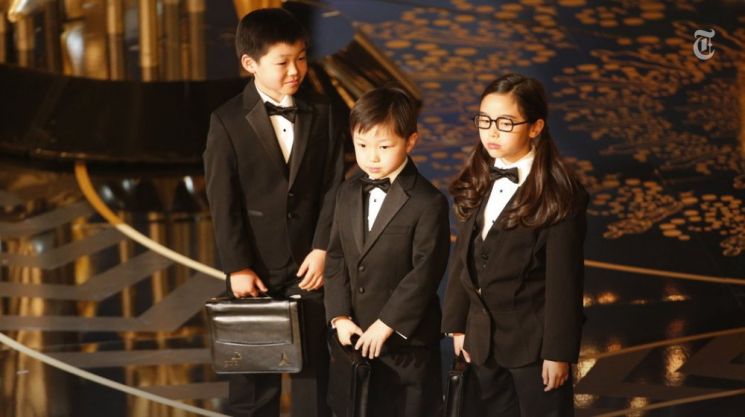 Asian children in suits walking onto the stage at the 2016 Academy Awards ceremony
 [Photo by Twitter]
In 2015, the #OscarsSoWhite movement began, calling for diversity in the Oscars after the nominee list was overwhelmingly white. However, Asian filmmakers were also criticized for being overlooked in this movement.
Shortly after the movement started, the 2016 Oscars host made a joke implying widespread child labor exploitation in Asia and brought an East Asian child dressed in a suit and glasses on stage, reinforcing the American stereotype that "Asians only study math," which sparked further controversy.
Vice, an online media outlet, reported, "The biggest barrier to East Asians entering Hollywood is prejudice and discriminatory perceptions against them," explaining that "most Americans wrongly believe that Asians lack emotions." This stereotype?that Asians are "emotionless"?has led to the perception that they are unsuitable as actors, which in turn hinders their opportunities in Hollywood and blocks avenues to dispel these prejudices.
Nancy Wang, an associate professor of sociology at Biola University, pointed out, "Hollywood views East Asians as having limited emotional range, which restricts the roles they can play," adding, "Such stereotypes make casting East Asian actors less likely."
 A scene from 'Nomadland,' nominated for Best Picture at the 93rd Academy Awards
 [Image source=AP Yonhap News]
As the Oscars approach their 100th anniversary, will the perception of East Asians in Hollywood change following last year's Best Picture win for Parasite and this year's nominations for Minari? This year, films directed by East Asian directors, Nomadland and Minari, have been nominated for Best Picture and Best Director. Currently, Nomadland, which won Best Picture at last month's 78th Golden Globe Awards, is widely predicted to win the Oscar for Best Picture, as Golden Globe winners often go on to win the Oscar in the same category.
Importantly, this year shows signs that Hollywood's attitude toward East Asians is beginning to change. Chris Tashima, a member of the Academy's Asian Action Committee, said, "(East Asians' entry into Hollywood) has been a long and difficult struggle," but added, "Compared to five years ago, there has been significant progress. The integration of East Asians into mainstream Hollywood is steadily advancing."

© The Asia Business Daily(www.asiae.co.kr). All rights reserved.



















