Korea Institute of Radiological & Medical Sciences Completes System Setup and Promotes Mass Production
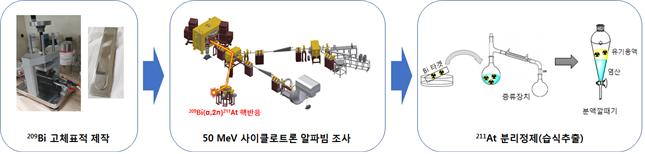 Schematic diagram of Astatine-211 production process. Image courtesy of Korea Institute of Radiological & Medical Sciences
[Asia Economy Reporter Kim Bong-su] The domestic production of the radioactive isotope Astatine-211, which can treat prostate and neuroendocrine cancer patients with a high success rate without damaging normal cells but was previously difficult to import, has become possible.
The Korea Institute of Radiological & Medical Sciences announced on the 19th that the RI Application Department research team (Dr. Lee Gyo-cheol, Kim Jeong-young, Oh Se-young, Kang Chung-mo) at the Radiation Medicine Research Institute has established the first domestic production, separation, and purification system for the radioactive isotope Astatine-211 (At-211) used for cancer treatment.
Astatine-211, a radioactive isotope that emits alpha rays, is mainly manufactured as a therapeutic radiopharmaceutical and used for treating metastatic and advanced neuroendocrine and prostate cancers. Compared to radioactive isotopes that emit beta rays, it delivers radiation to cancer cells with energy tens to hundreds of times higher without damaging normal cells, showing high therapeutic efficacy.
While overseas development and clinical research of therapeutic radiopharmaceuticals using Astatine-211 are underway, domestic import and development have not been conducted, resulting in supply limitations despite high demand. This is because Astatine-211 has a short half-life of 7.2 hours, making transportation difficult, so most of it is consumed within the producing country.
The research team utilized the medical cyclotron (MC50) owned by the Korea Institute of Radiological & Medical Sciences to irradiate the target material Bismuth-209 (Bi-209) with an alpha beam, producing Astatine-211 (At-211) through nuclear reactions. They secured production technology capable of generating quantities sufficient for preclinical research through separation and purification processes.
Using independently developed separation and purification equipment and software, they succeeded in separating Astatine-211 through three experiments and plan to introduce additional production systems to obtain sufficient amounts for future clinical use.
Kim Mi-sook, director of the Institute of Radiological & Medical Sciences, said, “With the institute’s accumulated research and production technologies for various diagnostic and therapeutic radiopharmaceuticals, we have achieved the great feat of domestic production of the radioactive isotope Astatine-211.” She added, “We hope this will allow cancer patients, who have faced many treatment limitations, to receive timely treatment without missing the opportunity.”
© The Asia Business Daily(www.asiae.co.kr). All rights reserved.

















