Press Walks Out After All Speak
Blinken US Secretary of State "Come Back"
Unusual Scene in Diplomatic Field
"Are We Going to Talk Like This?"
Yang Jiechi, Member of CPC Politburo, Expresses Dissatisfaction
Both Sides Lower Expectations for Talks
US "Will Maintain Strong Stance Toward China
Even in Private Meetings"
China "Pre-Talk Sanctions
Are Like Spitting at Guest's Table"
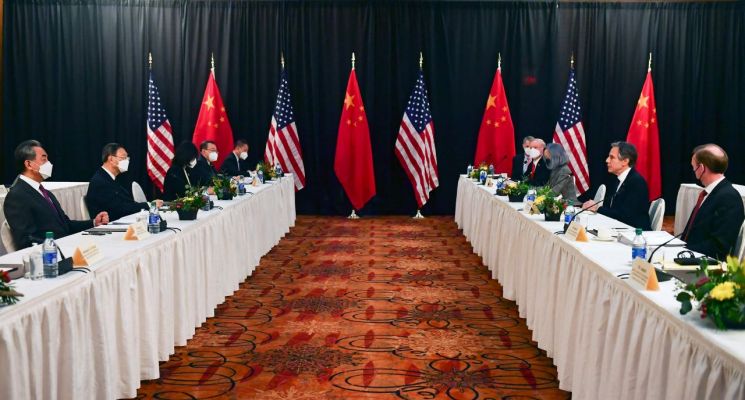 U.S. Secretary of State Tony Blinken (second from right) and White House National Security Advisor Jake Sullivan (first from right), along with Chinese Communist Party Politburo member in charge of foreign affairs Yang Jiechi (second from left) and State Councilor and Foreign Minister Wang Yi (first from left), began the high-level U.S.-China talks on the 18th (local time) in Anchorage, Alaska. [Image source=AFP Yonhap News]
[Asia Economy New York=Correspondent Baek Jong-min, Beijing=Correspondent Jo Young-shin] The first meeting between the Joe Biden administration and China was marked by extreme tension and a hostile atmosphere. It signaled that improving U.S.-China relations will not be easy going forward. As the conflict between the world's largest power, the United States, and the challenging China fails to find a solution, the South Korean government's concerns are expected to deepen. Some worry that the relationship between the two countries could rapidly deteriorate and fall into the 'Thucydides Trap.'
Blinken Calls Back Press Leaving the Venue
On the 18th (local time), an unusual incident occurred during the U.S.-China high-level talks held in Anchorage, Alaska, which is rarely seen in diplomatic settings.
After both sides exchanged opening remarks without any concessions and the press began to leave, U.S. Secretary of State Tony Blinken called out, "Bring our colleagues back," stopping them. Although Chinese officials appeared embarrassed and urged the press to leave, reporters were able to hear remarks from Yang Jiechi, China's Politburo member in charge of foreign affairs.
This broke the agreed procedure for the event and was considered a rare breach of diplomatic protocol. It was interpreted as an attempt to let the press hear China's tough statements until the end. Yang Jiechi immediately expressed dissatisfaction, saying, "Is this the kind of dialogue you wanted? We thought the U.S. would adhere to diplomatic standards. Perhaps we thought too highly of the U.S."
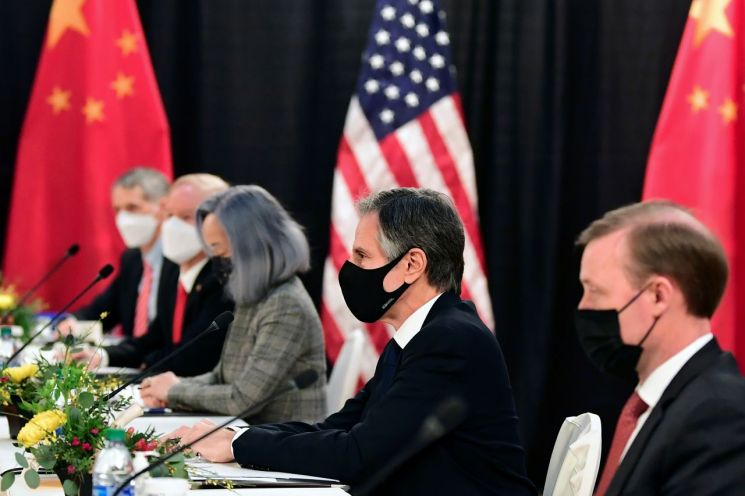 Tony Blinken (second from right), U.S. Secretary of State, and Jake Sullivan (first from right), U.S. National Security Advisor, are attending the U.S.-China high-level diplomatic talks held on the 18th (local time) in Anchorage, Alaska.
 [Image source=Reuters Yonhap News]
Secretary Blinken also made remarks that were not in the prepared script. When Yang Jiechi used harsh expressions such as "America's human rights are at the lowest level" and "Black people are being massacred in the U.S." to attack and urge the U.S. to improve human rights, Blinken responded immediately. He said, "We are endlessly exploring how to build a more perfect community. This exploration means we are not perfect and make mistakes."
Blinken took a firm stance from the start of his opening remarks. He raised the issue of human rights in China's Xinjiang region, directly addressing the most sensitive topic for China. One foreign media outlet reported that the ice had already begun to melt before the main talks started, and the exchanges between the two sides heated up from the beginning.
U.S.-China Relations Heading Toward the Worst
The talks are scheduled to last two days until the following day. The U.S. side had already anticipated that a joint declaration would be difficult to produce. It was expected that the talks would essentially only confirm each side's positions. A senior U.S. official said after the first meeting, "We will maintain a tough stance toward China not only in public statements but also in private meetings." He seemed conscious of Chinese criticism and claimed, "It is China that broke the promise regarding the format of the talks."
White House spokesperson Jen Psaki also said during a regular briefing that whether there will be additional U.S.-China meetings depends on "discussions on all issues during the talks, after which President Biden will decide on the future of bilateral relations." Considering the atmosphere of the talks, it seems unlikely that a meeting between President Biden and Chinese President Xi Jinping will be arranged soon.
The Chinese side has also lowered its expectations for the talks. Chinese state-affiliated scholars expressed opinions that there was no need for talks after the U.S. imposed sanctions on 24 senior Hong Kong officials just before the U.S.-China high-level meeting.
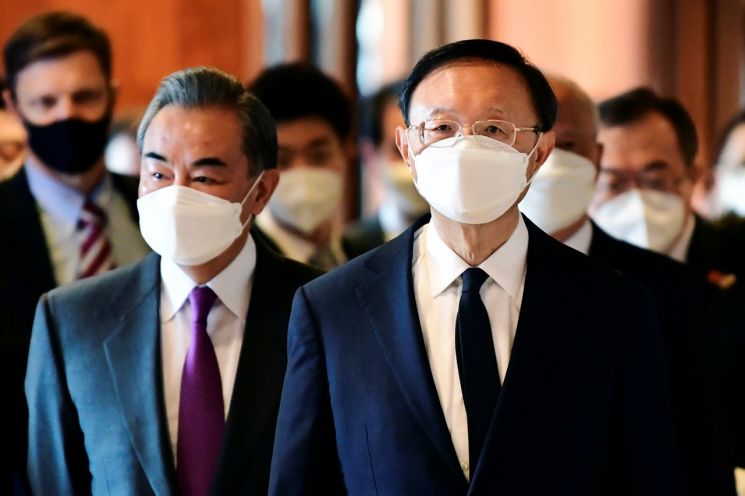 Yang Jiechi (center in photo), member of the Political Bureau of the Communist Party of China in charge of foreign affairs, and Wang Yi (left in photo), State Councilor and Minister of Foreign Affairs in charge of diplomacy, are attending the high-level China-US diplomatic talks held on the 18th (local time) in Anchorage, Alaska, USA. [Image source=Reuters Yonhap News]
Lu Xiang, a researcher at the Chinese Academy of Social Sciences, condemned, "Sanctioning Chinese officials related to the Hong Kong election law amendment ahead of the talks was a deliberate act by the U.S. It is like a host spitting on the table after inviting guests."
Jin Chanlong, deputy director of the Institute of International Relations at Renmin University of China, expressed dissatisfaction, saying, "The U.S. sanctions show that the Biden administration has inherited most of the confrontational policies of the previous Donald Trump administration. We should not harbor illusions or hopeful thoughts about the Biden government."
Yang Siyu, senior researcher at the China Institute of International Studies, warned, "Since the handshake between former Chairman Mao Zedong and former U.S. President Richard Nixon, Sino-U.S. relations are facing their worst situation. For the future, there are only two options: return to the right path or revert to the pre-diplomatic relations situation, that is, the Cold War or even war."
▶Thucydides Trap: The concept that war occurs when a rising power challenges an existing dominant power.
© The Asia Business Daily(www.asiae.co.kr). All rights reserved.



















