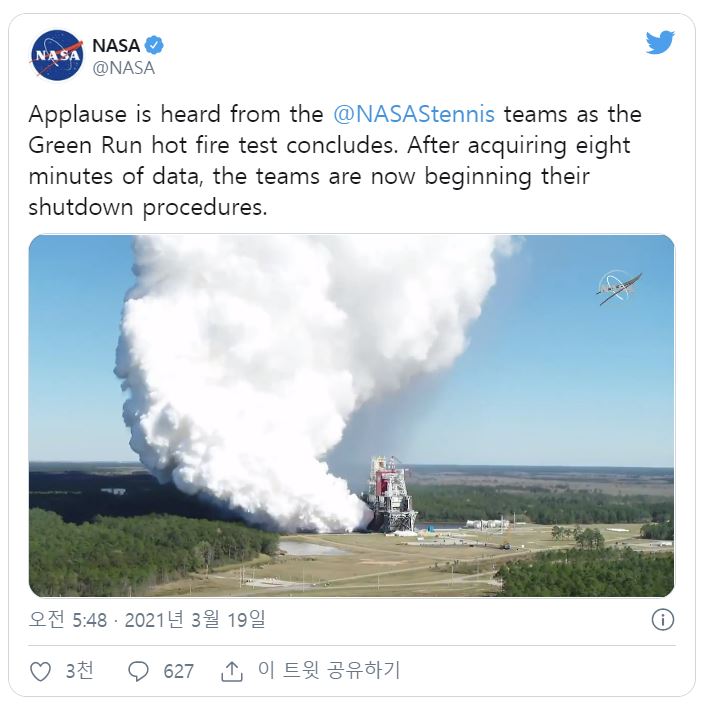
[Asia Economy Reporter Yujin Cho] The rocket engine ignition test conducted as part of NASA's 'Artemis' project to send humans back to the moon was reported to have been successfully completed on the 18th (local time) by the New York Times and others.
On that day, four engines of the rocket named 'Space Launch System' (SLS) ignited for 8 minutes at the Stennis Space Center in Mississippi.
Steve Jurczyk, acting NASA administrator, stated, "This is an important step in advancing our goals."
This test evaluated the rocket's performance in an environment identical to an actual launch. In the test conducted last January, the engine automatically shut down after 1 minute of combustion due to detected anomalies.
NASA plans to send the Boeing-manufactured rocket to the Kennedy Space Center in Florida to prepare for the actual launch after successfully completing this test.
This test is part of the 'Artemis' project, which aims to send humans back to the moon for the first time in half a century since Apollo 17's last moon landing in 1972. NASA aims to send one male and one female astronaut to the moon in 2024.
The SLS rocket will be mounted on the spacecraft 'Orion,' developed by Lockheed Martin, and will conduct an unmanned flight around the lunar orbit. The launch is scheduled for November this year, but according to the NYT, NASA officials did not clarify the schedule.
© The Asia Business Daily(www.asiae.co.kr). All rights reserved.

















