Kazakhstan Space Center Launches at 3:07 PM... Independently Developed 'Best Value' Domestic Satellite
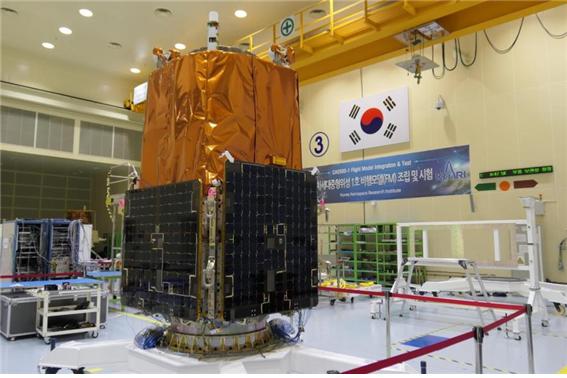
[Asia Economy Reporter Kim Bong-su] The 'Next-Generation Medium-Sized Satellite 1' that will open the era of 'K-Satellites' is being launched and entering its mission.
The Ministry of Science and ICT announced on the 19th that at around 3:07 PM (Korean time) on the 20th, the domestically developed 'Next-Generation Medium-Sized Satellite 1' will be launched aboard a Russian Soyuz rocket from the Baikonur Cosmodrome in Kazakhstan. The Ministry plans to broadcast the launch live on YouTube starting at 2:15 PM on the same day.
The Next-Generation Medium-Sized Satellite 1 was mostly developed using domestic technology from design to parts manufacturing and assembly. Even the core component, the optical payload (satellite camera), was made with all parts except the photodetector using domestic technology.
After assembly was completed, the Next-Generation Medium-Sized Satellite 1 was transported to the Baikonur Cosmodrome last January, where it successfully completed all launch preparations including functional checks, fuel loading, and integration with the launch vehicle over about 50 days. It will be launched aboard the Soyuz 2.1a launch vehicle. Approximately 64 minutes after launch, it will separate from the launch vehicle, and about 38 minutes later (approximately 102 minutes after launch), it will establish initial communication with the Norwegian Svalbard ground station. This will confirm whether the satellite has successfully reached its mission orbit.
After launch, the Next-Generation Medium-Sized Satellite 1 will undergo an initial six-month operation phase in an orbit at an altitude of 497.8 km, and from October onward, it plans to provide standard imagery to users. Its applications include national land and resource management, responding to public sector demands related to disaster and emergency management, and providing precise earth observation imagery for national spatial information services.
The government views the production of the Next-Generation Medium-Sized Satellite 1 as securing a 500kg-class satellite standard platform and opening the path for independent development and export of high-performance satellites for precise earth observation at the private sector level. Notably, it was produced at less than half the cost of comparable foreign satellites, around 150 billion KRW, while outperforming them in performance, securing international competitiveness.
The Korea Aerospace Research Institute, which has led the satellite development and launch, involved many domestic companies during the production process to transfer technology. The second satellite is planned to be produced and launched in 2022, and as part of the second phase project, satellites 3 and 4 with improved performance will continue to be launched into orbit.
© The Asia Business Daily(www.asiae.co.kr). All rights reserved.
![User Who Sold Erroneously Deposited Bitcoins to Repay Debt and Fund Entertainment... What Did the Supreme Court Decide in 2021? [Legal Issue Check]](https://cwcontent.asiae.co.kr/asiaresize/183/2026020910431234020_1770601391.png)
















