Delivery Platform Delivery Fee Increase
"Intense Competition in Delivery Market...Inevitable Measure to Prevent Rider Attrition"
Leads to Consumer and Small Business Burden
Experts: "Before Criticizing Price Hike, Delivery Market Structure Must Be Examined"
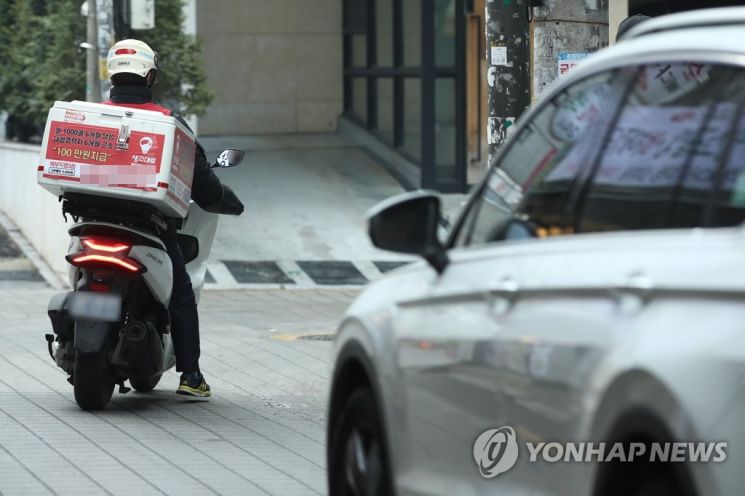 A delivery rider from a delivery agency is making a delivery in downtown Seoul.
 [Photo by Yonhap News]
[Asia Economy Reporter Kim Choyoung] Amid the boom in the delivery market due to increased remote work and online classes caused by COVID-19, both consumers and self-employed restaurant owners are voicing complaints about the rise in delivery service fees. Companies explain that the increase is an unavoidable measure due to growing delivery demand and rising labor costs, but public opinion remains negative. Experts emphasize the need to also examine the changed system, including the structure of delivery platforms.
Currently, the delivery market operates as follows: when consumers order food through delivery order platforms (Baedal Minjok, Yogiyo, Baedaltong), restaurants receive the orders and then request delivery through delivery agency platforms (Booroong, Saenggakdaero, Barogo). The delivery agency platforms then pass the orders to local delivery agencies, which deliver to consumers.
The total delivery fee that consumers and store owners must bear is determined by the local delivery agencies. Local delivery agencies are delivery companies operated by individual business owners contracted with the delivery agency platforms. In the case of 'Saenggakdaero' and 'Barogo,' local agencies have the authority to set delivery fees, while 'Booroong' sets delivery fees at the headquarters level.
In February, Mesh Korea, which operates Booroong, restructured delivery commissions and raised the base delivery fee, sparking controversy. The Seocho and Bangbae branches in Seoul raised the base fee for 1.3 km from 3,600 won to 4,730 won starting at 9 p.m., a 31% increase. The Songpa branch in Seoul also raised the 1.3 km base fee from 3,500 won to 4,000 won.
In the Yongin area of Gyeonggi Province, the base distance was reduced from 1.5 km to 1 km starting from the 15th of last month. Some expressed concerns that other branches might also experience similar price hikes since the increase was implemented at the headquarters level.
'Saenggakdaero,' where local delivery agencies decide delivery fees, also raised delivery commissions between August and September last year. The Nowon branch raised the base delivery fee from 3,000 won to 3,500 won, Dongdaemun branch from 3,300 won to 3,500 won, and Seocho and Songpa branches from 3,500 won to 4,000 won respectively.
The Nowon branch, which was the first to raise delivery fees at the time, sought understanding by stating that the surge in orders due to COVID-19 and the rainy season made it impossible to cope otherwise. However, consumer criticism did not subside easily because the official notice from Nowon branch included content asking consumers to bear the increased fees.
The notice stated, "Since this is a temporary measure until COVID-19 subsides, we ask for the understanding and cooperation of franchise owners," and "If only the stores bear the increased fees, the burden could be significant, so we would like to recommend encouraging consumers to bear the delivery tip."
However, self-employed business owners are in a situation where they cannot fully pass the increased delivery fees on to customers. This is because passing the increase on to customers may reduce the number of customers. Business owners complain that considering costs paid to delivery agencies, monthly rent, and labor costs, they are operating at a loss.
Mr. Lee (56), who runs a chicken restaurant in Seocho-gu, said, "The delivery agency recently raised delivery fees again," adding, "It is practically impossible to charge customers 6,000 won for delivery, so the store's burden has only increased." He added, "In the saturated chicken market, attracting customers is more difficult. If I were a customer, I probably wouldn't order if the delivery fee was 6,000 won, so the store has no choice but to bear more of the cost."
Mr. Jeon (45), who runs a snack bar in Gangnam-gu, Seoul, said, "I am already burdened by rent and brokerage fees, and with the delivery agency raising delivery fees, I am even considering closing the business," adding, "The delivery fee increase only fattens the delivery agencies' pockets."
In fact, when selling chicken priced at 17,000 won through a delivery app, the profit margin was found to be only 2,344 won.
According to data from the Seoul Credit Guarantee Foundation, when selling chicken at this price through a delivery app, the chicken restaurant bears △ raw material costs of 7,469 won △ taxes of 2,805 won △ rent (assuming 1 million won monthly, per chicken) of 833 won, as well as △ delivery agency fee of 1,500 won △ delivery app commission of 1,156 won △ payment processing fee of 560 won △ delivery app advertising fee of 333 won, leaving a profit of 2,344 won.
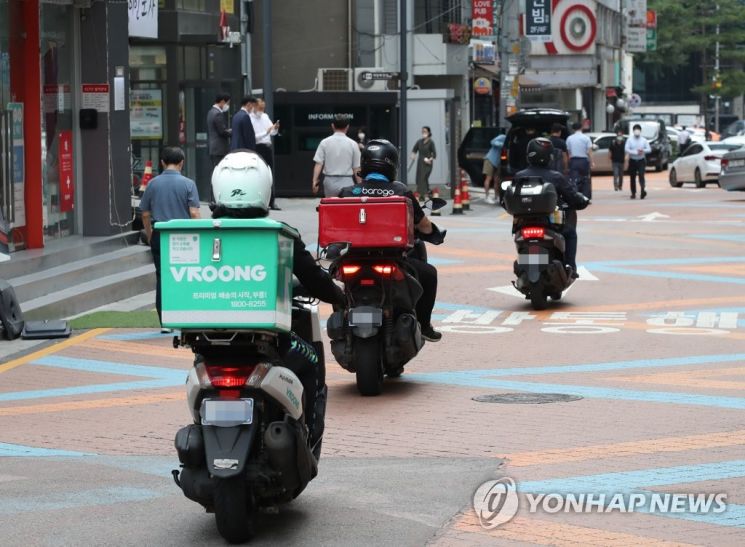 Delivery riders from a delivery agency are making deliveries near Gangnam Station in Seoul.
 [Photo by Yonhap News]
Meanwhile, delivery agencies argue that raising delivery fees is unavoidable due to difficulties in maintaining delivery personnel.
As the delivery market grows, delivery riders have been moving to places offering higher commissions, making it difficult to secure manpower. Especially recently, delivery apps like Yogiyo Plus, Baemin Riders, and Coupang Courier have started direct delivery mediation, further narrowing the position of delivery agencies.
Mr. Kim, who operates a branch of a delivery agency in Seoul, said, "Delivery demand is steadily increasing, so everyone is busy recruiting riders," adding, "Since companies like Coupang have raised riders' wages, we have no choice but to raise delivery fees to prevent riders from leaving." He lamented, "The insurance premiums for riders that the branch must bear are also steadily increasing, which is a significant burden."
Given this situation, there are public calls for delivery agency platforms to step in and regulate delivery fees set by local delivery agencies, which hold the authority to decide fees. However, delivery agency platforms maintain that they cannot intervene in the delivery fees set by local agencies, making it unlikely that delivery fee reductions will be realized easily.
Experts emphasize that the issue of increased burden on consumers and self-employed business owners due to delivery fee hikes should be approached from multiple angles.
Professor Ko Hyungsuk of the Law Department at Sunmoon University said, "From the perspective of consumers and self-employed business owners, costs have increased and burdens have grown, but the system has changed from hiring delivery workers and bearing salary costs to using delivery agency services," suggesting, "We need to consider whether it is simply a matter of increased costs and burdens."
Professor Ko added, "From the consumer's point of view, food prices have increased and delivery fees have appeared, but we also need to consider the perspective of delivery workers," emphasizing, "We should consider whether the previous delivery fees were excessively low and whether the current increase is a normalization of those fees rather than a sudden hike."
© The Asia Business Daily(www.asiae.co.kr). All rights reserved.


















