A Child Suffering from Abuse... Later Endures Aftereffects like ADHD and Depression
If Aftereffects Worsen, 'Cycle of Abuse' Continues... Childhood Victims Grow Up to Become Perpetrators
Current Health Management System for Abused Children Is Inadequate... Active Treatment Needed for Children's Body and Mind
[Asia Economy Reporter Joo-mi Lee] # Miss A was rushed to the hospital emergency room at the age of 4. She had fractured ribs and ruptured pancreas and kidneys. Medical staff suspected that Miss A's mother had kicked and assaulted her daughter, and reported a suspicion of child abuse. Miss A was rescued at that time and has now turned 22 years old. She will live with lifelong aftereffects such as diabetes, post-traumatic stress disorder (PTSD), growth disorders, and loss of labor capacity.
Recently, as shocking abuse cases like the 'Jung-in case' continue, awareness of child abuse is increasing. However, there is still insufficient interest in how abused children are separated from perpetrators and how they are managed afterward. Especially since abuse experienced in early childhood can negatively affect the entire life span, managing the aftereffects of abuse victims is urgently needed.
Abuse leaves deep scars on children's bodies and minds. Research shows that abused children are four times more likely to develop mental illnesses than those who are not abused. According to a study by a research team at the University of Birmingham, UK, published in the international academic journal The Lancet Psychiatry, people who experienced abuse in childhood were four times more likely to develop severe mental illnesses such as schizophrenia and bipolar disorder. The likelihood of developing mild mental illnesses such as depression and anxiety disorders was also more than twice as high.
Additionally, according to the 2015 paper "Prevalence of Mental Disorders in Child Abuse Victims" (published by the Korean Neuropsychiatric Association / Ha Ji-hye, Lim Seong-hoo, Cho Soo-hyun), about 50% of 61 children aged 0-18 with abuse experience suffered from one or more mental disorders. This means that one in two abused children continues to suffer from mental distress afterward. Among these, attention deficit hyperactivity disorder (ADHD) was the highest at 23%, followed by post-traumatic stress disorder (21.3%) and depressive disorder (16.4%).
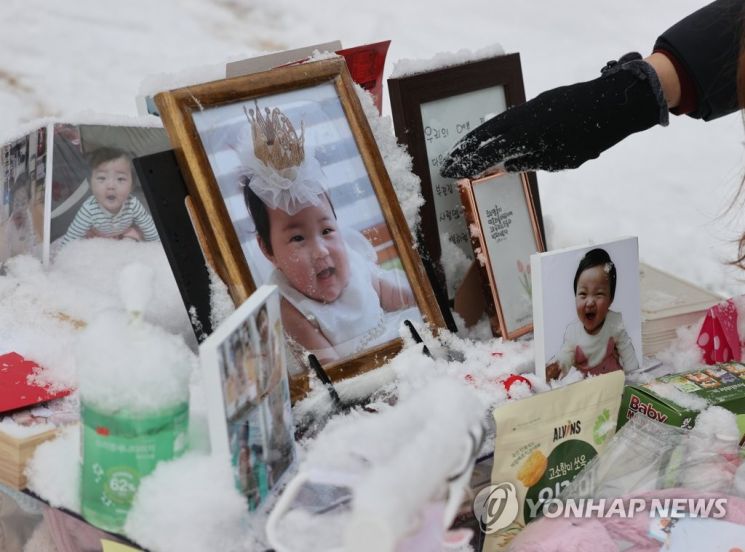 Jeong-in, who died at 16 months old due to abuse by her adoptive parents. Following this case, public anger demanding severe punishment for child abuse has spread.
 [Image source=Yonhap News]
If such aftereffects are not treated in time, it can lead to the tragedy of "abuse inheritance." A child who suffered abuse in childhood eventually becomes a perpetrator and passes on the abuse they received.
The 'Won-young case,' where a stepmother and biological father caused the death of a 7-year-old child through horrific abuse and secretly buried the body, is a representative case of abuse inheritance. Stepmother A revealed that she was abused while growing up between her stepmother and biological father after her parents' divorce during childhood. A professional psychological counselor who interviewed A at the time also diagnosed that "the abuse by the stepmother since childhood accumulated and resulted in 'intergenerational transmission (inheritance).'"
The fact that "abuse inheritance" continues can also be confirmed by statistics. According to the 2019 study "Interrelationship of Abuse Experiences by Life Cycle" by the Korea Institute for Health and Social Affairs, among 2,153 people with experience of domestic violence perpetration, 52.8% had experienced victimization both in childhood and adulthood. 36.7% experienced abuse or other victimization in childhood, and only 9.1% had perpetrated domestic violence despite no victimization experience throughout their life course.
Thus, abuse occurring in childhood not only implants terrible memories and pain at the time but also leaves lifelong aftereffects and eventually pushes victims to become perpetrators. This is why the bodies and minds of children who suffered abuse during what should have been a happy childhood must be actively treated and managed. Systematic and long-term support must be provided so that the wounds from abuse do not hinder their future lives.
 Shin Won-young, who died due to abuse by his stepmother and biological father. At the time, Won-young's stepmother revealed that she had also been abused during her childhood.
 [Image source=Yonhap News]
However, the current post-care health management system for abused children is inadequate. Although the dedicated medical institution system for child abuse was introduced in 2018 to professionally treat abused children and help them recover from physical and mental pain, it is not being properly implemented.
According to Democratic Party lawmaker Kang Seon-woo in February, there are only eight child abuse dedicated medical institutions designated at the city, county, and district levels, and notably, there is not a single medical institution designated by the Ministry of Health and Welfare. Because of this, child protection agencies at the field level separately coordinate with medical institutions to provide medical support for abused children, but it was confirmed that only 401 abused children received support out of a total of 30,045 child abuse cases judged in 2019.
At the same month's forum held by the Korean Medical Association titled "What is Needed in the Health Care System to Prevent Child Abuse," Professor Bae Ki-soo of Ajou University Hospital's Department of Pediatrics and Adolescents pointed out, "Psychological therapy service support (for abused children) ends after six months. The child is still deeply trapped in hell when the treatment stops." He added, "Currently, cooperating institutions are limited to hospitals/clinics, public health centers, mental health centers, and alcohol counseling centers, so there are insufficient cooperating institutions to help abused children," and insisted, "At least a specialized center for post-traumatic stress disorder should exist."
Other experts also emphasize that post-treatment systems for abused children should be more actively implemented.
Professor Kwak Geum-joo of Seoul National University's Department of Psychology said, "Violence in childhood can affect a person throughout their lifetime," and expressed concern, "Especially, violence is learned through experience, so there is a high possibility that abuse will be inherited."
She continued, "A system is needed that not only provides short-term treatment for abused children but also continues long-term treatment and monitors their growth process continuously." Furthermore, she emphasized, "Children from vulnerable groups often face financial burdens for psychological therapy and counseling, so national support for this is necessary."
© The Asia Business Daily(www.asiae.co.kr). All rights reserved.
![User Who Sold Erroneously Deposited Bitcoins to Repay Debt and Fund Entertainment... What Did the Supreme Court Decide in 2021? [Legal Issue Check]](https://cwcontent.asiae.co.kr/asiaresize/183/2026020910431234020_1770601391.png)


















