Korea Research Institute of Standards and Science Quantifies Brainwaves Through Measurement
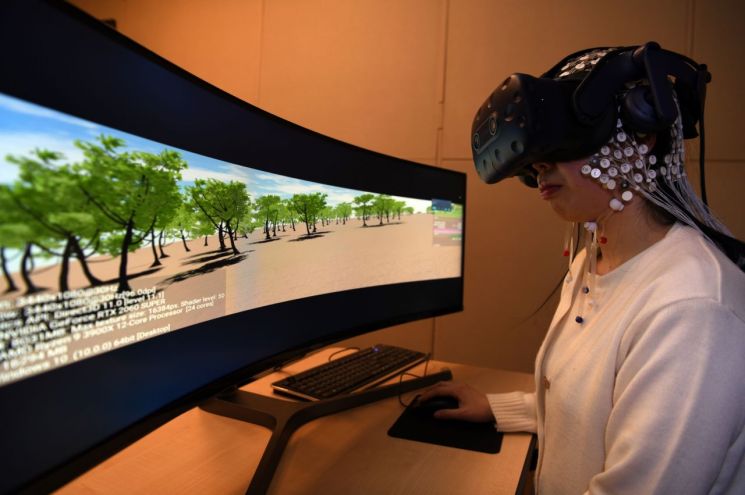 An EEG measurement experiment is being conducted using the 'Cyber Motion Sickness Standard Video' developed by the Korea Research Institute of Standards and Science. Photo by Korea Research Institute of Standards and Science
[Asia Economy Reporter Kim Bong-su] A method to measure the intensity of so-called cyber sickness experienced when using brainwaves to experience virtual reality (VR) has been devised by a domestic research team. It is pointed out that this can be utilized for personalized production in the process of VR content development in the future.
The Korea Research Institute of Standards and Science (KRISS) announced on the 18th that the research team led by Principal Researcher Lim Hyun-gyun at the Safety Measurement Research Institute succeeded in quantitatively measuring cyber sickness caused by experiencing VR using brainwaves.
They quantitatively analyzed and identified consistent changes in specific brain areas and specific brainwaves while experiencing virtual reality visually. Until now, cyber sickness was mainly measured through subjective questionnaires based on personal evaluations, but an objective measurement technique has now been developed.
 Excitation and relaxation recovery patterns measured by brain waves after cyber motion sickness. Provided by Korea Research Institute of Standards and Science.
Virtual reality is rapidly developing and being utilized in various fields such as medical care, gaming, sports, and education. It has very high utility as it allows indirect experience of various technical experiences such as education, surgery, rehabilitation, and training. However, when using head-mounted display (HMD) devices during VR experiences, immersion increases but cyber sickness also increases as a downside.
Cyber sickness is a symptom of dizziness and nausea experienced while watching fast movements on digital device screens. When wearing a goggle-type device and rapidly turning the gaze, the device cannot match the rotation speed, causing screen delay. The accumulated difference between the eye’s visual information and the body’s positional information increases cyber sickness.
To minimize this, the degree of individual sickness must be considered from the content production stage. If cyber sickness can be quantitatively measured and graded like movies, personalized virtual reality content provision could become possible. However, cyber sickness has mainly been evaluated through questionnaires due to the lack of objective and quantitative evaluation methods.
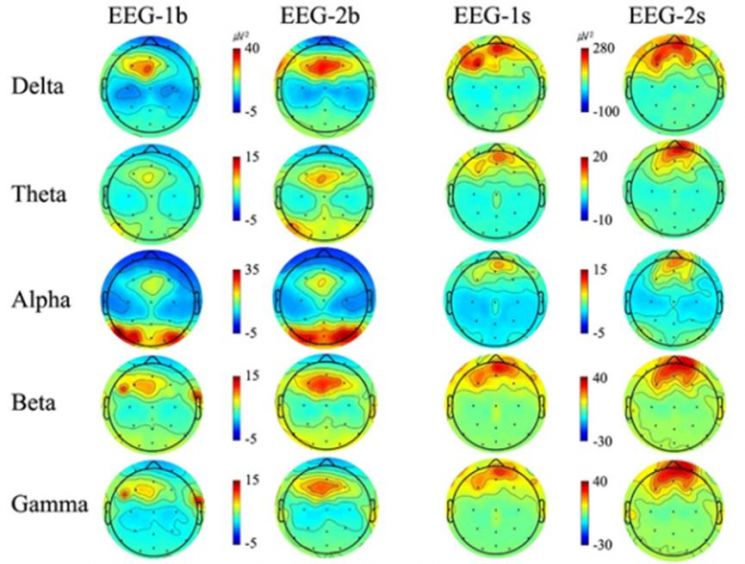 Cyber motion sickness experiment results. Photo by Korea Research Institute of Standards and Science
The most commonly used “Simulator Sickness Questionnaire” asks about dizziness, nausea, disorientation, sweating, vomiting, and vertigo experienced, rated from 0 to 3. However, this is a very subjective evaluation, with a high possibility of inconsistent answers and difficulty in observing immediate changes.
To solve this, the research team devised a method to quantitatively measure cyber sickness using brainwaves. They created a “cyber sickness standard video” and presented it to participants while measuring changes in brainwaves. Brainwaves can be easily and quickly observed in real time for specific events or brainwave changes. Since accurate image data is provided, it has the advantage of being objective and quantitative.
The research team observed whether brainwaves responded consistently when the same stimulus was given to 21 subjects at one-week intervals. In two experiments, they found that the frequency ranges of delta, theta, and alpha waves in specific areas such as the frontal and central regions of the same person were consistent. In particular, the greater the cyber sickness severity, the larger the range of brainwave changes.
Principal Researcher Lim Hyun-gyun said, “We plan to assign cyber sickness grades in future content production and development to utilize them for personalized content creation,” adding, “We will expand the experimental subjects and continue research.”
This research achievement was published online in February in the prestigious international journal Neuroscience Letters.
© The Asia Business Daily(www.asiae.co.kr). All rights reserved.
!["The Woman Who Threw Herself into the Water Clutching a Stolen Dior Bag"...A Grotesque Success Story That Shakes the Korean Psyche [Slate]](https://cwcontent.asiae.co.kr/asiaresize/183/2026021902243444107_1771435474.jpg)


















