Korea Astronomy and Space Science Institute Reveals World's First Observation of Asteroid '2012 TC4'
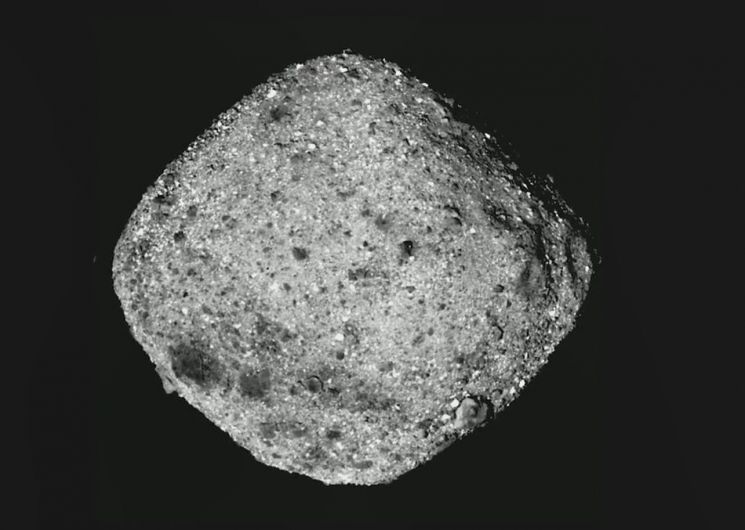
[Asia Economy Reporter Kim Bong-su] Korean researchers have, for the first time in the world, confirmed that the asteroid which twice approached Earth and threatened collision recently exhibited wobbling of its rotation axis and an increase in its spin rate.
The Korea Astronomy and Space Science Institute, together with a research team from Charles University in the Czech Republic, announced on the 18th that they captured the unusual non-principal axis rotation of the asteroid ‘2012 TC4’, unlike typical asteroids, and through analysis of observational data discovered that TC4’s rotation period has accelerated.
Non-principal axis rotation refers to a motion similar to a spinning top wobbling just before it falls. In other words, rotational motion and precession of the spin axis occur simultaneously.
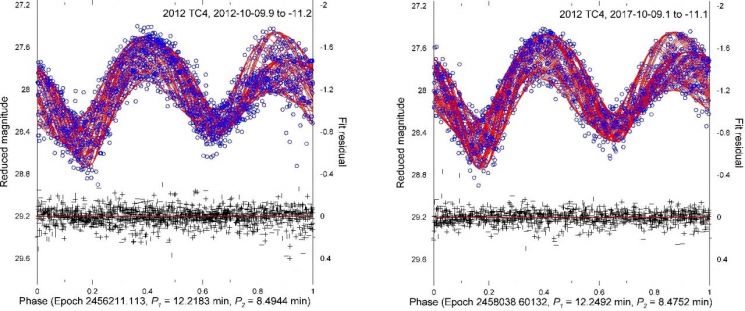 Light curves of asteroid 2012 TC4 in 2012 and 2017. Photo by Korea Astronomy and Space Science Institute
Asteroid TC4 approached Earth at distances of approximately 95,000 km and 50,000 km in 2012 and 2017, respectively. In response, the International Asteroid Warning Network (IAWN), under the United Nations, which tracks near-Earth asteroids to assess collision risks and issue alerts, has mobilized 21 observatories worldwide to monitor brightness changes and other indicators.
Estimated to be 15m x 8m in size, TC4 is relatively small but similar to the asteroid that exploded over Chelyabinsk, Russia, on February 15, 2013, and could cause localized casualties and property damage if it collided with Earth. TC4 has a rotation period of 27.8 minutes and a precession period of 8.5 minutes, making it a rapidly spinning asteroid, and is believed to be composed of highly reflective rocky materials.
The joint research team from KASI and Charles University analyzed the observational data to create a 3D shape model of TC4, revealing that its rotation speed increased by 18 seconds over five years from 2012 to 2017. Since asteroids do not emit their own light but only reflect some sunlight and are small in size, direct observation and study are limited. The researchers reconstructed the 3D model by inversely calculating brightness variations caused by TC4’s rotation reflecting sunlight, thereby confirming that TC4 is a non-principal axis rotating asteroid.
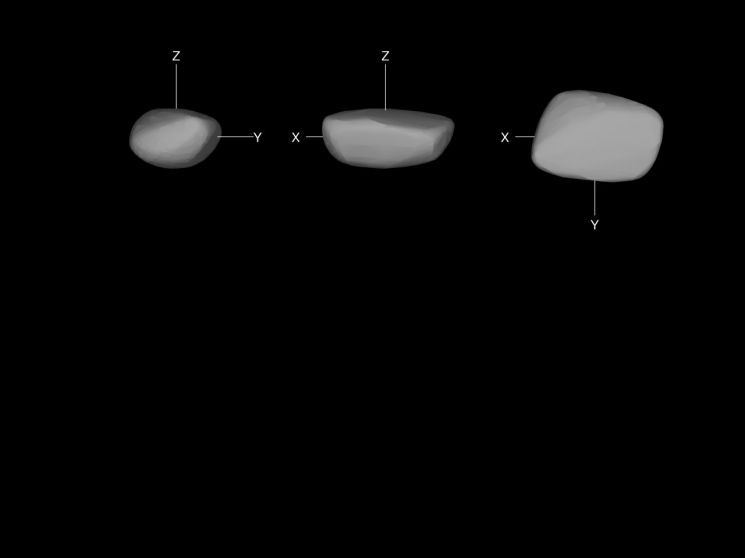
Additionally, by assuming various internal and external factors acting on the asteroid and performing calculations, they confirmed that the main cause of the change in TC4’s rotation state is the YORP (Yarkovsky?O'Keefe?Radzievskii?Paddack) effect, which alters its orbit due to absorption and re-emission of solar energy.
Dr. Lee Hee-jae of KASI stated, “Research on the characteristics of near-Earth asteroids and the YORP effect is very important for early detection and accurate orbit determination of asteroids with high collision potential with Earth,” adding, “Through this study, we have actually confirmed the rotational changes of a non-principal axis rotating asteroid, which will greatly contribute to predicting asteroid collision risks with Earth in the future.”
The results of this study were published in the June 11 issue of the ‘Astronomical Journal’ of the American Astronomical Society.
© The Asia Business Daily(www.asiae.co.kr). All rights reserved.
!["The Woman Who Threw Herself into the Water Clutching a Stolen Dior Bag"...A Grotesque Success Story That Shakes the Korean Psyche [Slate]](https://cwcontent.asiae.co.kr/asiaresize/183/2026021902243444107_1771435474.jpg)


















