"Official Position: Zero Interest Rate Maintained Until 2023"
"Dot Plot Reflects Individual Opinions, Beware of Overinterpretation"
"Tightening Policy Implemented Based on Market Communication"
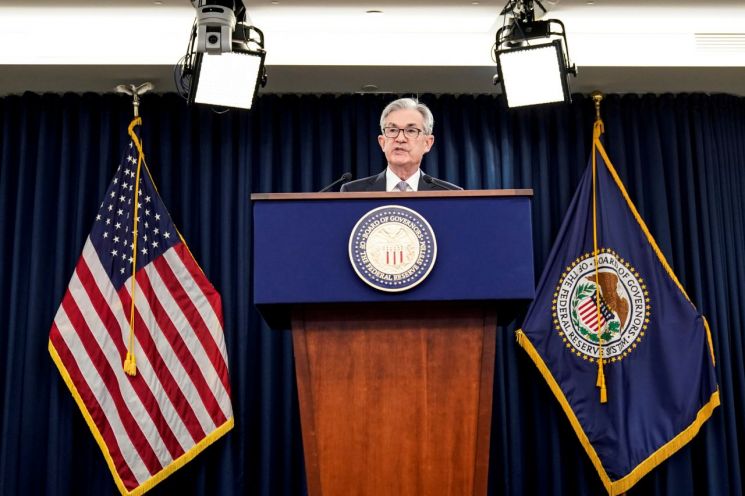
[Asia Economy Reporter Kim Suhwan] Jerome Powell, Chairman of the U.S. Federal Reserve (Fed), stated that the U.S. inflation rate temporarily exceeding 2% would be tolerated and emphasized that the zero interest rate policy would continue through 2023. Amid rising U.S. Treasury yields and growing market concerns about inflation, this is interpreted as a strong signal from the Fed to reassure the market.
At a press conference held immediately after the Federal Open Market Committee (FOMC) meeting on the 17th (local time), Chairman Powell said, "The Fed's goal is to maintain an average inflation rate of around 2%," adding, "We will tolerate inflation temporarily exceeding 2% and maintain zero interest rates."
"Inflation Will Be Temporary"...Dismisses Possibility of Asset Bubble
In his opening remarks at the press conference, Chairman Powell acknowledged that the U.S. economy has entered a recovery phase but emphasized that recovery in certain industries remains slow and unemployment rates are still higher than pre-pandemic levels. He said, "As of February, the unemployment rate was 6.2%, higher than the pre-pandemic level of 3.5%," and added, "Recovery in service industries such as hotels and tourism is still slow."
Accordingly, the Fed plans to continue its current expansionary fiscal policy, anticipating that it will take time to achieve its target of full employment. Powell stated, "There is still a long way to go to achieve inflation and employment targets," and "We are prepared to use all available tools to expedite economic recovery."
Powell predicted that due to a surge in consumer sentiment ahead of economic reopening, the inflation rate could rise to as high as 2.4% this year but reaffirmed that this would be temporary and there is no cause for inflation concerns. He explained, "Last year's inflation rate was quite low, so a base effect could cause higher inflation this year," adding, "This is expected to be short-lived and will not meet our long-term inflation target of 2%."
Furthermore, Powell anticipated that the reduction in unemployment due to economic recovery is unlikely to trigger inflation. He cited the example of 2019, when the unemployment rate was as low as 3.5% but inflation remained absent for several years. He said, "Although wages increased due to lower unemployment, companies did not raise product prices despite losses from wage increases," and "It appears they absorbed wage increases by adjusting profit margins." While unemployment is expected to return to the pre-pandemic level of 3.5% in 2023, this does not necessarily mean a sharp rise in inflation.
In other words, regardless of improvements in unemployment, the inflation rate must be steadily maintained at 2%, and to achieve this, the current zero interest rate policy will continue. Powell emphasized, "We will tolerate inflation somewhat exceeding 2% to achieve our long-term inflation target," and "Discussions on raising interest rates will only begin when data shows a sharp rise in actual inflation."
He also dismissed concerns about the possibility of asset bubbles alongside inflation. Powell analyzed, "Although zero interest rates have been maintained for seven years, debt levels have not increased significantly," and "Our financial market, strengthened by enhanced supervision and regulation, appears to be holding up well."
"Not the Time to Discuss Tapering...Tightening Policies Will Be Based on Market Communication"
Powell ruled out the possibility of pursuing tightening policies such as tapering (reducing asset purchases), which some have expressed concern about. In response to a reporter's question about the possibility of discussing tapering, he said, "Inflation has not yet occurred, and tapering can only be discussed once inflation is visible in actual data," adding, "Even if discussions begin, we plan to inform the market as soon as possible."
Regarding criticism that the Fed's indication of tolerating some inflation is an ambiguous message, Powell proposed strengthening communication with the market as a solution. He stated, "We are well aware of market concerns, and to gain trust, it is important to follow through on what we declare."
He also emphasized thorough preparation against the so-called 'taper tantrum' that caused a global financial market crash following the Fed's interest rate hike in 2013. Powell said, "Through the experiences of the past 12 years, we have recognized the importance of communicating with the market," and "Whatever tightening measures we take, we will give advance signals." This means that based on the experience of the 2013 rate hike that caused turmoil due to insufficient communication with the market, future tightening policies will also be based on communication with the market.
"Dot Plot Reflects Individual Opinions...Cautions Against Overinterpretation"
Powell also cautioned against overinterpreting the dot plot released with the FOMC meeting results, where some members advanced the timing of rate hikes to 2023. He said, "The dot plot is simply a compilation of individual members' opinions," emphasizing, "The important point is that the vast majority of the committee expects no rate hikes until 2023."
He further expressed that current economic uncertainties make it difficult to accurately predict the timing of rate hikes. He said, "With unprecedented levels of economic stimulus and the ongoing COVID-19 pandemic, economic forecasts for the next two years are full of uncertainties," and "It is too early to precisely predict the timing of rate hikes, and the Fed will act based on actual economic data rather than forecasts."
"No Concern Over Rising Treasury Yields"...Declines to Comment on Extension of SLR Exemption
Regarding questions about the Fed's interpretation of the recent sharp rise in long-term U.S. Treasury yields, Powell responded, "According to our analysis, the current financial market situation is positive." He characterized the rise in Treasury yields as a phenomenon caused by a disorderly market and emphasized that the financial market is not actually unstable.
He reaffirmed the stance of maintaining zero interest rates and asset purchase levels regardless of rising Treasury yields, stating, "The current fiscal policy is most appropriate." He also dismissed the possibility of using the 'Operation Twist' strategy, which involves selling short-term Treasury bonds and buying long-term Treasury bonds to lower long-term yields.
Meanwhile, Powell declined to provide a specific answer to reporters' questions about whether the Supplementary Leverage Ratio (SLR) exemption would be extended. The SLR is a regulation requiring banks to hold a certain level of capital before purchasing additional risky assets, including Treasury bonds. Last year, the Fed temporarily exempted the SLR to stimulate investment.
The SLR exemption is effective only until the 31st of this month, and if not extended, banks may be forced to sell Treasury bonds, potentially causing Treasury yields to rise sharply. Powell said, "We will decide on the extension within a few days."
© The Asia Business Daily(www.asiae.co.kr). All rights reserved.
![Clutching a Stolen Dior Bag, Saying "I Hate Being Poor but Real"... The Grotesque Con of a "Human Knockoff" [Slate]](https://cwcontent.asiae.co.kr/asiaresize/183/2026021902243444107_1771435474.jpg)










