In-Depth Analysis of the 3 Major Pledges in the April 7 By-Election - ▶Real Estate ②Jobs ③COVID-19 Support
Evaluation by 6 Real Estate Experts
[Asia Economy Reporters Kim Hyemin and Im Onyu] The Seoul mayoral by-election scheduled for April 7 can be aptly called a ‘real estate election.’ Various opinion polls show that a majority of voters intend to base their votes on ‘candidates’ real estate pledges.’ In response, candidates are promising ‘housing price stabilization’ through massive supply, but some critics have consistently raised concerns about the ‘proliferation of unrealistic pledges.’
Asia Economy, together with six experts from academia and the market, examined the feasibility and expected effects of the real estate pledges proposed by the leading candidates: Park Young-sun of the Democratic Party, Oh Se-hoon of the People Power Party, and Ahn Cheol-soo of the People’s Party.
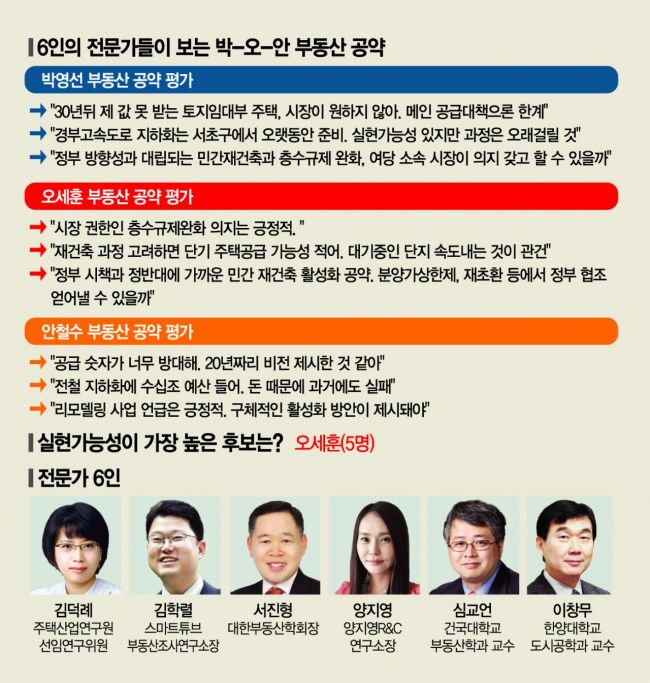
◆ Oh receives the highest evaluation for proposing only pledges that the mayor can realistically implement = Among the six experts, five selected candidate Oh as the one with the most realistic pledges.
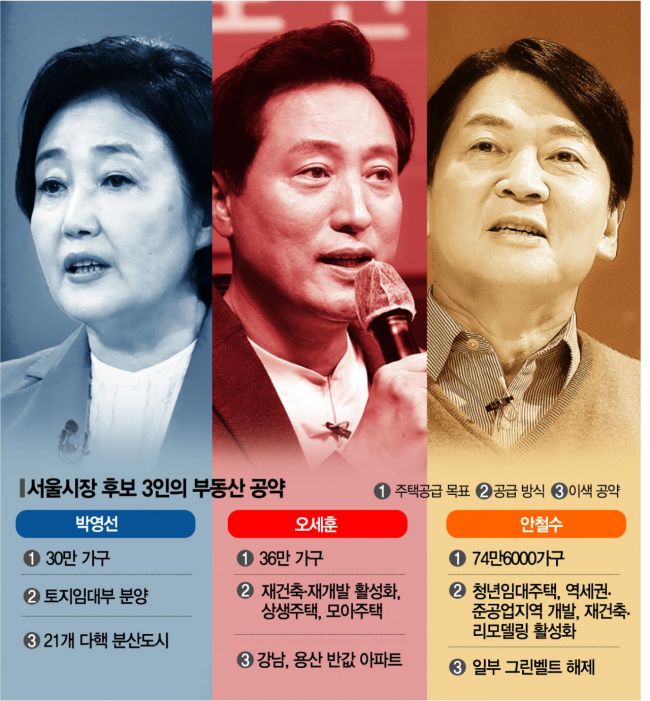
Candidate Oh pledged to supply 360,000 housing units over five years by revitalizing private-led redevelopment and reconstruction. He proposed lifting the maximum floor height restriction of 35 floors, and increasing the floor area ratio (FAR) for residential areas in Seoul, which is currently set lower than the national Land Planning Act. He also promised to abolish the regulation limiting general residential areas in Seoul to buildings under seven floors. Kim Hak-ryeol, head of the SmartTube Real Estate Research Institute, evaluated this as a “seasoned pledge based on market experience.” He said, “Contrary to appearances, the Seoul mayor must comply with the Ministry of Land, Infrastructure and Transport’s control except for what can be decided by city ordinances. It seems that, due to his experience, he only pledged what is feasible.”
Experts particularly praised his willingness to relax the ‘maximum 35-floor restriction along the Han River.’ Professor Shim Gyo-eon of Konkuk University’s Department of Real Estate said, “The floor height restriction created by the previous mayor can be changed if there is the mayor’s will.” The maximum floor height limit for residential buildings can be lifted by revising the 2030 Seoul Plan (the city’s basic urban plan) established by Seoul City.
However, some pointed out that simply lifting the floor height restriction is insufficient to revitalize reconstruction. Kim Deok-rye, senior researcher at the Korea Housing Industry Research Institute, said, “Reconstruction regulations go beyond the city’s authority, including the price ceiling system for sale prices, the excess profit recovery system for reconstruction, and strengthened safety inspections. It is questionable whether cooperation from the central government can be obtained.”
◆ “Park’s half-price apartments target niche markets... unlikely to gain strong market response” = Candidate Park pledged to supply 300,000 half-price apartments priced at around 10 million KRW per pyeong (3.3 square meters) over five years. The plan involves securing space by undergrounding the Gyeongbu Expressway and utilizing city-owned and national land, and supplying affordable public apartments through a land leasehold system. In this system, the contract holder owns only the building portion and does not bear the land cost, enabling lower prices. However, the feasibility of supplying 300,000 units through the land leasehold method is widely considered low.
Senior researcher Kim pointed out, “The plan is to supply 60,000 units annually through public housing alone, but public housing accounted for only 5% of Seoul’s permitted housing supply over the past five years.” Seo Jin-hyung, president of the Korea Real Estate Society, said, “Houses are already perceived as investments as well as residences, so few people would want to own only buildings whose value depreciates over time.” There are also concerns about future conflicts over land rent and reconstruction. Kim said, “The monthly land rent, like monthly rent, will continue to rise, and the cost burden may become controversial later. While the land leasehold method can serve as a pilot model, it clearly has limitations as a core supply policy.”
Relatively, the undergrounding of the Gyeongbu Expressway (from Hannam to Yangjae) is considered more feasible. Professor Shim said, “It has been studied for a long time under the leadership of Seocho District Office, so preparations are well underway.” However, considering procedures such as impact assessments, it may take a long time.
Candidate Park also mentioned revitalizing private reconstruction and relaxing floor height restrictions, but experts expressed doubts about her determination. Professor Shim said, “There is skepticism about whether she can push this through while breaking the difficult relationship with the central government.”
◆ “Ahn’s 746,000 units is a utopian idea” = Candidate Ahn promised the largest supply among the three candidates, with a total of 746,000 units over five years. His proposed measures are also the most numerous. He plans to supply 100,000 youth rental housing units by utilizing old government office sites, and 400,000 units for the 30s, 40s, 50s, and 60s generations through development of station areas and semi-industrial zones and partial greenbelt lifting. He also aims to promote urban maintenance projects such as reconstruction and remodeling.
However, considering that the private housing supply in Seoul this year is about 45,000 units, the target is criticized as excessively inflated. Professor Lee Chang-moo of Hanyang University’s Department of Urban Engineering said, “Annual supply in Seoul is about 40,000 apartments and 70,000 units including non-apartments. Supplying 746,000 units over five years means about 150,000 units per year, which is too high compared to existing supply.” He also criticized the lack of specificity. Senior researcher Kim said, “It feels utopian as it only presents a vision for housing supply. It is difficult to find a ‘how to’ on how to apply it.”
In particular, the pledge to underground national and metropolitan railways and supply youth rental housing on the upper space received much criticism. This plan was attempted in the past but failed due to budget and other reasons. However, Ahn’s pledge lacks alternatives to overturn this. Professor Lee said, “Happy Housing also required huge budgets and eventually failed. Even if the railways are undergrounded, improving accessibility to the site requires a very complicated process, making it difficult to increase cost-benefit.” Kim also pointed out, “It requires tens or hundreds of trillions of won, making it difficult to implement, yet no differentiated strategy is visible.”
However, remodeling revitalization and development of station areas and semi-industrial zones are steadily demanded by the market and recognized as necessary, so if made more specific, they could contribute to housing price stabilization. Yang Ji-young, director of R&C Research Institute, said, “Although the target volume is so large that it seems unrealistic, if detailed considerations are added, it could contribute to housing supply.”
◆ Seoul citizens’ urgent ‘jeonse’ crisis overlooked = All three candidates focus on supply, leading to criticism of insufficient measures for the ‘jeonse’ (long-term lease) crisis. Since the new lease protection law, including the right to request contract renewal and the cap on rent increases, was implemented in July last year, jeonse listings in Seoul have sharply decreased, causing jeonse prices to soar. According to the Korea Real Estate Board, Seoul apartment jeonse prices rose 5.58% last year, the largest increase in five years.
However, aside from candidate Oh’s pledge to supply 70,000 long-term jeonse housing units through cooperative housing, there are no significant pledges. Director Yang said, “If we consider the future direction of housing prices, stabilizing the jeonse market should come first. However, there seems to be a lack of consideration for measures that can definitely affect the jeonse market.”
© The Asia Business Daily(www.asiae.co.kr). All rights reserved.


















