The Complete Revision of the 4·3 Incident Act Passed at the Cabinet Meeting
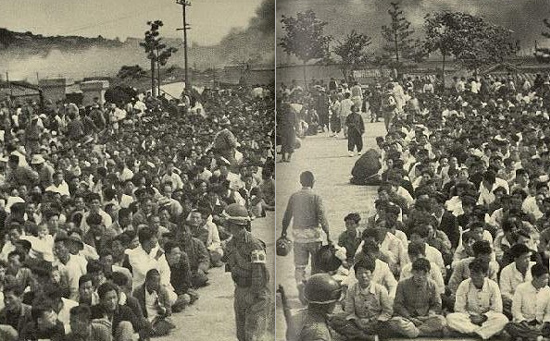 Jeju residents who were arrested by the military and police suppression forces during the Jeju 4.3 incident and were awaiting punishment. Archive photo
[Asia Economy Reporter Lim Cheol-young] The amendment to the "Special Act on the Investigation of the Truth and Restoration of Honor of the Victims of the Jeju 4·3 Incident (4·3 Incident Act)" passed by the National Assembly opens the way for prisoners to restore their honor and receive compensation through special retrials.
On the 16th, the Ministry of the Interior and Safety announced that the full amendment to the 4·3 Incident Act was passed at the Cabinet meeting that day. This amendment was prepared by integrating and adjusting the bills proposed by Oh Young-hoo of the Democratic Party of Korea and Lee Myung-soo of the People Power Party. It is expected to be an important turning point for the complete resolution of the 4·3 Incident issue, which marks its 73rd anniversary this year.
The amendment allows prisoners to restore their honor through special retrials. About 2,500 prisoners who were sentenced through military trials during the 4·3 Incident can now restore their honor through special retrials. When the "Jeju 4·3 Incident Truth Investigation and Victims' Honor Restoration Committee" collectively recommends the ex officio retrial of guilty verdicts to the Minister of Justice, the Minister of Justice may take necessary measures.
The amendment also specifies the grounds for state-level compensation for victims. Article 16 of the amendment states that "the state shall seek special support such as consolation money for those determined to be victims and establish necessary standards."
Accordingly, the Ministry of the Interior and Safety is conducting a research project to establish compensation standards for victims, and plans to pursue additional legislation based on the research results. Currently, the research project is being conducted as a joint research task by the Korea Legislation Research Institute and the Korea Institute of Criminology and Justice, research institutes under the National Research Council for Economics, Humanities and Social Sciences.
Furthermore, measures to ensure the objectivity and credibility of additional truth investigations have been supplemented. Four members (two from the ruling party and two from the opposition) are to be recommended by the National Assembly as committee members, and a separate subcommittee will be established to conduct deliberations on the commencement of additional truth investigations and their results. The results of the additional truth investigations will be reported to the National Assembly.
The state's obligation to support community restoration has also been codified. The amendment stipulates that the state and local governments shall endeavor to heal the physical and mental damages of victims and their families and restore the community, and provides grounds for conducting trauma healing projects.
The passed amendment is scheduled to take effect in June, three months after its promulgation. Minister Jeon Hae-cheol said, "Properly healing Jeju's pain means moving beyond old conflicts and divisions toward a new Republic of Korea," and added, "We will make every effort to ensure that follow-up measures, including special retrials for prisoners and the establishment of compensation standards such as consolation money for victims contained in this amendment to the 4·3 Incident Act, are carried out without fail."
© The Asia Business Daily(www.asiae.co.kr). All rights reserved.
![Clutching a Stolen Dior Bag, Saying "I Hate Being Poor but Real"... The Grotesque Con of a "Human Knockoff" [Slate]](https://cwcontent.asiae.co.kr/asiaresize/183/2026021902243444107_1771435474.jpg)
















