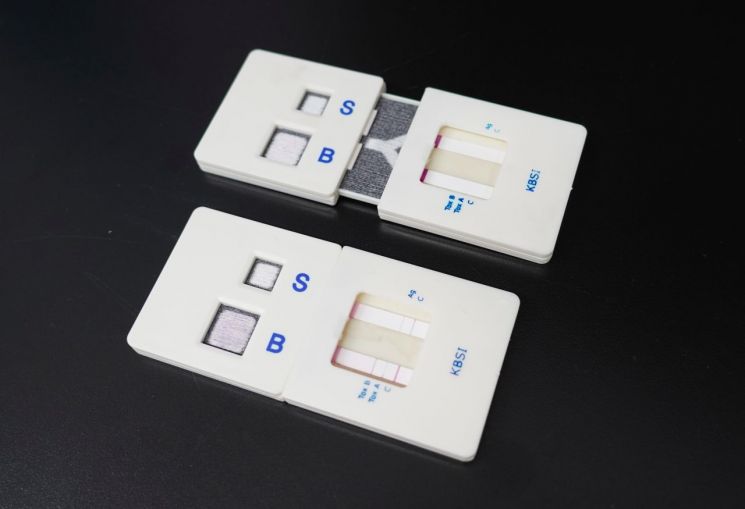
[Asia Economy Reporter Kim Bong-su] Domestic researchers have developed a rapid detection kit that can detect antibiotic-resistant super bacteria on-site.
The Korea Basic Science Institute announced on the 15th that Dr. Choi Jong-soon (Deputy Director) and his research team at the Materials Analysis Research Department developed a rapid detection kit capable of detecting the antibiotic-resistant super bacteria Clostridioides difficile (C. difficile) on-site. C. difficile is an intestinal bacterium that cannot be treated with antibiotics and causes fever, diarrhea, and abdominal pain when infected. In severe cases, it can lead to fulminant pseudomembranous colitis, toxic megacolon, sepsis, and even death. The U.S. Centers for Disease Control and Prevention (CDC) classifies C. difficile as an “Urgent level” highest threat.
The research team developed a highly sensitive multiplex analytical technology for rapid detection of C. difficile and devised a paper-based multiplex analytical device (mPAD) applying this technology.
Since there is currently no clear treatment for C. difficile, rapid and accurate early diagnosis is necessary to prevent the spread of infection. However, current testing methods require three steps?C. difficile antigen test, toxin test, and genetic test on patient stool samples?taking a considerable amount of time. Moreover, the sensitivity of antigen and toxin tests is very low, making accurate and rapid diagnosis difficult.
The mPAD developed by the research team can detect C. difficile within 10 minutes with just one analysis. Even trace amounts of low-concentration C. difficile samples can be detected within up to one hour through high-sensitivity signal amplification. When stool samples from suspected C. difficile-infected patients are dropped onto the mPAD, the presence of one C. difficile biomarker antigen (GDH) and two toxins (Toxin A, B) can be simultaneously visually confirmed.
The research team created hydrophilic and hydrophobic patterns on paper through wax printing and stacked five layers to produce a three-dimensional fluidic channel mPAD. When the patient’s stool sample is dropped into a hole on the mPAD and water is dropped into another hole where reagents are dried for signal amplification, the sample first flows through the fluidic channel, followed by the reagent. The solutions react with gold nanoparticles on the mPAD paper surface, and due to the principle of metal precipitation, measurement sensitivity is amplified, allowing clear color development to be observed. The mPAD’s detection sensitivity is 97%, specificity is 88%, and accuracy is 95%. Being made of paper, it is inexpensive to produce and requires no additional equipment, making it user-friendly.
In this joint research, the team conducted the design, fabrication, characterization of the mPAD, and analysis of actual patient specimens using the mPAD. The research team from Jeonbuk National University Medical School participated in analyzing actual patient specimens using the current standard analysis method and evaluating the mPAD detection analysis.
The research results were published on the 15th in the top-tier analytical chemistry journal Biosensors and Bioelectronics.
Dr. Kwon Yosep of KBSI stated, “This research is an example suggesting the possibility of securing and domesticating the fundamental technology for C. difficile diagnosis,” adding, “Through this research achievement, it will be possible to provide an accurate and inexpensive C. difficile diagnostic method that can replace existing costly testing methods that include genetic tests.”
© The Asia Business Daily(www.asiae.co.kr). All rights reserved.

















