[Asia Economy Honam Reporting Headquarters Reporter Lee Gwan-woo] Gwangju Institute of Science and Technology (GIST) announced on the 15th that Professor Song Young-min's research team from the Department of Electrical, Electronics and Computer Engineering has developed a patch-type wearable healthcare electronic device that solves the heating problem of wearable devices such as smartwatches.
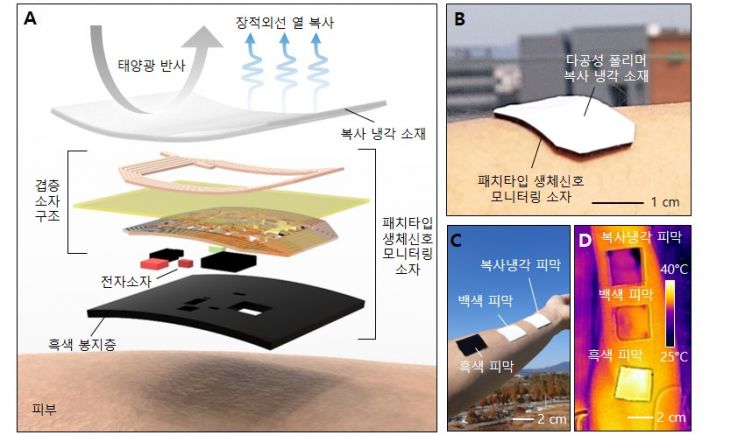
The research team developed a thermally stable wearable electronic device by integrating radiative cooling materials that cool the temperature of objects without external power and wearable optoelectronic devices.
Smartwatches with health management functions such as blood pressure and electrocardiogram measurement have gained more attention since the COVID-19 pandemic brought the establishment of non-face-to-face medical systems to the forefront. However, recently, some smartwatches have experienced unexplained heating and ignition issues, causing widespread controversy.
In wearable electronic devices like smartwatches, to prevent such accidents, a thin metal heat sink is generally inserted inside to dissipate heat generated within the device.
However, this method not only has low cooling efficiency but also reduces the overall flexibility of the wearable electronic device. Moreover, metal heat sinks interfere with wireless power and data transmission, making them unsuitable as a cooling solution.
The research team developed a flexible, ultra-thin radiative cooling material without metal components that can cool the device temperature simply by attachment without energy consumption.
Radiative cooling materials lower the surrounding temperature without external power supply by emitting long-wave infrared radiation.
The newly developed radiative cooling material consists of a harmless polymer containing nano- and micro-sized pores. These pores strongly reflect sunlight (over 97%) and emit internal heat in the form of electromagnetic waves.
Additionally, unlike conventional radiative cooling materials that require metal layers such as silver or aluminum to reflect sunlight effectively, this method operates without metal, thus not interfering at all with wireless power and data transmission of wearable electronic devices, representing a new form.
Professor Song Young-min said, “While previous wearable electronic device research focused on improving mechanical properties and functionality, future improvements must also address heat control issues in wearable electronic devices. The wearable electronic device platform integrated with porous polymer-based radiative cooling materials can overcome existing technical limitations.”
© The Asia Business Daily(www.asiae.co.kr). All rights reserved.

















