Record High Import Value Last Year
Rising Costs of Agricultural Products and Labor
Increase Income for Small Restaurants
Over 99% Imported from China
Surge in Origin Checks and Refund Requests
Due to Unsanitary Napa Cabbage Pickling Video
Strengthen Safety Management to Prevent Defects
Increase Support for Domestic Farms and Industry
 A scene of pit-buried cabbage pickling in the northeastern region of China. / Photo by Internet Community Capture
[Asia Economy Reporter Lim Hye-seon] Working mom Lee Jeong-mi (43, pseudonym) always checks the origin of ingredients whenever she visits a restaurant after watching a video circulating on social media showing Chinese pickled cabbage. She even canceled a weekend order of bossam after realizing late that it used Chinese cabbage. Lee said, "I don't eat food made with ingredients imported from China," adding, "I can't eat it because I'm anxious, not knowing anything about the safety and hygiene management process."
◇Shocked by the video= On the 15th, the aftermath of the video showing Chinese pickled cabbage spread like wildfire. The scene of excavators scooping up cabbage is just the tip of the iceberg. Many people cannot forget the sight of workers swimming through muddy water in containers where the cabbage is being pickled. Although the Chinese side explained that the cabbage is not used for imported kimchi, there are growing calls for the government to strengthen supervision and management of Chinese food products.
Kim Cheol-soo (52, pseudonym), who runs a restaurant serving set meals in Yeongdeungpo, Seoul, said, "We use Chinese kimchi because of the price, but more customers are checking the origin labels before leaving," adding, "Sales have been cut in half due to the COVID-19 pandemic, and now we can't even get five groups during lunchtime."
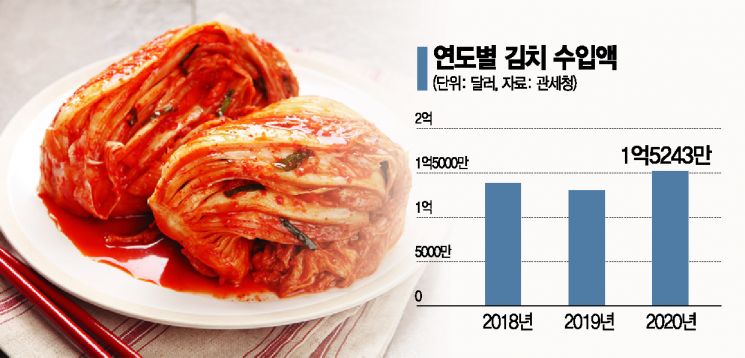
◇300,000 tons imported and distributed last year= According to the Korea Customs Service, kimchi import value last year was $152.43 million, a 16.4% increase from the previous year ($130.91 million), marking an all-time high. As prices of agricultural and marine products surged and labor costs rose, small restaurants faced difficulties, leading to a significant increase in kimchi imports.
More than 99.0% of kimchi entering Korea is from China. Of the total kimchi import value last year, $152.42 million came from China. The estimated annual domestic kimchi consumption is 1.8 million tons, of which 300,000 tons are Chinese kimchi.
The majority of small restaurants rely on Chinese kimchi. While some make kimchi themselves, when including those that import red pepper powder and pickled cabbage from China, over 90% of all restaurants serve kimchi made with Chinese ingredients.
◇10 kg for 10,000 won on open markets= The price of Chinese kimchi is less than 10,000 won for 10 kg, less than one-third the price of domestic kimchi. Because it is so cheap, it is also distributed to ordinary households. Chinese kimchi sold on major open markets, including Naver Smart Store, has faced a flood of refund requests following the pickled cabbage video scandal.
Kimchi sold by small and medium food companies is priced between 20,000 and 30,000 won for 10 kg. Most raw materials such as cabbage, radish, and onions are domestic, but red pepper powder and sea salt are imported from China. Domestic products from companies like Daesang Jonggatjip, CJ CheilJedang Bibigo, and Pulmuone are made with 100% domestic ingredients. Their prices reach around 40,000 won, about four times that of Chinese kimchi.
◇"Safety management must be strengthened"= This is not the first time safety issues with Chinese kimchi have surfaced. In 2005, lead was detected in kimchi imported from China, followed by the discovery of parasite eggs, which spread a 'kimchi phobia.' The Ministry of Food and Drug Safety took measures to suspend imports from 36 out of 112 imported kimchi manufacturers with poor hygiene conditions by last year. More than 30% of imported kimchi producers have been producing substandard kimchi. As this situation repeats annually, the Ministry plans to strengthen kimchi safety management from local production in exporting countries to domestic distribution and will mandate food safety management certification standards starting in 2024.
An industry insider emphasized, "While the debate over the origin of kimchi continues, imports of substandard kimchi are increasing," adding, "The government needs to provide various supports to enhance the competitiveness of Korean farms and help mid-sized kimchi companies gain an advantage over Chinese imported kimchi."
© The Asia Business Daily(www.asiae.co.kr). All rights reserved.


















