Last Year, 160,000 People Learned Korean at 1,699 Schools in 39 Countries
This Year, 23.6 Billion Won Support Planned, Double Last Year
Full Implementation of TOPIK Internet Test from 2023
[Asia Economy Reporter Han Jinju] Despite COVID-19, the enthusiasm for learning Korean has not waned. The government will support Korean language education in 1,800 schools across 43 countries this year.
On the 14th, the Ministry of Education announced the "2021 Overseas Korean Language Education Support Project Basic Plan," which supports learning Korean as a regular foreign language subject in overseas elementary and middle schools. This year, the budget has doubled from the previous year to 23.6 billion KRW, expanding support mainly to New Southern and New Northern countries where demand is rapidly increasing.
Last year, 160,000 people learned Korean in 1,699 schools across 39 countries. Guatemala, Denmark, Latvia, Rwanda, Sri Lanka, Afghanistan, the Czech Republic, Turkey, and Laos were added as new countries. Vietnam, a key partner in the New Southern region, started pilot education in 2016 and adopted Korean as the first foreign language in February this year. In Vietnam, Korean is taught on an equal footing with six other languages including English and Chinese, and can be chosen as a subject for university entrance exams.
This year, focused support will be given to three countries including Jordan, Belgium, and Ecuador, as well as pilot education countries such as Laos and Cambodia, where demand is high. The Korean language curriculum for overseas elementary and middle schools will be developed to provide direction for Korean language education, and based on this, Korean language textbooks will be developed and distributed. The goal is to establish Korean language classes in 2,000 schools across 45 countries by 2022.
The new elementary and middle school Korean language curriculum is subdivided into eight levels according to proficiency, following the Common European Framework of Reference for Languages (CEFR). For countries without their own Korean language curriculum, intermediate and beginner textbooks will be developed based on the curriculum developed by our government, and for countries with existing curricula, customized textbook development will be supported in consultation with local authorities. Digital textbooks will be supported, and supplementary materials to enhance understanding of Korean history and culture will also be developed.
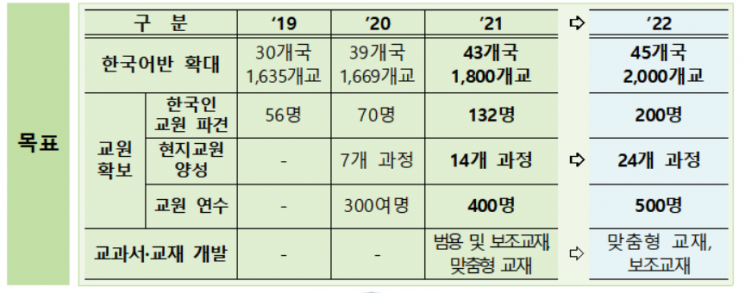
The Ministry of Education plans to expand 14 teacher training programs, dispatch 132 teachers, and provide training for up to 400 people this year. By 2022, the goal is to expand to 24 local teacher training programs, dispatch 200 teachers, and provide training for 500 people. To cultivate local Korean language teachers, degree programs will be supported at seven local universities each in the New Southern and New Northern regions. To train key teaching personnel, support will be provided for local teachers to obtain degrees at domestic universities through the Government Scholarship Program (GKS).
This year, 132 native Korean language teachers will be dispatched mainly to the New Southern and New Northern regions. Korean language teachers refer to those who have obtained at least a Level 2 Korean language teacher certificate and hold a bachelor's degree or higher. For a total of 400 teachers in the New Southern and New Northern regions, integrated regional training and customized local training will be provided to strengthen the capabilities of local teachers.
In response to the increasing demand for the Test of Proficiency in Korean (TOPIK), the test will be fully implemented as an internet-based exam in 2023 to expand testing opportunities. The introduction of speaking assessments and a question bank system is also being prepared. The Enforcement Decree of the Higher Education Act will be amended to establish grounds for test timing and sanctions against cheating.
Deputy Prime Minister and Minister of Education Yoo Eun-hye said, "The expansion of Korean language education despite COVID-19, such as Vietnam approving Korean as the first foreign language, shows that the demand is high and stable," adding, "We will cooperate with local education authorities to expand support so that students in all countries wishing to learn Korean can do so systematically."
© The Asia Business Daily(www.asiae.co.kr). All rights reserved.


















