Siemens, Philips, and Other Global Companies Form Successive Partnerships
AI Medical Devices Supplied to Mongolia and Indonesia
Research Papers Presented at Prestigious International Pathology Conferences
[Asia Economy Reporter Junhyung Lee] Domestic medical artificial intelligence (AI) venture companies are actively starting to expand overseas. JLK, VUNO, and Lunit are representative examples.
JLK, Participates in ECR for 3 Consecutive Years and Partners with Siemens
JLK, the first domestic medical AI company to be listed on KOSDAQ, participated in the 'European Congress of Radiology (ECR) 2021' for the third consecutive year this month. ECR is the largest radiology exhibition in Europe, attended by radiology specialists and medical solution company representatives worldwide. At ECR 2021, JLK showcased its all-in-one platform 'AIHuB' equipped with 37 medical solutions and the stroke analysis solution 'UNISTRO'.
Collaboration with global companies also continued. JLK recently signed an official channel partnership agreement with Siemens Industry Software. Through this agreement, JLK will collaborate on product development and sales by integrating AI technology into Siemens Industry Software's cloud-based platform.
JLK also entered the Indonesian medical AI market. The company registered three medical AI solutions with the Indonesian Ministry of Health (MOH). Indonesia has a population of approximately 270 million, ranking fourth in the world, but its medical infrastructure is significantly lacking. For this reason, the local government's interest in medical AI solutions is quite high, according to JLK. Previously, in July last year, JLK supplied a portable lung disease analysis system, 'HandMed-JViewerX', to an Indonesian company.
VUNO Supplies Solution to Mongolia National Center for Communicable Diseases with WHO Support
VUNO, the second company in the industry to be listed last month, recently supplied its AI-based chest X-ray image interpretation solution, 'VUNO Med-Chest X-ray', to the Mongolia National Center for Communicable Diseases (NCCD). According to VUNO, the Mongolia NCCD requested the solution from the World Health Organization (WHO) due to increased demand for chest disease screening caused by COVID-19 and other factors, and the solution was introduced with WHO's approval and support.
In 2017, Mongolia NCCD also conducted clinical trials locally for VUNO's AI-based sexually transmitted infection diagnostic solution. After a one-year verification period, this solution was introduced to major national hospitals in Mongolia.
Lunit Secures 50% of Global X-ray Market and Presents Paper at World Pathology Conference
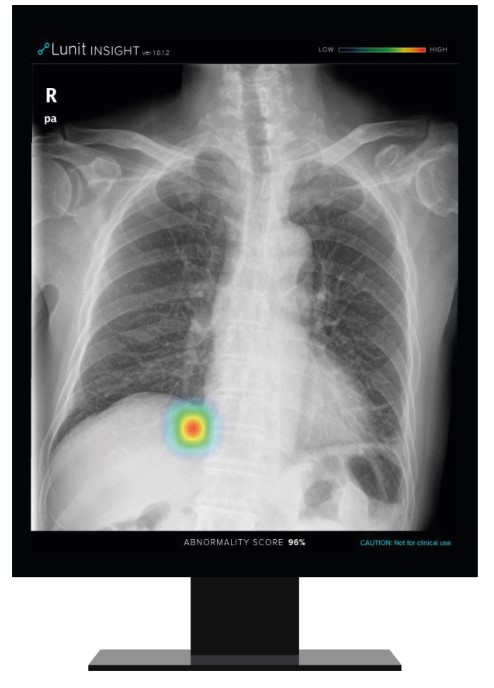
Lunit recently signed a partnership with Philips headquarters. Through this partnership, Lunit's lung disease diagnostic support software 'Lunit Insight CXR' will be integrated into Philips' chest X-ray diagnostic platform and supplied to medical sites worldwide. Philips is considered one of the top three global medical device companies alongside GE Healthcare and Siemens. According to the industry, Philips holds about a 20% share of the global chest X-ray market. Daan Van Manen, General Manager of Philips Diagnostic X-ray Division, praised Lunit's technology, stating, "The diagnostic accuracy and efficiency of Lunit's AI algorithm have already been proven through international academic journals."
Previously, Lunit also formed partnerships with GE Healthcare and Fujifilm, Japan's largest medical imaging equipment company. Following these two companies, the partnership with Philips has secured a distribution channel covering about 50% of the global X-ray market, according to Lunit.
Additionally, on the 15th (local time), Lunit will present a research paper on the accuracy and practical applicability of its AI-based tissue analysis platform 'Lunit Scope IO' at the United States and Canadian Academy of Pathology (USCAP). USCAP, celebrating its 110th session this year, is the world's largest pathology conference. Over 4,000 experts, including those from global pharmaceutical companies such as AstraZeneca, gather to share the latest research and information on pathology.
The research presented focuses on comparing and verifying the accuracy of immune phenotype classification of cancer patients between Lunit Scope IO and pathology specialists. Lunit conducted the study in collaboration with pathology research teams from Samsung Seoul Hospital, Seoul National University Bundang Hospital, and Ajou University Hospital.
The study results showed that for non-small cell lung cancer patients, the group of pathology specialists had an average accuracy of 80.5%, while Lunit's AI platform showed 92.4% accuracy. Professor Seokhwi Kim of Ajou University Hospital's Department of Pathology, who led the research, stated, "Immune phenotype classification through tissue analysis is a very important factor in predicting responses to immuno-oncology drugs. The accuracy of Lunit Scope IO demonstrates that AI can play a significant role in patient treatment."
© The Asia Business Daily(www.asiae.co.kr). All rights reserved.

















