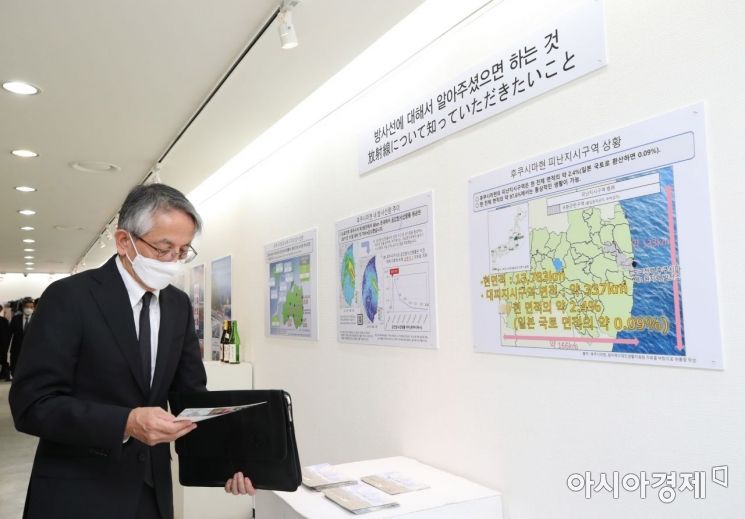
 Koichi Aiboshi, Ambassador of Japan to Korea, is viewing the Great East Japan Earthquake Disaster Reconstruction Exhibition after attending the commemorative event "10 Years Since the Great East Japan Earthquake: Gratitude and Revival" held at the Public Affairs and Cultural Center of the Embassy of Japan in Jongno-gu, Seoul on the afternoon of the 11th. 2021.03.11 Photo by Joint Press Corps
[Asia Economy Reporter Oh Hyung-gil] On the 11th, the Japanese government expressed gratitude for the support sent by Korea during the Great East Japan Earthquake 10 years ago and stated that the contaminated water (treated water) stored in tanks on the site of the Fukushima Nuclear Power Plant is a challenge that must be resolved one way or another.
However, it expressed regret over the Korean government's continued import restrictions on Japanese food products.
The Embassy of Japan in Korea held a commemorative event titled "10 Years Since the Great East Japan Earthquake: Gratitude and Revival" at the Public Information and Culture Center in Jongno-gu on the same day. The embassy conveyed thanks to Korea for supporting disaster recovery and reported on the current status and revival process of the disaster area.
Koichi Aiboshi, the newly appointed Ambassador of Japan to Korea, said in Korean during his greeting, "When we were in deep sorrow and pain, the Korean people sent us generous warmth and support," adding, "I sincerely thank the Korean people once again for the various support we have received since the disaster occurred."
Ambassador Aiboshi explained that recovery in the affected areas is steadily progressing, but "there are still challenges to be resolved. These include revival and regeneration from the nuclear disaster, especially issues related to Japanese food products and the ALPS (Advanced Liquid Processing System) treated water from Tokyo Electric Power Company's Fukushima Daiichi Nuclear Power Plant."
He stated, "It is a challenge that must be overcome in order to achieve the true revival of Fukushima," and claimed, "Regarding Japanese food products, strict standards have been introduced worldwide, thorough food inspections are conducted, and only foods proven to be safe are distributed."
He continued, saying that immediately after the nuclear accident, 54 countries and regions imposed import restrictions on Japanese food products, but 39 have lifted the restrictions and 13 are working on easing them, adding, "Regrettably, import restrictions are still in place in Korea."
Regarding the treated water from the Fukushima nuclear power plant, he reiterated the existing position, saying, "The Japanese government has not yet decided on the policy for its treatment method, but we will respond in accordance with international standards, fully considering the impact on the environment, human health, and safety, and meeting regulatory standards."
© The Asia Business Daily(www.asiae.co.kr). All rights reserved.

















