68 Cases from California, USA and 3 from New York, 4 Cases Originating from Nigeria Confirmed
"Transmission Rate and Severity Not Yet Significantly Confirmed... Monitoring Strengthened"
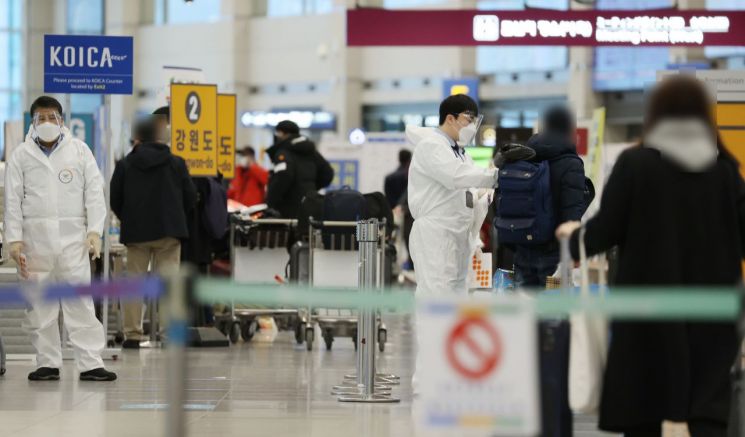
[Asia Economy Reporter Kim Ji-hee] The Central Disease Control Headquarters announced on the 11th that 68 cases of variant viruses originating from California, USA, have been identified since December last year. Variant viruses originating from New York, USA, and the UK and Nigeria have also been confirmed, with 3 and 4 cases respectively since February this year, bringing the total number of other variant virus cases to 75.
Other variant viruses refer to variants observed in some countries with increasing patient numbers but whose clinical and epidemiological risks have not yet been confirmed. The California-origin variant virus (452R.V1) accounts for 23 imported cases, the New York-origin variant virus (B.1.526) accounts for 3 imported cases, and the UK and Nigeria-origin variant virus (484K.V3) accounts for 4 imported cases. Of the 30 imported cases, 19 were identified during quarantine, and the remaining 11 were detected through tests conducted during self-isolation after entry.
Kwon Jun-wook, Deputy Director of the Central Disease Control Headquarters, stated, "The main concerns regarding variant viruses are increased transmissibility, severity, mortality, and vaccine resistance. However, for other variants, significant implications in these key aspects have not yet been confirmed." He added, "While continuously monitoring the variant situation, we have observed a slight increase in cases overseas, even if classified as 'other.' Variants named after California, New York, the UK, and Nigeria have been identified and immediately recorded and disclosed upon discovery."
Earlier, the World Health Organization announced a classification system for other variants in addition to the major existing variants starting from the 25th of last month. The health authorities explained that they classified and organized variant cases they had been monitoring according to the WHO classification, which led to the identification of these cases.
Deputy Director Kwon further stated, "At this point, there is no need to fear or feel threatened by other variants on the same level as the three major variants." He added, "Since variant viruses can be introduced from overseas at any time, we have prepared measures to strengthen entry management accordingly."
Among other variants, the California variant has 45 domestically confirmed cases, not imported. All are Korean nationals, with 43 linked to 11 cluster cases and 2 individual cases. All were identified during the domestic surveillance process for variant viruses.
In February, 12 variants were identified in a cluster related to a family gathering during the holiday in Uiseong-gun, Gyeongbuk Province, and 9 cases were confirmed in a family and acquaintance cluster in Seo-gu, Incheon. Four cases were reported in a hospital cluster in Donghae and Gangneung from December last year. Additionally, confirmed variant virus cases were found in clusters related to a bathhouse in Gangneung, a hospital in Donghae, a multicultural center in Donghae, a sports facility in Dong-gu, Daegu, and a postpartum care center in Jeju.
Notably, the connection between these cluster cases and overseas entrants has not yet been confirmed. Epidemiological investigation team leader Park Young-jun said, "The inability to detect infections during quarantine coincides with the period when tests were conducted before releasing all entrants from quarantine, so evaluation is needed." He added, "Testing before quarantine release for all overseas entrants began around December last year, and before that, additional introductions through some overseas entrants are also being considered."
He also explained, "For the two individual cases, the presumed infection routes have not been identified. It is currently difficult to specify the exact timing, but it is believed that the spread started from overseas importation and then propagated further into the community through additional transmission."
The health authorities plan to strengthen responses to suppress the community spread of variant viruses. To enhance the effectiveness of self-isolation management for overseas entrants, they will organize special inspection weeks for local governments and strengthen monitoring. They also urged the use of networks such as foreigner communities and foreign embassies in Korea to promote compliance with self-isolation rules and sanctions for violations. Furthermore, considering that airline crew members are exempt from self-isolation and could become blind spots in variant virus control, they plan to prioritize COVID-19 vaccination for them. The authorities will continue to monitor vaccine effectiveness against variant viruses and development status to establish related vaccine strategies.
Meanwhile, major variant viruses previously identified in Korea, including those from the UK, South Africa, and Brazil, have increased to a cumulative total of 182 cases since last October. The UK variant accounts for 154 cases, the South African variant 21 cases, and the Brazilian variant 7 cases.
© The Asia Business Daily(www.asiae.co.kr). All rights reserved.
![Clutching a Stolen Dior Bag, Saying "I Hate Being Poor but Real"... The Grotesque Con of a "Human Knockoff" [Slate]](https://cwcontent.asiae.co.kr/asiaresize/183/2026021902243444107_1771435474.jpg)
















