Investigation by Ministry of Science and ICT and National Information Society Agency
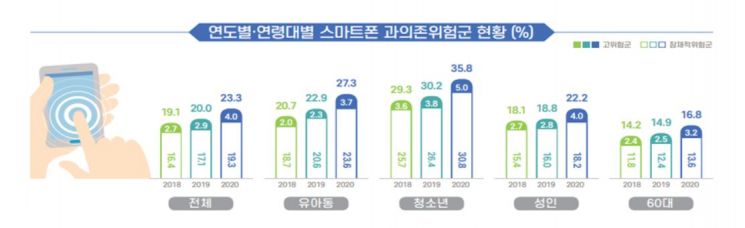
[Asia Economy Reporter Cha Min-young] A survey revealed that more than 23 out of 100 citizens belonged to the smartphone overdependence risk group last year. In particular, the increase rate among adolescents was steep, indicating an urgent need for preventive education tailored to younger age groups. During the same period, digital accessibility improved for marginalized groups such as low-income households, farmers, and people with disabilities, reducing the digital information gap.
The Ministry of Science and ICT and the National Information Society Agency (NIA) announced on the 10th that the results of the 2020 surveys on the 'digital information gap' and 'smartphone overdependence' showed these trends.
The smartphone overdependence survey was conducted through one-on-one interviews with 10,000 households across 17 cities and provinces nationwide. The digital information gap survey was conducted via one-on-one interviews with 15,000 vulnerable individuals nationwide, including low-income groups, people with disabilities, farmers and fishermen, and the elderly.
Smartphone Overdependence Risk Up 3.3%p Year-on-Year
The proportion of smartphone users in the overdependence risk group (high-risk and potential risk groups) was 23.3%, an increase of 3.3 percentage points from 20.0% the previous year. The overdependence risk rate among young children (ages 3?9) rose by 4.4 percentage points to 27.3%, adolescents (ages 10?19) increased by 5.6 percentage points to 35.8%, adults (ages 20?59) rose by 3.4 percentage points to 22.2%, and those in their 60s increased by 1.9 percentage points to 16.8%.
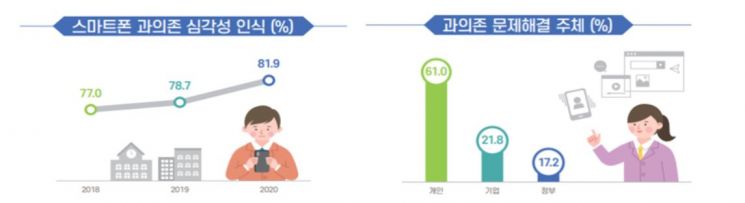
The proportion of respondents who felt that smartphone overdependence was a serious problem also increased. 81.9% of survey participants answered that it was 'somewhat or very serious,' up 3.2 percentage points from the previous year. Regarding who should address the overdependence issue, individuals accounted for 61.0%, companies 21.8%, and the government 17.2%, indicating that smartphone users themselves are perceived as the most important actors.
Digital Vulnerable Groups’ Informatization Up 2.8%p Year-on-Year
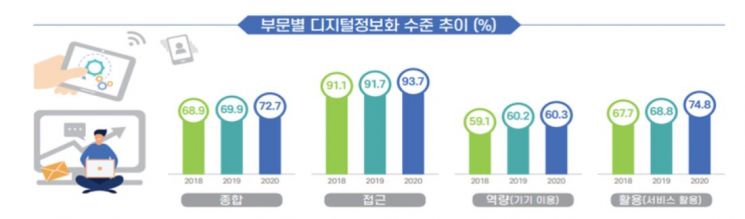
The digital information gap is showing a positive trend of narrowing. The informatization level of digitally vulnerable groups compared to the general public was 72.7%, an improvement of 2.8 percentage points from 69.9% the previous year. Digital access level rose by 2.0 percentage points to 93.7%, competency level increased by 0.1 percentage points to 60.3%, and utilization level grew by 6.0 percentage points compared to the previous year.
Improvements were observed across different groups. The informatization level of low-income groups rose by 7.3 percentage points to 95.1%, people with disabilities increased by 6.1 percentage points to 81.3%, farmers and fishermen rose by 6.7 percentage points to 77.3%, and the elderly increased by 4.3 percentage points to 68.6%.
Extending Digital Learning Center Operation Period... Also Overdependence Education
The Ministry of Science and ICT will extend the operation period of the 'Digital Learning Center' project, which is part of the 'Digital Social Safety Net Enhancement (Korean New Deal),' by 4 months to 9 months this year compared to last year. More than 70% of the curriculum will focus on basic and life education to reduce the information gap.
Measures to prevent smartphone overdependence will also be implemented. Education and counseling will be provided at 'Smart Sleep Centers' in 17 cities and provinces nationwide. A budget of 400 million KRW, ten times that of last year, will be allocated to develop and distribute customized preventive content for younger age groups (young children and adolescents). Mobile overdependence education and counseling linked with the Digital Learning Centers will also be conducted.
© The Asia Business Daily(www.asiae.co.kr). All rights reserved.



















