Samsung Electronics Increased Semiconductor Workforce by 4,700 Last Year, Approaching 60,000
Semiconductor Staff Grew 35% Over Past 5 Years
Industry Improvement Expected to Drive Large-Scale Hiring This Year
[Asia Economy Reporter Suyeon Woo] Samsung Electronics increased its semiconductor workforce by about 8% last year compared to the previous year, marking the largest employment growth rate since the supercycle. Last year, Samsung Electronics' semiconductor workforce approached a record high of 60,000 employees, and with rising expectations for industry improvement this year, employment creation is expected to increase across all sectors, including semiconductors.
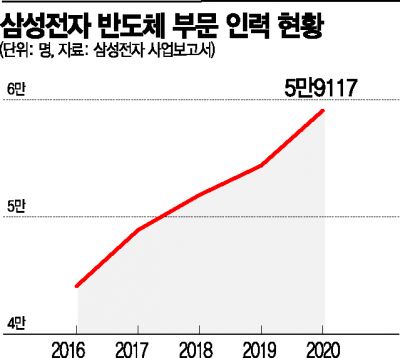
According to the business report disclosed by Samsung Electronics on the 10th, the semiconductor division (DS) workforce reached 59,117 last year, an 8.6% increase from the previous year. This is the first time since 2017, when the semiconductor workforce grew by 10.9% during the supercycle, that the increase has exceeded 8%.
The Samsung Electronics DS division workforce (based on regular employees) was only about 43,488 in 2015, just five years ago, but it increased to 59,117 last year, bringing the number close to 60,000 this year. Over the past five years, the number of regular employees in the semiconductor division has grown by approximately 35%.
Samsung Electronics has been increasing its workforce reflecting the semiconductor supercycle market conditions that lasted from the second half of 2016 to the end of 2018. The workforce expanded by between 5% and 10% annually, with 10.9% in 2017, 6.2% in 2018, and 4.8% in 2019.
Last year, when 4,700 employees were added, Samsung Electronics conducted experienced hires across 51 job roles in 10 organizations, including the Memory Business Division, System LSI Business Division, Foundry Business Division, and the semiconductor research institute. While Samsung Electronics has regularly recruited experienced professionals, last year was the first time it issued a large-scale announcement and hired a large number of experienced workers all at once.
With the industry improvement trend becoming clearer this year, Samsung Electronics' semiconductor experienced and new graduate recruitment is expected to increase. In February this year, Samsung Electronics announced recruitment for 42 job roles across 10 semiconductor business divisions and is currently conducting the selection process. Due to intensified competition for talent in the semiconductor industry recently, it is anticipated that the scale of this experienced recruitment will reach triple digits.
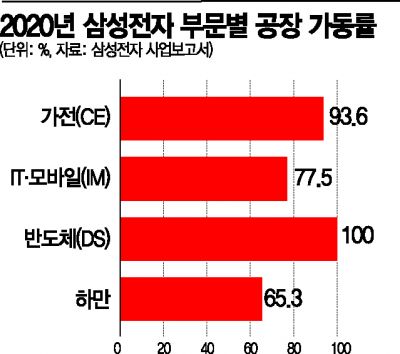
Driven by increased demand for non-face-to-face (untact) services due to COVID-19, Samsung Electronics increased its workforce mainly in the semiconductor and home appliance divisions, resulting in a record-high total of 108,880 employees last year. The factory operation rates by business division last year were 100% full operation for both memory semiconductor and display factories, 93.6% for home appliance factories, 77.5% for IT and mobile factories, and 65.3% for Harman.
A Samsung Electronics official stated, "Despite the impact of COVID-19 last year, the memory semiconductor factories operated at full capacity, and the display factories also achieved 100% operation due to industry improvement," adding, "The foundry (semiconductor contract manufacturing) factory operation rate is not separately announced as it reflects customer order fluctuations."
Meanwhile, not only employment but also Samsung Electronics' research and development (R&D) expenses exceeded 20 trillion won last year, reaching a record high. Last year's R&D expenses amounted to 21.2292 trillion won, an increase of over 1 trillion won compared to the previous year. The proportion of R&D expenses relative to total sales also showed an increasing trend over the past four years, reaching 9%.
Facility investment last year totaled 38.5 trillion won, the largest scale since the 43.4 trillion won supercycle investment in 2017. Of this, semiconductor facility investment accounted for most at 32.8915 trillion won, while 3.8895 trillion won was invested in the display division.
For memory semiconductors, investments increased in advanced process transitions and expansions, while foundry investments expanded mainly around the EUV 5nm process. Display investments also increased focusing on expanding QD display production capacity and new small-to-medium-sized technology processes. This year, Samsung Electronics plans to continue expanding investments focusing on the expansion and transition of leading-edge processes in memory and system semiconductors, infrastructure investments, and display expansion.
© The Asia Business Daily(www.asiae.co.kr). All rights reserved.



















