Consumer Alert Issued for 'Caution' Level
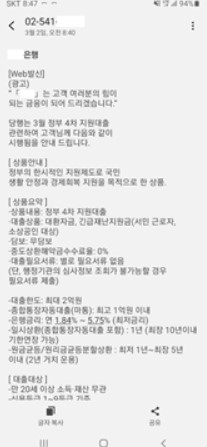
[Asia Economy Reporter Park Sun-mi] There is a growing need for caution as voice phishing attempts disguised as the government's 4th disaster relief fund payments and COVID-19 vaccinations are on the rise.
On the 9th, the Financial Supervisory Service (FSS) issued a consumer alert at the "caution" level, pointing out that voice phishing attempts are increasing, where scammers trick victims into entering personal information or installing malicious apps under the pretense of the 4th disaster relief fund payments and vaccinations to steal funds.
Fraudsters impersonate regulated financial institutions such as banks and send text messages claiming that emergency government support loan applications are possible, inducing victims to click on malicious URLs or make return calls under the pretext of verifying eligibility for selective payments or applying for non-face-to-face loans. There have also been cases where malicious URL clicks are induced through false investment information related to COVID-19 vaccines.
The FSS advised not to answer suspicious phone numbers, and if answered, not to engage in conversation or comply with demands but to hang up immediately. It also urged recipients to delete text messages containing URLs without clicking and not to reply or call back the number that sent the message.
It is best to refuse any requests for personal information or fund transfers unconditionally. Government agencies and regulated financial institutions never request advertising, personal information, fund transfers, or banking app installations via phone calls or text messages.
An FSS official explained, "Requests for personal information under the guise of loans, demands for fund transfers to repay existing loans or improve credit ratings are likely voice phishing. Similarly, cases where malicious URLs are used as bait with vaccine-related investment information or fund requests are also likely scams." He added, "Clicking on suspicious URLs sent by scammers can install remote-controlled malicious apps and lead to the leakage of all personal (credit) information, causing damage. Therefore, URLs from unknown sources should never be clicked."
In case of voice phishing damage, victims should promptly call the financial institution's call center or the Financial Supervisory Service call center to request a freeze on the relevant account and apply for damage relief. Using the integrated account information management service, one can check accounts or loans opened without their knowledge at a glance. To prevent unauthorized mobile phone subscriptions, the "Identity Theft Prevention Service" can be used to check subscription status and apply subscription restrictions.
© The Asia Business Daily(www.asiae.co.kr). All rights reserved.
















