Statistics Korea Announces Results of 2020 Elementary, Middle, and High School Education Expenses Survey
[Sejong=Asia Economy Reporter Kim Hyunjung] Last year, private education expenses for elementary, middle, and high school students dropped by more than 10% due to the spread of COVID-19. This was influenced by a sharp decline in private education expenses for arts and physical education, such as Taekwondo and piano academies, among elementary school students. On the other hand, as normal public education classes became difficult, private education expenses for high school students preparing for college entrance exams slightly increased.
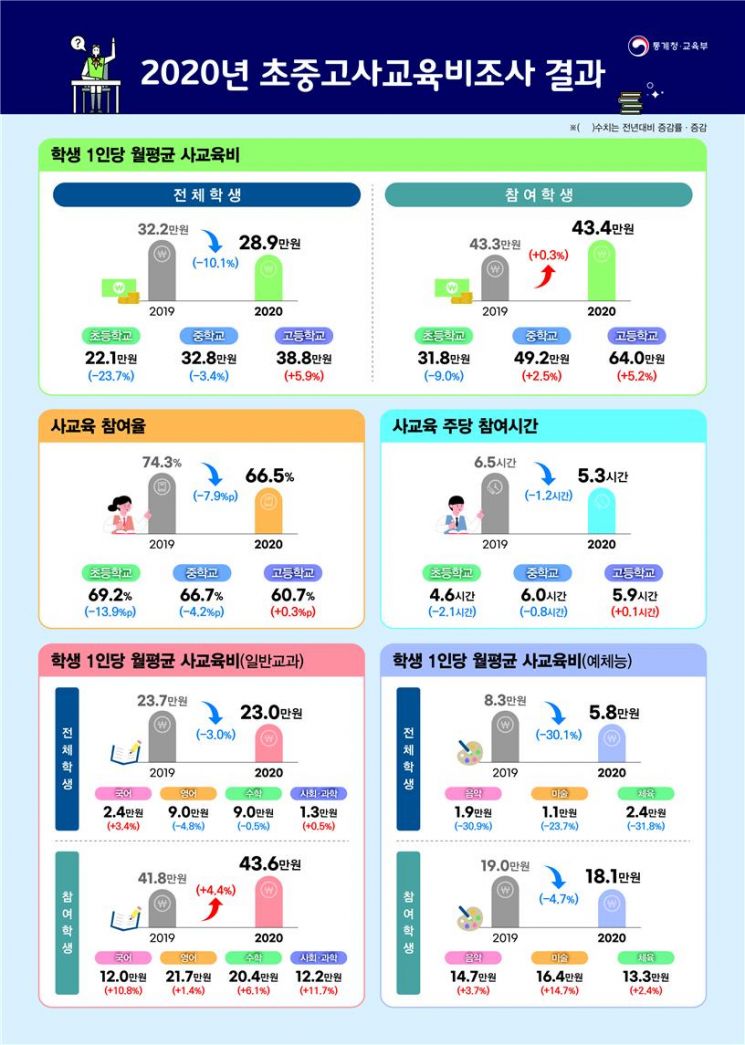
On the 9th, Statistics Korea announced the results of the "2020 Survey on Private Education Expenses for Elementary, Middle, and High School Students." According to the survey, the total private education expenses for elementary, middle, and high school students last year amounted to 9.3 trillion KRW, a decrease of 1.2 trillion KRW (11.8%) compared to the same period the previous year (10.5 trillion KRW). The total decrease also reflects a 1.9% reduction in the total number of students, from 5.45 million to 5.35 million. During the same period, the participation rate in private education dropped by 7.9 percentage points from 74.3% to 66.5%, and the average weekly participation time decreased by 1.2 hours from 6.5 hours to 5.3 hours.
The average monthly private education expense per student was 289,000 KRW, down 10.1% from the previous year. By school level, elementary school students spent 221,000 KRW, a 23.7% decrease from the previous year; middle school students spent 328,000 KRW, down 3.4%; and high school students spent 388,000 KRW, an increase of 5.9%. Lim Kyungeun, Director of Welfare Statistics at Statistics Korea, explained, "Until now, the average private education expense per participating student had never decreased. This year, due to the impact of COVID-19, the private education expenses per participating student have unusually decreased."
Breaking down the total by school level, private education expenses for elementary schools sharply declined by 25.2% to 3.5777 trillion KRW, middle schools decreased by 1.8% to 2.5917 trillion KRW, and high schools increased slightly by 0.3% to 3.1155 trillion KRW.
Looking separately at students participating in private education, the average monthly private education expense per student was 433,000 KRW, a 0.3% increase from the previous year. By school level, elementary school students spent 318,000 KRW, down 9%; middle school students spent 492,000 KRW, up 2.5%; and high school students spent 640,000 KRW, up 5.2%.
By subject, the decrease in private education expenses was more pronounced in arts and physical education than in major subjects directly related to college entrance exams. Private education expenses for general subjects such as math and English decreased by 3.0% to 230,000 KRW, while expenses for arts and physical education dropped sharply by 30.1% to 58,000 KRW.
There was also a notable disparity in private education expenses by household income. Households with a monthly income of 8 million KRW or more spent 504,000 KRW per student on private education, while households earning less than 2 million KRW spent 99,000 KRW per student. The participation rate in private education was 80.1% for households earning 8 million KRW or more and 39.9% for those earning less than 2 million KRW. However, Statistics Korea explained that due to the nature of this survey, it is difficult to determine whether income-based polarization in private education spending has intensified compared to usual.
By region, students in Seoul had the highest average monthly private education expenses at 430,300 KRW, followed by small and medium-sized cities (282,000 KRW), metropolitan cities (279,000 KRW), and rural areas (184,000 KRW).
Meanwhile, considering the exceptional circumstances caused by COVID-19, such as social distancing and changes in the academic calendar, Statistics Korea temporarily changed the survey period basis from annual to the survey target period and recompiled the 2019 statistics under the same criteria. They plan to review and announce comparable data with pre-2019 statistics after applying annualization.
© The Asia Business Daily(www.asiae.co.kr). All rights reserved.

















