Korea Research Foundation "Bionano Health Guard Research Group Increases Sensitivity by About 50% Using Nanogap Sensor"
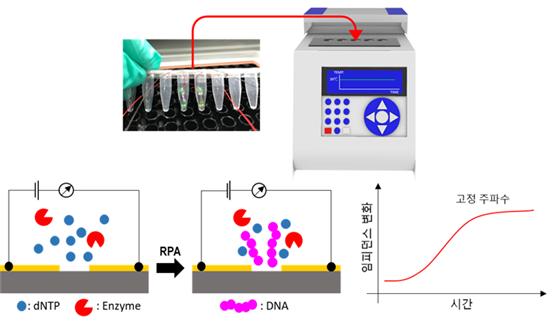 Overview of Pathogen Detection Technology Using Target DNA Amplification Monitoring Based on a High-Sensitivity Nanogap Impedance Sensor with Reduced Electrode Polarization. Image courtesy of the National Research Foundation of Korea.
[Asia Economy Reporter Kim Bong-su] A real-time high-sensitivity detection technology capable of identifying infectious pathogens that have invaded the body, such as the COVID-19 virus, within 5 minutes has been developed.
According to the Korea Research Foundation on the 9th, a research team from the Bio Nano Health Guard Research Group, a foundation corporation, developed a high-sensitivity pathogen detection technology based on real-time monitoring of nucleic acid amplification reaction (PCR) of pathogens. Currently, nucleic acid amplification methods (PCR), which amplify nucleic acids (biopolymers containing genetic material) included in samples, are widely used to detect the presence of pathogens that have invaded the human body, such as airborne pathogens like influenza, MERS, tuberculosis, or foodborne pathogens like shiga toxin-producing Escherichia coli. However, it is difficult to miniaturize the equipment, making on-site diagnosis challenging. There are also limitations in simultaneously detecting multiple components in a single sample due to the overlapping wavelengths of fluorescent labels.
In response, attempts have been made to use impedance sensors (Impedance: a measure of the degree to which electrical flow is hindered in a conductor) that capture electrical signal changes occurring as charged nucleic acids amplify without separate labeling. However, the challenge was to minimize electrical polarization caused by various charged substances in the amplification reaction solution to enhance sensor sensitivity and accurately capture signal changes caused by amplified external genes.
The research team significantly improved the sensitivity of electrical impedance sensors by using nano-gap sensors. The nano-gap sensor reduced electrical polarization, effectively decreasing signal loss caused by electric potential drop. As a result, the sensitivity to measure subtle electrical signal changes in the sample was increased by about 50%. Based on the fabricated nano-gap impedance, they detected the amplification of a single copy of target DNA of pathogenic E. coli 0157:H7 within 5 minutes using isothermal gene amplification. They were able to detect samples containing even a single cell of this E. coli.
They demonstrated that signal changes could be read at room temperature (39 degrees Celsius) without complex temperature control or equipment for fluorescence detection, while still using commercially available gene amplification reagents as is. Going forward, the research team plans to derive optimal measurement conditions for sensitivity stabilization and conduct research on miniaturized modules for on-site diagnosis to facilitate practical application.
This research achievement was published in the international journal Biosensors and Bioelectronics on January 29.
© The Asia Business Daily(www.asiae.co.kr). All rights reserved.
![User Who Sold Erroneously Deposited Bitcoins to Repay Debt and Fund Entertainment... What Did the Supreme Court Decide in 2021? [Legal Issue Check]](https://cwcontent.asiae.co.kr/asiaresize/183/2026020910431234020_1770601391.png)















