Operation of Advanced Welfare System Drives Record Performance Last Year
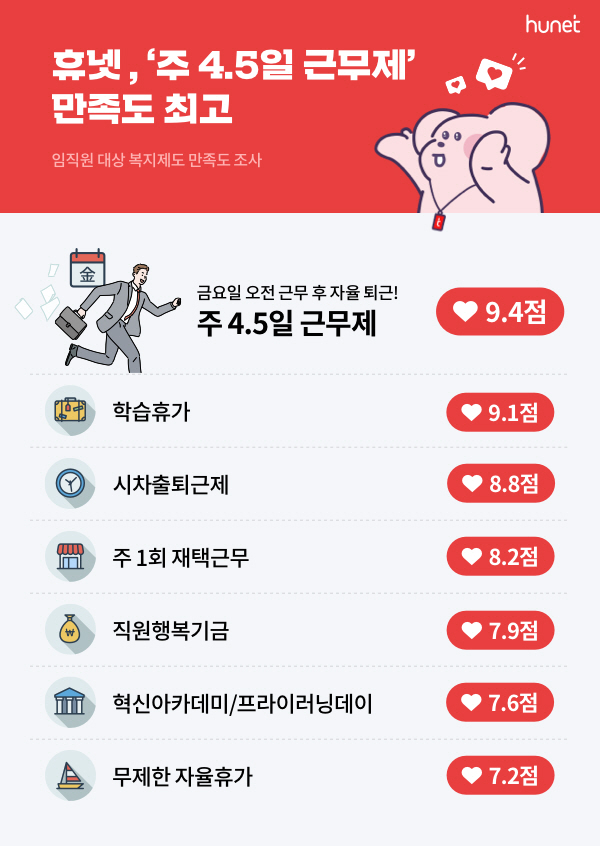 Lifelong education specialist Hunet announced on the 9th that employee satisfaction with the 4.5-day workweek (36 hours per week) scored 9.4 out of 10. Photo by Hunet
[Asia Economy Reporter Kim Heeyoon] Hunet, a lifelong education specialist company, announced on the 9th that employee satisfaction with the 4.5-day workweek (36 hours per week) scored 9.4 out of 10. Hunet operates a 4.5-day workweek system where employees work on Friday mornings and are free to leave afterward.
According to Hunet, a survey on satisfaction with major welfare programs for executives and employees showed that the most preferred system was the "4.5-day workweek" (9.4 points). This was followed by ▲ one-month paid leave "Learning Leave" after 5 years of service (9.1 points) ▲ flexible working hours "Flexible Working Hours System" (8.8 points) ▲ once-a-week autonomous remote work "Once-a-Week Work-from-Home System" (8.2 points) ▲ company pension system for long-term employees "Employee Happiness Fund" (7.9 points) ▲ self-development support programs such as weekly Friday lectures by experts "Innovation Academy/Pry Learning Day" (7.6 points) ▲ unlimited autonomous leave system without vacation day limits (7.2 points).
Respondents cited reasons for choosing the "4.5-day workweek" such as "improved quality and efficiency of work" and "being able to focus and concentrate during the given time on weekdays," indicating increased work productivity.
In addition, Hunet operates various welfare programs including ▲ learning groups "Field and Forum" ▲ unlimited support for books such as an in-house library ▲ constant provision of fruit/beer ▲ a resignation bonus of 3 million KRW if leaving after passing the basic course ▲ "Retirement at 100 years old," among others. Hunet also emphasized that, branding itself as "the company that studies the most," it actively encourages employee growth and self-development by investing over 20 million KRW annually in book expenses and over 200 million KRW in employee education costs.
CEO Cho Youngtak said, "Our happiness management system, which prioritizes employee happiness, contributes to securing excellent talent and improving employee productivity," adding, "By giving employees autonomy and creating a results-oriented company, work engagement and efficiency have significantly increased. Despite frequent work-from-home during the COVID-19 pandemic last year, our corporate culture based on 'autonomy and responsibility' has been proven by record-breaking performance since our founding."
© The Asia Business Daily(www.asiae.co.kr). All rights reserved.

















