Early Session Both Bulls and Bears Weak
Foreigners Increase Net Selling...Institutions Net Buying on KOSPI
"Sector Differentiation Will Continue"
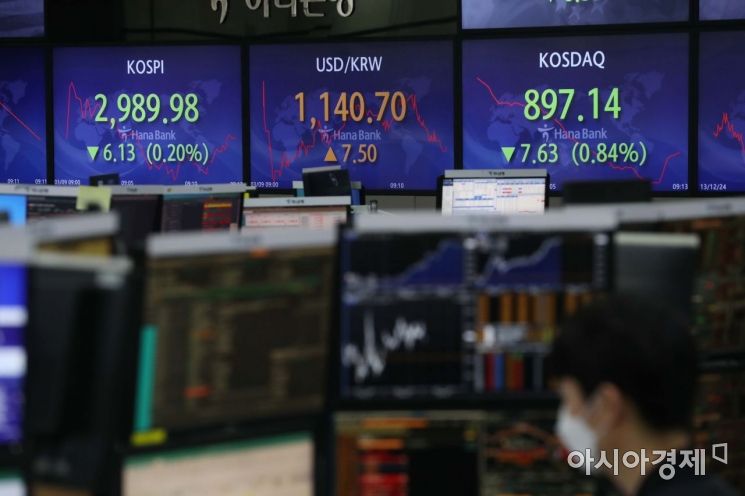 On the 9th, as the KOSPI index showed a flat trend in the early session, dealers were working in the Hana Bank dealing room in Euljiro, Seoul. Photo by Moon Honam munonam@
[Asia Economy Reporter Minwoo Lee] Both the KOSPI and KOSDAQ markets opened lower as foreign selling pressure continued. It is interpreted that the rise in U.S. Treasury yields, which affected the U.S. stock market, also impacted the domestic stock market.
On the 9th, the KOSPI opened at 2,989.96, down 0.21% (6.15 points) from the previous day. It continued to fall further, breaking below the 2,980 level. As of 9:22 a.m., it was recorded at 2,977.90.
Both foreigners and individuals were net sellers in the early session, selling 148.8 billion KRW and 68.9 billion KRW worth of stocks, respectively. On the other hand, institutions were net buyers, purchasing 221.2 billion KRW worth.
The number of sectors that rose and fell was about the same. Steel & Metals (2.23%), Insurance (1.99%), Banking (1.87%), and Transportation & Warehousing (1.77%) rose, while Non-metallic Minerals (-2.70%), Paper & Wood (-1.91%), Medical Precision (-1.36%), and Services (-1.16%) declined.
Most of the top 10 market capitalization stocks were down. Samsung SDI had the largest drop at -4.1%. Following were Kakao (-3.4%), LG Chem (-3.0%), NAVER (-2.0%), SK Hynix (-1.4%), Celltrion (-1.2%), and Samsung Electronics (-0.8%). Hyundai Motor (1.0%) and Kia Motors (0.6%) rose.
The KOSDAQ also showed a downward trend. It opened at 904.04, down 0.08% (0.73 points) from the previous day, and soon fell below the 900 level. As of 9:22 a.m., it was at 891.55.
In the KOSDAQ market, selling pressure from foreigners and institutions was prominent. They were net sellers of 5.8 billion KRW and 18.4 billion KRW, respectively. Individuals bought 28.9 billion KRW.
Unlike the KOSPI, most sectors declined. Publishing & Media Reproduction (-1.87%), Paper & Wood (-1.67%), General Electric & Electronics (-1.66%), Semiconductors (-1.47%), and IT Components (-1.39%) were among the sectors that fell. Only Computer Services (0.46%) and Finance (0.33%) rose.
Most of the top 10 market capitalization stocks also declined. Ecopro BM had the largest drop at -3.5%, followed by Alteogen (-3.05%), Kakao Games (-1.7%), Celltrion Pharm (-1.5%), Celltrion Healthcare (-1.2%), and SK Materials (-1.2%). Only CJ ENM (0.4%) and Seegene (0.1%) rose.
The rise in U.S. Treasury yields is interpreted to have affected the domestic stock market following the U.S. stock market. On the 8th (local time) at the New York Stock Exchange (NYSE), the Dow Jones Industrial Average closed at 31,802.44, up 0.97% from the previous day. However, the tech-heavy Nasdaq index closed at 12,609.16, down 2.41% from the previous day. The S&P 500 index also closed down 0.54% at 3,821.35 during the same period. The 10-year U.S. Treasury yield rose intraday to as high as 1.606%.
Seosangyoung, a researcher at Kiwoom Securities, said, "With U.S. and Chinese inflation indicators and U.S. Treasury auctions ahead, which could affect U.S. Treasury yields, the domestic stock market is expected to remain cautious while awaiting related news, leading to sector differentiation. From a supply-demand perspective, concerns about foreign selling due to rising U.S. Treasury yields and a stronger dollar are high, but as the economic normalization process continues, the impact is expected to be limited."
© The Asia Business Daily(www.asiae.co.kr). All rights reserved.
![User Who Sold Erroneously Deposited Bitcoins to Repay Debt and Fund Entertainment... What Did the Supreme Court Decide in 2021? [Legal Issue Check]](https://cwcontent.asiae.co.kr/asiaresize/183/2026020910431234020_1770601391.png)















