Including the Results of Last Year's Academic Research Project to Widely Promote Jongno, the Center of Korean History and Culture... The Title's 'Gaon' Means Center or Middle in Pure Korean... Revealing Jongno-gu as the Foundation of Korean History and Culture
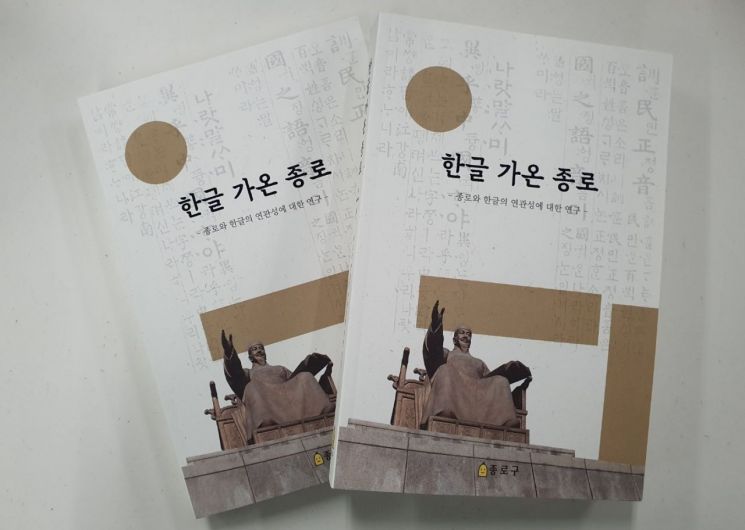
[Asia Economy Reporter Jong-il Park] Jongno is uniquely rich in historical sites related to Hangeul, starting with King Sejong the Great, who created the Hunminjeongeum and was born and raised in Tongin-dong.
From Jiphyeonjeon in Gyeongbokgung Palace where Hangeul was created, the Hangeul Society (Joseon Language Society) that led efforts to protect Hangeul during the Japanese colonial period, the former residence of linguist Ju Si-gyeong, to the statue of King Sejong located in Gwanghwamun Square.
Jongno-gu (Mayor Kim Young-jong) has focused on the long-standing relationship between Hangeul and Jongno and published the book Hangeul Gaon Jongno, which compiles the research results from the past year.
Hangeul Gaon Jongno contains the results of the 2020 academic research project on the “Connection between Jongno and Hangeul,” aiming to further promote Jongno as the historical and cultural center of Hangeul and enhance its cultural value.
Since the 5th local government administration, Jongno-gu has been promoting projects related to ‘Hanbok’, ‘Hanok’, ‘Hanji’, and ‘Hansik’ to strengthen the self-sustaining power of Korean (Han) culture and has worked to establish a foundation for these efforts.
This is to foster traditional culture and restore the nation’s unique identity. The publication of this book is also part of Jongno-gu’s ongoing Han culture projects. The word ‘Gaon’ in the title is a pure Korean word meaning ‘center’ or ‘middle,’ symbolizing Jongno-gu’s role as the foundation of Hangeul history and culture from past to present.
The contents are organized under six subheadings: ▲Hangeul, born in Jongno ▲Hangeul, developed in Jongno ▲Figures who illuminated Hangeul ▲Jongno, home to Hangeul landmarks ▲Hangeul Gaon Jongno ▲Hangeul seen through records. It includes detailed topics such as ‘The principles and background of Hunminjeongeum’s creation,’ ‘Modern Hangeul movements continued by the Joseon Language Society,’ ‘Historical figures who honored and protected Hangeul,’ ‘Hangeul landmarks within Jongno,’ and ‘Hangeul recorded through various media.’
Among these, several sections that explore the Hangeul history scattered throughout Jongno are particularly noteworthy. The Hangeul research by Ju Si-gyeong, the Hangeul movement by scholars of the Joseon Language Society (now the Hangeul Society) who resisted Japanese colonial rule, and the district-by-district introduction of the Hangeul Gaon-gil in the Gwanghwamun area can be considered the highlights of Hangeul Gaon Jongno.
Meanwhile, Jongno-gu enacted the ‘Jongno-gu Hangeul Love Ordinance’ in 2010 to promote the correct use and dissemination of Hangeul, which is recognized for its originality and excellence as a UNESCO Memory of the World.
Additionally, a dedicated Korean language officer was appointed to widely promote administrative simplified terms, Korean replacements for foreign words, and foreign language and loanword orthography. Continuous education has been held for all staff and residents to help them understand and use Hangeul correctly.
The district newsletter Jongno Sarang also includes a section on proper Korean language use, encouraging correct language use every month.
Mayor Kim Young-jong said, “To widely promote the greatness of our script, since the 5th of this month, we have been distributing the book not only to local libraries but also to 225 public libraries and research institutions nationwide.” He added, “We wanted to reflect the long hours of thought and research to rediscover Jongno’s role at the center of Hangeul history in Hangeul Gaon Jongno. I recommend reading Hangeul Gaon Jongno to learn about the connection between Jongno and Hangeul and to once again cherish the value of Hangeul in your heart.”
© The Asia Business Daily(www.asiae.co.kr). All rights reserved.

















