Classes until 5th period for 2nd graders, lunch in between
Concerns of infection during group meal of 300 without masks
No make-up for early leave even if skipping lunch
85% of teachers oppose providing meals to remote students too
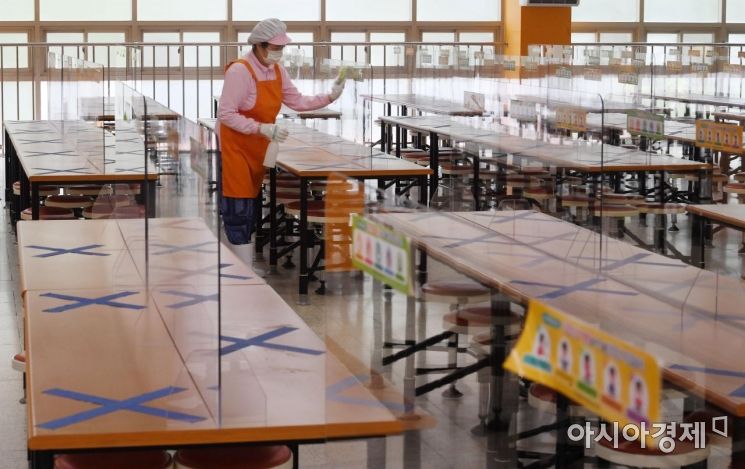 On May 26 last year, an official disinfects tables and partitions in the cafeteria of an elementary school in Seocho-gu, Seoul. Photo by Hyunmin Kim kimhyun81@
[Asia Economy Reporter Han Jinju] Amid the COVID-19 situation, first and second graders in elementary school and third-year high school students attend in-person classes daily, but parents cannot hide their anxiety due to mealtime when masks must be removed.
On the 8th, the first week of the new semester, most elementary schools provide meals to second graders and continue classes until the 4th and 5th periods. Although measures such as spaced seating in the cafeteria are implemented, meal selection is determined at the school's discretion, leading to strong dissatisfaction among parents.
Jung, a parent of a second grader in elementary school, pointed out, "There are 36 students in one class, but during mealtime, due to cafeteria capacity limits, 300 students simultaneously remove their masks and eat every day. There is no survey on the demand for non-meal participants, and if a student does not eat, they must choose early dismissal, but there is no provision for compensating learning loss."
Seo, a parent of a fourth grader in elementary school, complained, "I had my child skip meals because I was uneasy about removing masks, but since classes continue until the 5th period, the school said that if we do not want to apply for school meals, we should pack a lunchbox and have the child eat alone. There was no survey on how to operate class time, so I had no choice but to apply for school meals."
The Ministry of Education introduced a so-called ‘flexible meal’ system this year, providing meals upon application for students who do not attend school daily and take remote classes. This was triggered by incidents such as the ‘Ramen Brothers Incident’ in Incheon last year. Starting as early as April, meals will be provided to children who have difficulty securing meals on days they do not attend school.
However, parents and teachers are raising objections, saying it does not comply with quarantine measures. According to a survey by the Seoul Teachers' Union, 84.6% (1,019 out of 1,204) of teachers opposed flexible meals, citing problems securing distribution and dining spaces and difficulty maintaining class schedules before and after lunch.
The Seoul Teachers' Union pointed out, "Mealtime is the highest risk period for infection, and if flexible meal options are allowed, full attendance for all grades should also be permitted, which could cause children coming for meals to feel shame. School lunch breaks usually last less than an hour, and for students with long commutes, they may have to eat at school and miss afternoon classes."
In response, a Seoul Metropolitan Office of Education official explained, "If there are reasons such as quarantine issues or learning loss, it is acceptable not to operate flexible meals in unavoidable cases. After conducting demand surveys, the system is planned to be introduced in about a month, but since it is decided at the school's discretion, it is not mandatory."
© The Asia Business Daily(www.asiae.co.kr). All rights reserved.
![Clutching a Stolen Dior Bag, Saying "I Hate Being Poor but Real"... The Grotesque Con of a "Human Knockoff" [Slate]](https://cwcontent.asiae.co.kr/asiaresize/183/2026021902243444107_1771435474.jpg)











