Gunsan Plant Invests 130 Billion KRW to Improve Production Facilities
Recycling of Broken Glass and Utilization of Steel Slag Waste Acid
Development of Functional Glasses with Coating, Waterproofing, and More
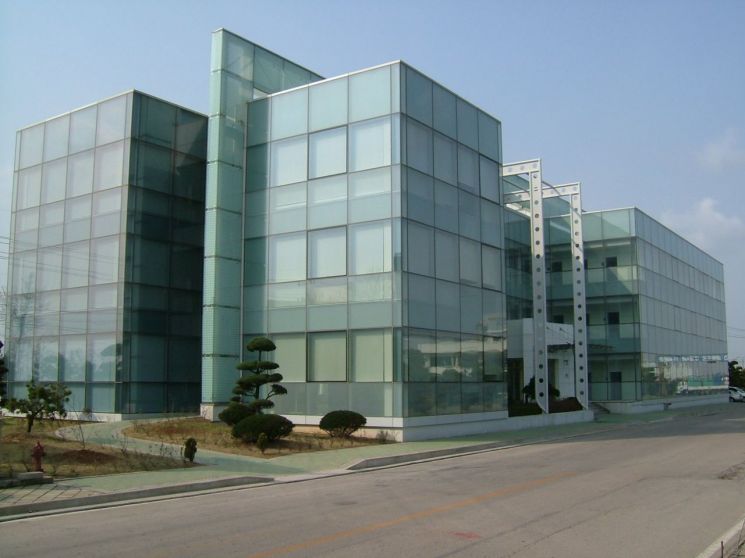
[Gunsan, Jeonbuk = Asia Economy Reporter Kim Heeyoon] Hanglas, the first domestic glass manufacturing company, invested 130 billion KRW in its Gunsan factory last year to improve production facilities. In particular, it expressed its determination to become a production facility that ensures stable production of high-quality glass while minimizing energy consumption and air pollution emissions. A significant factor behind Hanglas's technical confidence is the role of the Hanglas Technology Research Institute, a specialized glass technology research organization with 32 years of history. Director Yoo Byungho of the Technology Research Institute explained, “The current key issues in the glass industry are energy saving and reduction of pollutant emissions,” adding, “Despite the slow pace of change typical of the industry, we are making efforts such as increasing the proportion of recycled raw materials through technology development aligned with current trends.”
With the expansion of eco-friendly industrial policies, the issue of glass waste recycling has emerged as a major topic in the glass industry. Hanglas has developed and applied eco-friendly glass manufacturing technologies that utilize not only recycled broken glass but also industrial waste materials such as steel slag. Director Yoo stated, “We developed a technology to process ‘slag,’ a waste material generated from steel mills, which has a composition similar to glass raw materials, to function similarly to broken glass,” and added, “Since it helps reduce energy consumption when melting glass, slag is also introduced and used as one of the glass raw materials.”
Based on over 30 years of continuous research and development achievements, the Hanglas Technology Research Institute was selected as a KOLAS-accredited testing and inspection institution by the Korea Agency for Technology and Standards in 2000. Notably, it has established itself as the only internationally accredited testing institution in Korea for glass physical property testing. The journey was not smooth from the start. When it was acquired by Saint-Gobain, the world’s number one glass company, the internal system only recognized precise evaluations conducted at the French headquarters, meaning that every product development required waiting for approval from the headquarters. Director Yoo recalled, “It took six months to send and receive quality inspections from Saint-Gobain headquarters, and if feedback and modifications were needed, it could take up to two years,” adding, “We proposed conducting a round test of the same product between Saint-Gobain and our research institute to verify whose measurement results were more accurate. Since we produced superior results, our in-house quality evaluation capabilities were recognized.”
 Research Director Yoo Byung-ho recently stated that he is focusing on developing materials, processes, and technologies that surpass technical limitations to satisfy durability, optical properties, and insulation performance in line with the trends of the architectural glass market. Photo by Hanglas provided
Selected as KOLAS-Accredited Testing Institution, the Only Internationally Accredited Testing Institution in Korea
Becoming an internationally accredited testing institution, the Technology Research Institute has long been nurturing glass experts and steadily improving the precision of product development and verification through the accumulation of technological assets, Director Yoo added. He also explained that through active exchanges with domestic and international academia and other research institutions, they continuously promote the development and commercialization of advanced glass.
Hanglas pioneered the domestic artificial marble market, which was monopolized by Japan’s Denki Chojya, by developing Marblite in 1990, leading the localization of glass technology. Additionally, with the support of the Technology Research Institute, it has achieved various functional glass research outcomes such as the development of variable transmittance glass in 1992, architectural coated glass in 1996, automotive water-repellent glass in 1998, and the SPG (Structural Point Glazing) system for double glazing and multifunctional energy-saving low-E glass in 1999. Director Yoo emphasized, “The current architectural glass market faces the challenge of developing technologies that satisfy both aesthetics and minimal heat loss,” adding, “We are focusing our efforts on developing materials, processes, and technologies that overcome technical limitations to satisfy durability, optical properties, and insulation performance simultaneously.”
© The Asia Business Daily(www.asiae.co.kr). All rights reserved.
![Clutching a Stolen Dior Bag, Saying "I Hate Being Poor but Real"... The Grotesque Con of a "Human Knockoff" [Slate]](https://cwcontent.asiae.co.kr/asiaresize/183/2026021902243444107_1771435474.jpg)

















