Epidemiological Investigation and Medical Capacity Enhancement... Home Treatment Allowed for Pediatric Confirmed Cases
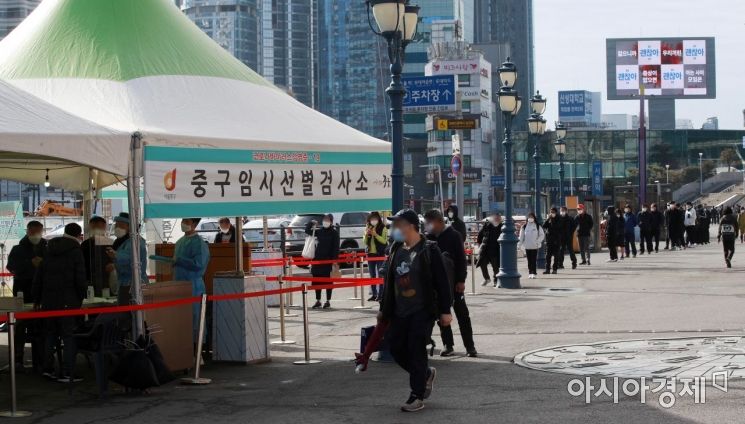
[Asia Economy Reporter Seo So-jeong] The government is increasing the daily number of COVID-19 tests from the current 230,000 to up to 500,000 to suppress the 4th wave of the pandemic.
On the 7th, the Central Disaster and Safety Countermeasures Headquarters announced the "Quarantine Response Plan to Suppress the 4th Wave of COVID-19" and stated that it will focus on early detection of confirmed cases by expanding diagnostic testing.
First, the government plans to actively utilize pooling testing methods to expand testing capacity and sufficiently use rapid antigen tests and rapid PCR tests, in addition to the existing polymerase chain reaction (PCR) tests, according to the situation.
Accordingly, the daily number of tests will be significantly increased from 230,000 to up to 500,000. The proportion of pooling tests will be raised from 45% to 70%.
The government will concentrate testing capacity based on priority considering risk level and urgency. The testing priority order is ▲ suspected COVID-19 cases ▲ contacts and overseas entrants ▲ vulnerable groups ▲ high-risk regions and occupations ▲ individuals wishing to be tested.
Groups vulnerable to infection such as nursing hospitals and nursing facilities will have their testing frequency adjusted and optimized according to vaccination status, and additional vulnerable facilities such as homeless shelters and workplace dormitories will be identified.
For high-risk regions and occupations, mass testing will be conducted to identify sources of infection and hidden cases, and when local governments conduct tests according to the principles and standards of proactive testing, national funding will be provided.
Additional Temporary Screening Clinics in Non-Capital Metropolitan Cities by Next Month
For temporary screening clinics, which have been effective in expanding testing accessibility through anonymous testing, operations in the capital area will be stabilized, while temporary screening clinics will be additionally operated in non-capital metropolitan cities (with social distancing level 1.5) by next month.
Epidemiological investigation personnel will also be reinforced. To strengthen local government capabilities, re-education will be conducted this month for public health center epidemiological investigation teams, cooperation systems with regional disease response centers will be enhanced, and information management support from police and military personnel will be maintained.
As of March, there are a total of 354 epidemiological investigators: 100 at the central level, 78 at the city/province level, and 176 at the city/county/district level. For cities/counties/districts with populations over 100,000 (42 in total) without assigned investigators, guidance and support will be provided to recruit epidemiological investigators.
Additionally, an evaluation system considering relationships with confirmed cases, infection locations, and infection-inducing activities will be established, and the epidemiological investigation support system will be improved. Through this work, the Central Disaster and Safety Countermeasures Headquarters aims to reduce the time required to collect electronic entry logs, card transaction records, and medical institution information (DUR) from the current 1-2 days to 1 hour.
Efforts will also be made to block variant viruses by strengthening overseas entry management and monitoring. When variant virus outbreaks occur, countries will be designated as quarantine reinforcement countries for additional consideration, and the number of variant strain analysis targets and analysis institutions will be expanded from 2 to 8, reducing analysis time from the current 5-7 days to 3-4 days.
Strengthening Medical Capacity to Handle 2,000 Daily Confirmed Cases
Medical response capacity will be enhanced to prepare for the 4th wave. Currently, the medical system can handle 1,000 new confirmed cases daily, but it will be strengthened to treat up to 2,000 cases per day.
To treat severe patients, additional emergency treatment beds will be secured. The mandatory designation period for base dedicated hospitals will be extended from the 15th of this month to the second quarter, and base dedicated hospitals will be preliminarily designated to expand beds dedicated to severe patients.
In addition, more infectious disease dedicated hospitals will be designated, and each local government will prepare a list of preliminary institutions to enable rapid additional designation when necessary.
Living treatment centers will be preliminarily designated and managed to enable rapid operation within 2 to 4 days, and if group infections occur in facilities such as detention centers or dormitories, the facility itself will be operated as a living treatment center.
Asymptomatic or mild pediatric confirmed cases under the age of 12 who require parental care and adult confirmed cases with children needing care will be allowed to undergo home treatment.
© The Asia Business Daily(www.asiae.co.kr). All rights reserved.

















