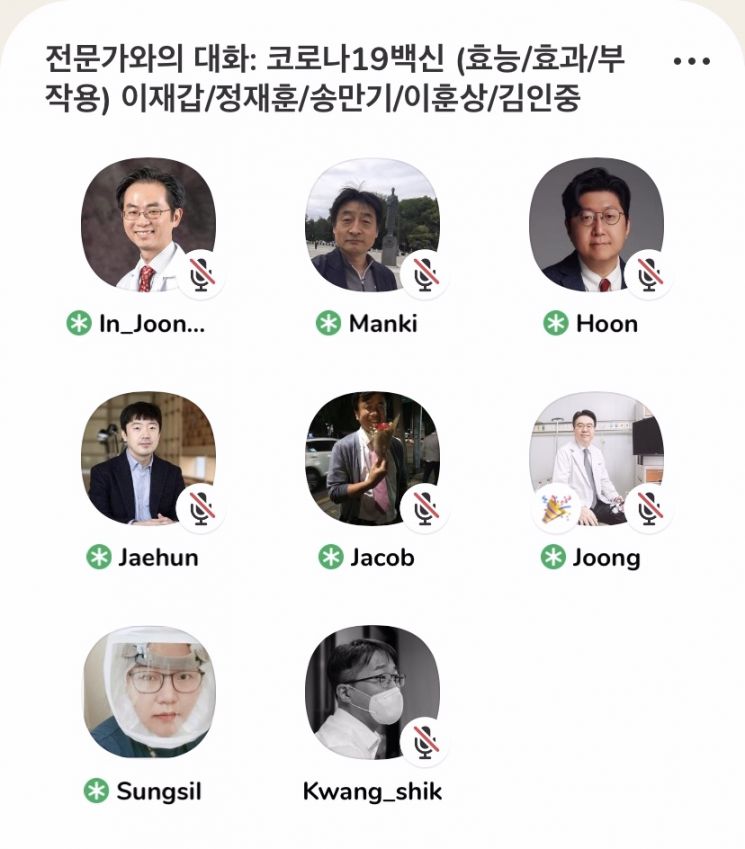
[Asia Economy Reporter Chunhee Lee] At 10 p.m. on the 6th, over 300 people gathered in a room on the social networking service (SNS) 'Clubhouse,' which has recently gained great popularity. The topic of this room was the efficacy, effectiveness, and side effects of the COVID-19 vaccine. As vaccinations began last month, various questions and doubts related to the vaccine have arisen, and frontline experts took the initiative to explain directly to the listeners.
Dr. Injoong Kim, a Korean-American veterinary pathologist who hosted the discussion, stated, "There is a problem where inaccurate information circulating in media reports and on social networks like YouTube is amplified and reproduced as if it were fact." He explained that the purpose of the discussion was to create an opportunity for experts and the public to communicate directly.
Along with Dr. Injoong Kim, eight experts participated in the discussion and answered citizens' questions: Deputy Director Manki Song of the International Vaccine Institute, Professor Hoonsang Lee of Yonsei University Graduate School of Public Health, Professor Jaegab Lee of Hallym University Kangnam Sacred Heart Hospital Infectious Diseases Department, Professor Jaehun Jung of Gachon University Gil Medical Center Department of Preventive Medicine, Professor Joongsik Eom of Gachon University Gil Medical Center Infectious Diseases Department, Dr. Seongsil Moon (Korean-American virus and vaccine researcher), and KBS medical specialist reporter Kwangsik Park. The discussion, originally scheduled for two hours, ended around 12:30 a.m. on the 7th.
'Death after vaccination' is a temporal sequence, not a causal relationship
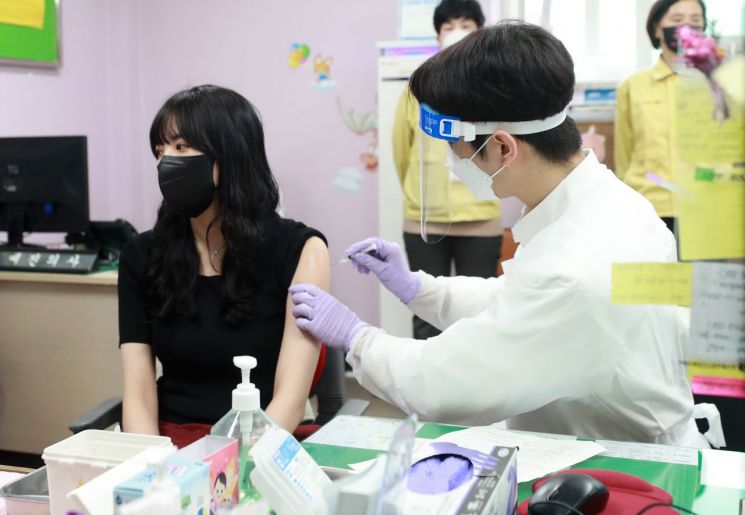 On the morning of the 26th, a worker at a nursing hospital received the first dose of the AstraZeneca COVID-19 vaccine at the Busanjin-gu Public Health Center. [Image source=Yonhap News]
The experts attending the discussion agreed that the probability of a causal relationship is low regarding recent cases where patients with underlying conditions died after receiving the COVID-19 vaccine. While understanding the public's anxiety about the vaccine, the experts urged people to be patient and wait.
Professor Jaehun Jung likened proving that death after vaccination is not causally related to the vaccine to the "devil's proof." Proving the existence of the devil (causal relationship) only requires showing the devil, but proving the devil does not exist always faces the counterargument that "the devil is always hiding and thus cannot be seen." In other words, no matter how much one proves there is no causal relationship, as long as suspicion that there might be one remains, perfect proof cannot be achieved.
He emphasized, "(Vaccination and death) have a temporal sequence, which is a necessary but not sufficient condition for establishing causality." As a means to investigate actual causality, he presented a comparison between the usual mortality rate of hospitalized or institutionalized patients under 65 years old in nursing hospitals/facilities and the mortality rate after vaccination. By comparing these, it is possible to statistically determine whether the vaccine is related to actual deaths. However, he noted, "It takes time to investigate," and asked for understanding that while they want to provide reassuring information to the public, they also need time.
Regarding other adverse reactions, the experts shared their personal experiences of receiving COVID-19 vaccines and other vaccines, emphasizing that "they are no different from existing vaccines." Professor Joongsik Eom said, "When I get a flu shot, I feel sick and lie down for about half a day," but added, "I experience this every year, so I don't report adverse reactions," emphasizing that existing vaccines also cause similar side effects. He further suggested that adverse reactions to new vaccines might be perceived more subjectively, causing fear and possibly being felt as more severe, thus systematic investigation is necessary.
Dr. Injoong Kim also emphasized that adverse reactions can occur, sharing his experience as a veterinarian receiving the rabies vaccine four times, with the fourth shot making it difficult to use his arm. He analyzed, "In the COVID-19 vaccine clinical trials, both the vaccinated and control groups reported similar levels of fever, fatigue, and lethargy," and suggested that a significant portion might stem from psychological fear.
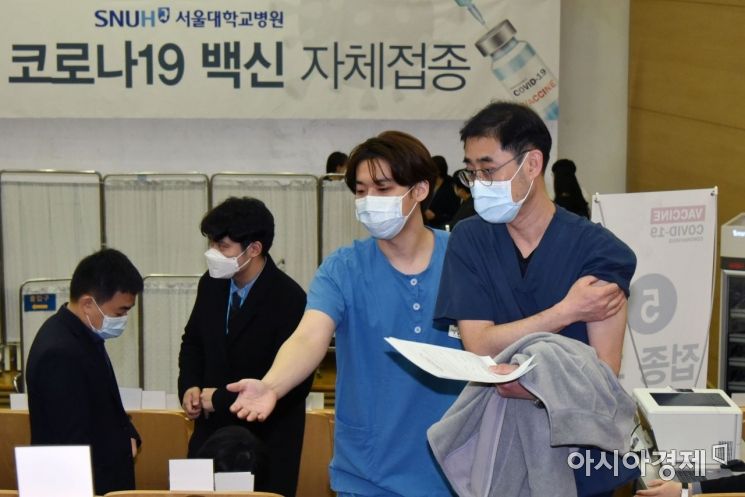 The Seoul National University Hospital's in-house COVID-19 vaccination took place on the morning of the 4th at Seoul National University Hospital in Daehak-ro, Jongno-gu, Seoul. Medical staff who received the AstraZeneca vaccine are being guided by an employee.
The discussion also continued on vaccine efficacy. Professor Jaegab Lee stated, "The vaccine's effectiveness must be compared under the same clinical conditions," noting that AstraZeneca, Moderna, Pfizer, Novavax, and Johnson & Johnson (Janssen) conducted clinical trials under different subjects, timings, and variant virus prevalence. However, he emphasized, "I believe there is not a significant difference in efficacy among the vaccines actually released."
Deputy Director Manki Song said, "The vaccine next to you, the one you can get vaccinated with, is the best vaccine," adding, "AstraZeneca shows a good immune response after the first dose, and mRNA vaccines show better characteristics after the second dose." He stressed that each vaccine has different features and that each country is introducing vaccines suitable for their circumstances.
After the experts' discussion, citizens watching the discussion asked questions about vaccines. Regarding the fact that Pfizer and AstraZeneca vaccines are administered separately even within the same hospital, Professor Jaegab Lee explained, "It is due to vaccination priority and the vaccine supply process," emphasizing, "It is not that the vaccine with better efficacy is given to healthcare workers who directly care for patients." Due to delays in the Pfizer vaccine supply through the global vaccine procurement project 'COVAX Facility' and the postponement of AstraZeneca vaccination for those over 65, the latter's supply was prioritized to hospital-level medical institutions, causing overlapping timing. He clarified that the health authorities did not rank the vaccines in superiority.
In response to a question about many people refusing vaccination because the currently developed vaccines might not cope with the spreading variant viruses, Deputy Director Manki Song explained, "There is a strategy for additional vaccinations against variants," adding, "New vaccine recipients need to get vaccinated two to three times, but those already vaccinated only need one more dose."
A resurgence can occur anytime... Masks cannot be removed even after vaccination
Finally, the experts reiterated that even after vaccination begins, vigilance in quarantine measures must never be relaxed. Professor Jaehun Jung emphasized repeatedly, "It would not be surprising if a resurgence occurs at any time," urging adherence to quarantine rules. He said, "Although quarantine has been relatively well managed, paradoxically, this has created a burdensome situation," noting that since immunity through infection has hardly been acquired and antibody positivity is less than 1%, immunity must be formed solely through vaccination, making Korea "much more vulnerable to the 4th and 5th waves than other countries."
Professor Jaegab Lee also said, "(Even after vaccination) depending on immune status and the prevalence of variant viruses, infection can occur at any time," warning, "If asymptomatic infected people do not wear masks and move around, they can transmit the virus even after vaccination," and urged the public to "make efforts to prevent the 4th and 5th waves."
© The Asia Business Daily(www.asiae.co.kr). All rights reserved.



















