[Asia Economy Reporter Suyeon Woo] It has been found that the higher the female labor force participation rate in a country, the lower the future generation's elderly support burden. This suggests that increasing women's participation in economic activities could be a solution for the Korean economy, which is facing population decline and a rapid increase in elderly dependency ratio.
On the 8th, the Federation of Korean Industries analyzed economic indicators of 23 countries with projected elderly dependency ratios in 2080 lower than the OECD average, finding that 20 of these countries have female labor force participation rates (hereafter FLFPR) exceeding the OECD average.
The elderly dependency ratio refers to the number of people aged 65 and over supported by 100 working-age individuals aged 20 to 64, while the female labor force participation rate indicates the proportion of economically active women aged 15 to 65 within the female population.
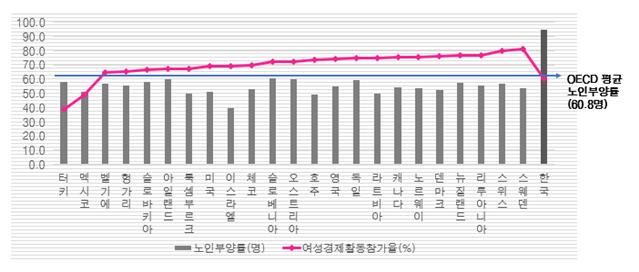 OECD Projected Elderly Dependency Ratio in 2080: 23 Countries Below Average vs. South Korea
(Data Source: OECD Statistics, Federation of Korean Industries)
This result means that countries with currently (2019) high female labor force participation rates are expected to have a reduced elderly support burden in the future (2080). The average FLFPR in 2019 for the 23 countries with lower support burdens was 70.1%, significantly surpassing the OECD average of 65.1%.
In Korea's case, the projected elderly dependency ratio in 2080 is expected to be 94.6, ranking first among OECD countries, while the 2019 female labor force participation rate was 60%, 10 percentage points lower than the OECD average.
Japan, a traditionally aging country, is expected to have the second highest elderly dependency ratio among OECD countries at 82.9 in 2080, but its rate of increase is much slower than Korea's. Japan's 2019 female labor force participation rate was 72.6%, exceeding the OECD average. The Federation of Korean Industries analyzed that Japan's high female labor force participation rate played a key role in slowing the increase in elderly dependency ratio.
Looking at Korea's female labor force participation rate by age group, the 25-34 age group, which is most active in employment and job seeking, recorded the highest rate at 71.8%. It then sharply dropped by about 9 percentage points to 62.9% in the 35-44 age group, and further declined rapidly to 57% in the 55-64 age group.
In contrast, the average age-specific labor force participation rates in OECD countries were 73.5% for 25-34, 74.5% for 35-44, and 74.1% for 45-54, showing little difference across generations. This indicates that while Korean women experience career interruptions due to marriage and childcare in the 35-44 age group, women in major OECD countries maintain steady economic activity without career breaks related to childcare.
Korea's poor employment environment for women is also confirmed by other figures. In the Economist's 2020 Glass Ceiling Index, a representative female employment index, Korea ranked lowest among OECD countries, and in the Women's Economic Participation Index published by consulting firm PwC, Korea ranked 32nd out of 33 countries.
Kim Bong-man, Director of International Cooperation at the Federation of Korean Industries, emphasized, "In the current scenario where the number of dependents is increasing exponentially, it is important to incorporate as many potential workers as possible into the economically active population." He added, "To raise the female labor force participation rate, institutional support for work-family balance and ensuring a free business environment for job creation are necessary."
© The Asia Business Daily(www.asiae.co.kr). All rights reserved.

















