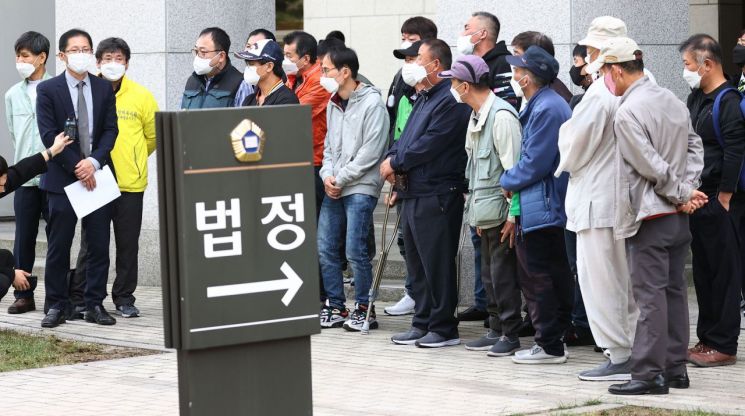
[Asia Economy Reporter Lim Chun-han] The Supreme Court's retrial results on the 'Hyeongjebokjiwon Incident,' a representative human rights violation case of the 1980s, will be announced this week.
According to the legal community on the 7th, the Supreme Court's 2nd Division (Presiding Justice Ahn Cheol-sang) will hold a verdict hearing on the extraordinary appeal case regarding the illegal confinement charges against the late Park In-geun, former director of Busan Hyeongjebokjiwon, on the 11th.
Hyeongjebokjiwon, established under the pretext of 'rehabilitating vagrants,' operated like a detention facility from 1975 to 1987, where citizens were illegally confined, and forced labor, beatings, and sexual assaults were allegedly committed within the facility. According to Hyeongjebokjiwon's own records, the death toll reached 513, and some bodies were secretly buried, with their exact locations still unknown.
Director Park was indicted on charges including illegal confinement, but in 1989, the Supreme Court acquitted him, ruling that his actions were the lawful detention of vagrants under government directives at the time, thus constituting a justifiable act under criminal law. However, 29 years later, in 2018, then Prosecutor General Moon Moo-il filed an extraordinary appeal on Park's case following recommendations from the Prosecutorial Reform Committee under the Supreme Prosecutors' Office. An extraordinary appeal is an emergency remedy procedure where the Prosecutor General requests the Supreme Court to reopen a retrial when illegalities are found in a finalized criminal judgment.
Even if the extraordinary appeal trial acknowledges problems with the past ruling, the effect of Park's acquittal, which has already been finalized, will not change. However, if the Supreme Court points out issues in the previous judgment, it will open the door for Hyeongjebokjiwon victims to seek not only restoration of honor but also claim damages against the state and others based on that.
In the first hearing held last October, the prosecution argued, "Isolating victims from society and detaining them indefinitely violates the principles of prohibition of excess and due process," and stated, "The 'act under the law' stipulated in Article 20 of the Criminal Act means actions that are lawful and constitutional."
© The Asia Business Daily(www.asiae.co.kr). All rights reserved.