Active Empathy for Environmental Issues, Launch of Plastic-Free Products
Increased Favorability by Reducing Plastic in Beverages and Kitchenware
[Asia Economy Reporter Lim Hye-seon] The distribution industry is focusing on eco-friendly products. This is because they not only contribute to environmental protection but also resonate strongly with consumers who value ethical consumption, achieving a win-win effect.
Among eco-friendly products, those with the undeniable charm of being plastic-free are receiving the most attention. By reducing or eliminating labels and packaging materials, they ease consumers' inconvenience during recycling, gaining positive responses.
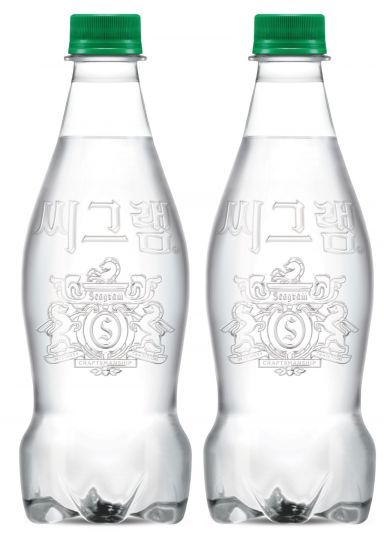
According to related industries on the 6th, Coca-Cola has launched ‘Seagram Label-Free,’ the first carbonated beverage in Korea without a label. Following an agreement signed in January with the Ministry of Environment to expand recycling of plastics and other packaging materials, Seagram Label-Free was introduced as part of positive resource circulation efforts.
‘Seagram Label-Free’ enhances convenience by not attaching labels to transparent PET bottles, eliminating the hassle of separating waste. In particular, it also reduces the amount of plastic used in the production process of PET bottles. Through lightweighting Seagram PET products, it is expected to reduce plastic by 445 tons annually.
Detergents and cosmetics, which are frequently purchased in daily life, are also actively adopting ‘refill’ products to avoid producing new plastic containers.
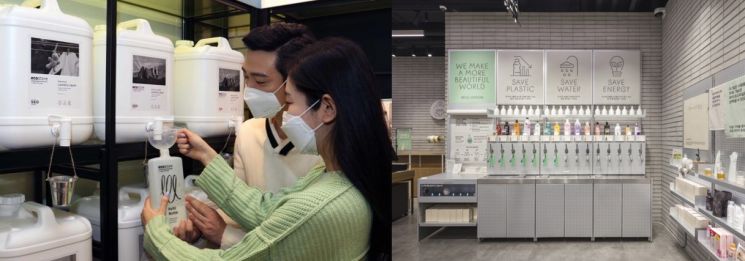
Emart plans to expand its ‘Eco Refill Station,’ which started operation in September last year, to seven branches this year. The ‘Eco Refill Station’ is Korea’s first ‘laundry detergent and fabric softener refill vending machine’ created through collaboration between Emart, the Ministry of Environment, Sugar Bubble, and others. With only a dedicated container, consumers can refill detergents and fabric softeners, reducing the purchase of new plastic containers in daily life and contributing to broader environmental protection.
Amorepacific also opened the first refill station in the cosmetics industry. Located in Gwanggyo, Gyeonggi-do, this refill station sells eight types of body wash and seven types of shampoo sold by Amorepacific in customer-desired quantities.
Convenience stores are also taking active eco-friendly steps, such as introducing biodegradable plastics.
CU announced that after applying biodegradable plastic (PLA) materials to ready-to-eat products for the first time in the industry last August, it will apply PLA to other products such as salads this year. This is because eco-friendly packaged ready-to-eat products received a positive response from consumers, selling one million units within six months of launch. Furthermore, single-use plastic bags, which contain a large amount of plastic, will be replaced with eco-friendly bags by April this year.
GS25 announced that starting February 25, all straws given with 33 types of pouch drinks will be replaced with PLA biodegradable straws. Made from corn material, these straws are 100% biodegradable, contributing positively to resource circulation. Unlike paper straws, they do not lose shape when wet or impart a paper taste.
© The Asia Business Daily(www.asiae.co.kr). All rights reserved.
![Clutching a Stolen Dior Bag, Saying "I Hate Being Poor but Real"... The Grotesque Con of a "Human Knockoff" [Slate]](https://cwcontent.asiae.co.kr/asiaresize/183/2026021902243444107_1771435474.jpg)

















