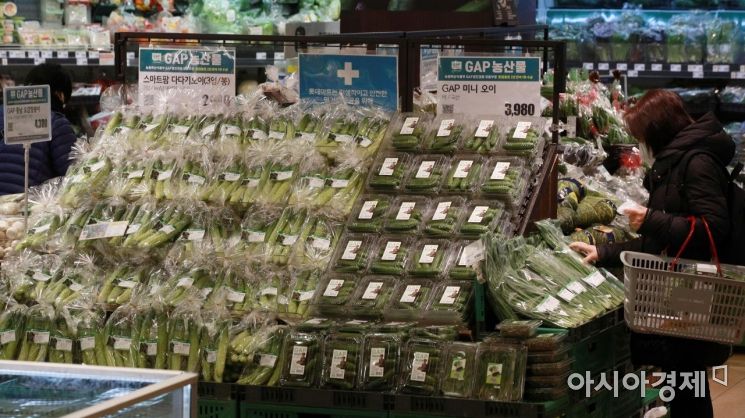
 Amid the economic downturn caused by COVID-19, the livelihood economy has suffered a severe blow, and with inflation continuing, the cost of food is also in a state of emergency every day. According to Statistics Korea on the 25th, the consumer price index in January increased slightly by 0.6% compared to the same period last year, but agricultural, livestock, and fishery products surged by 10%. The photo shows citizens shopping at a large supermarket in Seoul on the same day. Photo by Kim Hyun-min kimhyun81@
[Asia Economy Reporter Seungjin Lee] Since the beginning of the year, food prices have been rising one after another, increasing the burden of consumer prices. On top of this, the prices of red pepper powder and international grain prices are soaring, raising concerns about price increases for kimchi and ramen.
According to the Korea Agro-Fisheries & Food Trade Corporation (aT) on the 6th, the wholesale price of dried red pepper (hwageon) for 30kg as of the 5th was 770,400 won, more than 90% higher compared to the same period last year (401,250 won). The price of dried red pepper began to surge sharply due to a drastic decrease in harvest caused by last year's longest rainy season on record.
According to aT's supply and demand control manual, dried red pepper was forecasted to reach the 'serious increase' stage. If it reaches the serious stage, the government may intervene by selling stockpiled quantities at a discount or, if necessary, directly importing. The supply and demand control manual classifies market conditions into stable, caution, alert, and serious stages based on agricultural product prices.
With the price of dried red pepper failing to stabilize for several months, the possibility of price increases for packaged kimchi is rising. Previously, CJ CheilJedang and Daesang raised the price of gochujang (red pepper paste) citing increased raw material costs, and they are expected to gradually reflect raw material costs in packaged kimchi products as well. Last month, CJ CheilJedang raised the price of five types of 'Haechandle' brand gochujang by an average of 9%, and Daesang increased the price of 'Chungjungone' brand gochujang products by an average of 7% starting from the 1st of this month.
The possibility of ramen price increases is also being raised due to rising international grain prices. Last month, Ottogi attempted to raise ramen prices for the first time in 13 years but withdrew the plan amid concerns over rising living costs. However, if pressure from rising grain prices continues, price increases in the ramen industry will be inevitable.
International grain prices are expected to rise in the first quarter compared to the previous quarter due to abnormal weather conditions worldwide, including the worst cold wave in the United States. According to the Korea Rural Economic Institute, the grain futures price index for the first quarter of this year is projected to be 138.2, a 17.4% increase from the fourth quarter of last year. Previously, the futures price index in the fourth quarter of last year also rose 17.3% compared to the previous quarter. Additionally, the early warning index for international grain supply and demand has risen to the highest level, 'serious,' among the four stages.
As pressure from rising raw material costs continues in the food industry, if prices for kimchi and ramen, essential foods for Koreans, also increase, the burden on consumer prices is expected to soar. Earlier this year, the food industry raised prices for most processed foods such as instant rice, beverages, tofu, and seasoning sauces, and the dining-out industry, including McDonald's and Lotteria, also joined in price increases.
© The Asia Business Daily(www.asiae.co.kr). All rights reserved.

















