Draft Released at Public Hearing... "Minimize Gathering Bans and Reclassify Multi-use Facilities"
[Asia Economy Reporter Seo So-jeong] The current five-level social distancing system will be simplified to four levels, and the criteria for adjusting distancing stages will change from the weekly average daily number of confirmed cases to the weekly daily average number of patients per 100,000 population.
The 'ban on private gatherings of five or more people' measure will be applied from level 3, and gatherings of up to eight people will be allowed at level 2. Applying the new criteria, the metropolitan area, which recently had an average of 295.4 confirmed cases per day over the past week, will be subject to level 2. All non-metropolitan areas will be subject to level 1.
◆Level 2 in the Metropolitan Area Allows Gatherings of Up to 8 People= The Central Disaster and Safety Countermeasure Headquarters of the Ministry of Health and Welfare held a public hearing on the 'Social Distancing System Reform (Draft)' on the 5th at the LW Convention in Jung-gu, Seoul, and disclosed the draft of the distancing system.
Son Young-rae, head of the Social Strategy Division at the Central Disaster and Safety Countermeasure Headquarters, said, "The existing five-level system was overly segmented, making public behavioral response messages unclear," adding, "As medical capacity has expanded with the increase of severe patient beds and residential treatment centers, we plan to reflect this and minimize gathering bans that could disrupt livelihoods such as those of self-employed people by reorganizing the distancing stages."
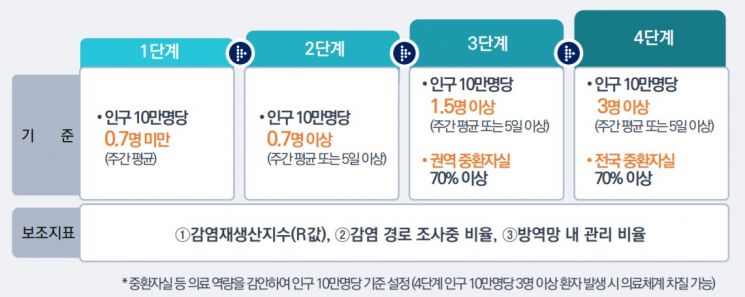
According to the distancing reform draft released that day, the current five-level system will be reduced to four levels. Based on the weekly daily average number of patients per 100,000 population, level 1 is less than 0.7, level 2 is 0.7 or more, level 3 is 1.5 or more, and level 4 is 3 or more.
Supplementary indicators include the infection reproduction number, the proportion of cases under investigation for infection routes, and the proportion managed within the quarantine network. When deciding levels 3 and 4, whether the ICU occupancy rate exceeds 70% is also included as a criterion.
For the metropolitan area, if the weekly daily average number of confirmed cases per 100,000 population is less than 181, it is level 1; 181 or more is level 2; 389 or more is level 3; and 778 or more is level 4. Nationwide, less than 363 is level 1; 363 or more is level 2; 778 or more is level 3; and 1,556 or more is level 4.
The authority to adjust levels 1 to 3 is shared among city/county/district governments, provincial governments, and the Central Disaster and Safety Countermeasure Headquarters (CDSCH), but adjustments to level 4 are decided by the CDSCH.
Son said, "As of today, the weekly daily average number of confirmed cases in the metropolitan area is about 295, so if the reform plan is applied, it will be level 2," adding, "All areas except the metropolitan area correspond to level 1." He explained, "Level 4 corresponds to a nationwide daily average of 1,556 or more confirmed cases, a number our country has never experienced before," and "This was prepared reflecting the expanded medical capacity with 764 dedicated beds for severe patients."
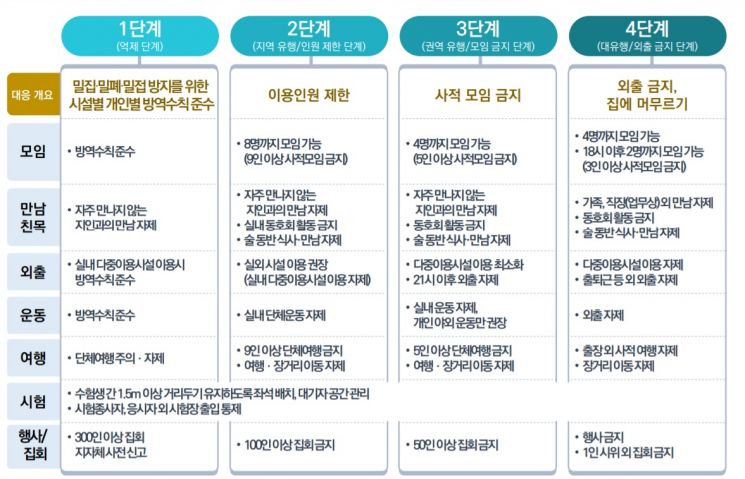
Private gathering standards by level were also presented. At level 2, restrictions on the number of people begin, and private gatherings of nine or more people are prohibited. At level 3, private gatherings of five or more people are banned, and at level 4, gatherings of three or more people after 6 p.m. are prohibited, effectively discouraging all outings.
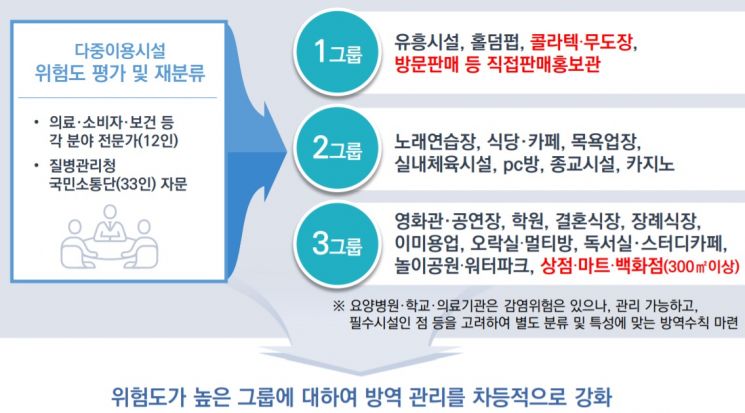
Multi-use facilities are categorized by risk assessment into ▲Group 1: entertainment facilities, holdem pubs, colatecs and dance halls, direct sales promotion centers such as door-to-door sales ▲Group 2: karaoke rooms, restaurants and cafes, bathhouses, indoor sports facilities, PC rooms, religious facilities, casinos ▲Group 3: movie theaters and performance halls, academies, wedding halls, funeral halls, beauty salons, arcades and multi-rooms, reading rooms and study cafes, amusement parks and water parks, stores, marts, and department stores (over 300㎡).
◆Only Some Facilities Like Clubs Are Banned at Level 4= From level 2, one person per 8㎡ is the basic standard, adjusted according to the characteristics of the business type. At level 3, Groups 1 and 2, and at level 4, Groups 1 to 3 have operating hours restricted to 9 p.m. Restaurants and cafes apply a 1-meter distance between tables from level 1 and only allow takeout and delivery after 9 p.m. Gathering bans apply only at level 4 to Group 1 facilities such as clubs (including nightclubs), hunting pubs, and emotional pubs.
Son said, "The adjustment of the current 10 p.m. operating restriction back to 9 p.m. is a contentious issue," adding, "Although it is only a one-hour difference, the risk can increase significantly due to increased movement, so the 9 p.m. restriction is judged to be more effective in blocking the spread." The government plans to gather opinions through meetings with associations related to multi-use facilities.
Son also said, "Some have pointed out that allowing gatherings of up to eight people at level 2 and limiting the number of people per area is insufficient," adding, "We are also considering adding a measure to restrict operating hours until 11 p.m. for three types of businesses: entertainment facilities, karaoke rooms, and restaurants/cafes."
For indoor sports facilities, discussions are underway with related associations and groups to allow operation after 9 p.m. if risk factors such as treadmill speed limits, shower use restrictions, and food sales bans are implemented.
Quarantine management for high-risk vulnerable facilities will be strengthened. For religious facilities, occupancy limits are 50% at level 1, 30% at level 2, 20% at level 3, and non-face-to-face use at level 4. Choirs (except one person) and loud prayers are prohibited at all levels. From level 2, gatherings, meals, and overnight stays are banned.
For nursing hospitals, workers including caregivers must undergo PCR testing twice a week from level 2, and workers at nursing facilities are required to have PCR tests once a week.
Son said, "This reform plan is a draft, and after coordinating opinions with related associations, central ministries, and local governments for one to two weeks, the final plan will be announced within this month," adding, "The timing of application will be decided by comprehensively reviewing vaccination, school openings, and epidemic trends."
At the public hearing, various expert opinions on future social distancing were presented. Professor Ki Mo-ran of the National Cancer Center said, "I agree that gathering bans are removed at levels 1 to 3," but added, "It would be good to include an operating restriction time around 11 p.m. at level 2." He also said, "The guideline to refrain from long-distance travel is ambiguous regarding the definition of 'long-distance,'" and "The guidelines need to be clarified."
Joo Young-soo, head of the Public Health Medical Headquarters at the National Medical Center, said, "The difficulty in securing beds last year was due to relying on vulnerable public medical institutions and a squeezing response," adding, "Ultimately, the government resolved this by mobilizing administrative orders to tertiary hospitals, but if private medical institutions, which account for over 90% of the total, take more social responsibility, medical capacity will be able to handle even if confirmed cases exceed level 4."
© The Asia Business Daily(www.asiae.co.kr). All rights reserved.
!["The Woman Who Threw Herself into the Water Clutching a Stolen Dior Bag"...A Grotesque Success Story That Shakes the Korean Psyche [Slate]](https://cwcontent.asiae.co.kr/asiaresize/183/2026021902243444107_1771435474.jpg)


















